


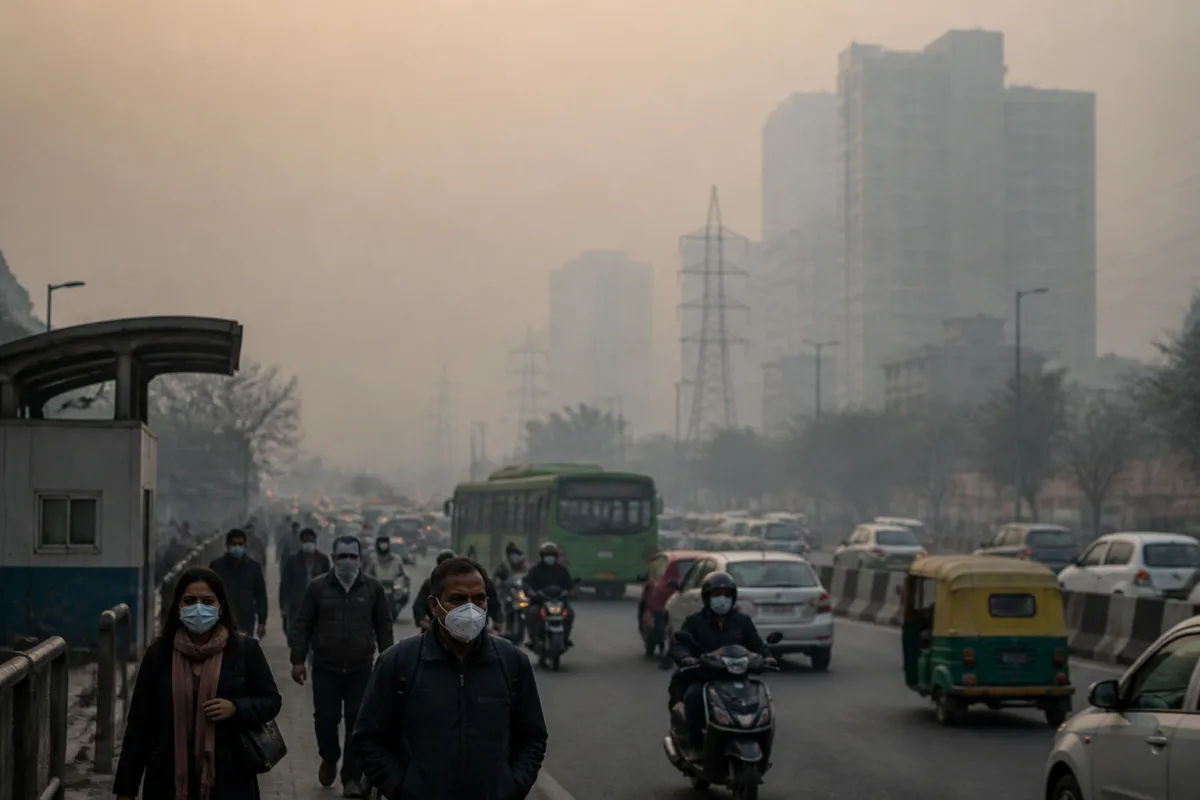
A new analysis of more than 180 epidemiological studies has widened the public-health case against air pollution in India: the damage is not confined to the lungs, but extends to cardiovascular disease, diabetes, pregnancy complications, child development, tumours, blood disorders and mental and neurological health. The evidence also challenges an urban assumption at the centre of pollution policy—that the gravest risks are concentrated in metropolitan areas.
The analysis, released by the Centre for Research on Energy and Clean Air (CREA), examined studies published between 1975 and 2025. More than 91 per cent of the studies found an association between exposure to air pollution and at least one adverse health effect. The finding is significant not because it identifies one new disease pathway, but because it brings together five decades of Indian research to show how widely the health burden is distributed.
That breadth changes the way air pollution has to be understood as an urban issue. Pollution is often discussed through daily air-quality readings, winter smog episodes and respiratory hospital visits. The CREA review indicates that this frame is incomplete. It places air pollution across several systems that cities depend on—public health, maternal care, child development and emergency services—while also showing that the sources and effects extend beyond municipal boundaries.
The geographical distribution of research itself reveals an imbalance. Delhi accounted for 26 of the studies reviewed, the highest number among the locations listed in the analysis. Punjab followed with 13 studies; Maharashtra and Uttar Pradesh had 11 each; West Bengal had 10; Tamil Nadu had nine; Karnataka eight; and Telangana seven. This does not establish that Delhi alone faces the greatest health risk. It shows, instead, that the capital has attracted a disproportionate share of research attention while evidence from many other parts of the country remains thinner.
The rural findings are especially important for policy design. Of the 180 studies, 40 examined the health effects of pollution among rural populations. Thirty-eight of those found a link with at least one adverse health outcome. The sample is small compared with the scale of the rural population, but the proportion of studies reporting harm makes it difficult to treat rural pollution as a marginal concern. It also exposes a gap between where pollution is studied and where it is experienced.
Manoj Kumar, an analyst at CREA, said the findings showed that air-pollution strategies should not be limited to cities and should instead be prepared at a regional level. He called for rural areas to be explicitly included in the next phase of the National Clean Air Programme, referred to in the analysis as NCAP 2.0, and for an air-shed-based approach that accounts for shared pollution sources and their effects across a region.
The air-shed argument is an institutional one. Municipal boundaries determine which local authority is responsible for many actions, but pollution does not stop at those boundaries. The analysis points to a system in which cities, rural settlements, industrial areas, power-generation sites and households may be connected by the same emissions and atmospheric processes. A strategy organised only around individual cities can therefore miss the regional sources that shape local exposure.
The review also complicates the idea that reducing one pollutant is sufficient. Forty-five studies assessed both particulate matter and gaseous pollutants. Thirty-two examined PM2.5, four examined PM10, and 16 assessed both PM10 and PM2.5. The analysis also identified adverse outcomes associated with gaseous pollutants, including increased mortality, hospital and emergency-service visits for respiratory illness, asthma admissions and reduced lung function.
Sulphur oxides and nitrogen oxides are identified as important parts of this picture. According to the analysis, they can undergo chemical reactions in the atmosphere and form sulphate and nitrate particles, which contribute to secondary PM2.5 pollution. This means that a pollution-control strategy focused only on measuring or reducing directly emitted PM2.5 may not address the full chain of pollution formation described in the review.
Kumar said controls would need to address emissions from industries, power plants, household cooking and other fuel-burning activities. He also said gaseous pollutants that contribute to PM2.5 and ground-level ozone formation should be included in control strategies. The statement shifts the policy focus from a single pollutant target to the emissions processes that produce several pollutants and health risks.
This has direct implications for the design of clean-air programmes. The evidence supplied in the analysis does not establish how NCAP 2.0 will be structured, funded or implemented. It does, however, identify the areas in which the existing policy frame would need to become broader: rural coverage, regional air-shed planning, gaseous pollutants and the full range of pollution-producing activities.
It also raises a measurement problem. The studies reviewed did not examine one uniform exposure or one uniform health outcome. They covered different pollutants and different effects, from mortality and hospital use to pregnancy complications, child growth and mental health. The review therefore does not provide a single national risk figure. Its value lies in showing the range of documented associations and the uneven distribution of research across locations and populations.
The numbers make that unevenness visible. Delhi’s 26 studies represent the largest concentration among the locations listed, while only 40 studies across the entire review considered rural populations. At the same time, 38 of those 40 rural studies found at least one adverse health association. The evidence cannot be used to compare the health risk of a Delhi resident with that of a rural resident, because the studies may differ in design, location and pollutant exposure. It can support a narrower conclusion: rural communities are under-represented in the research while still appearing repeatedly in evidence of harm.
For cities, the wider health evidence also changes the meaning of exposure. Air pollution is not only an issue for people who already have respiratory conditions, nor is it limited to the days when pollution levels become highly visible. The CREA review associates exposure with multiple health systems and life stages. That makes clean air a concern for hospitals, maternity services, schools, emergency response and long-term public-health planning, rather than a seasonal issue confined to pollution-control agencies.
The review does not, by itself, establish causation for every health outcome or identify the relative contribution of each pollution source. It is an analysis of epidemiological studies, and its findings should be read within the limits of the underlying research. But the consistency of the headline finding—more than 91 per cent of the studies reported at least one adverse association—makes a narrow respiratory-only policy frame difficult to sustain.
The larger urban question is whether India’s clean-air institutions are organised around the way pollution is actually produced and experienced. The evidence presented by CREA points towards a connected geography: urban and rural populations, direct and secondary particles, industrial and household emissions, and health effects that extend beyond the lungs. The policy response described by the analysis is correspondingly regional rather than city-bound.
What is established is that the reviewed research links air-pollution exposure to a broad set of adverse health outcomes and that rural populations have received comparatively limited study. What remains unclear from the supplied material is how these findings will be translated into enforceable air-shed governance, expanded monitoring and specific NCAP 2.0 measures. Those implementation details will determine whether the wider evidence changes pollution policy or remains confined to the research record.

