


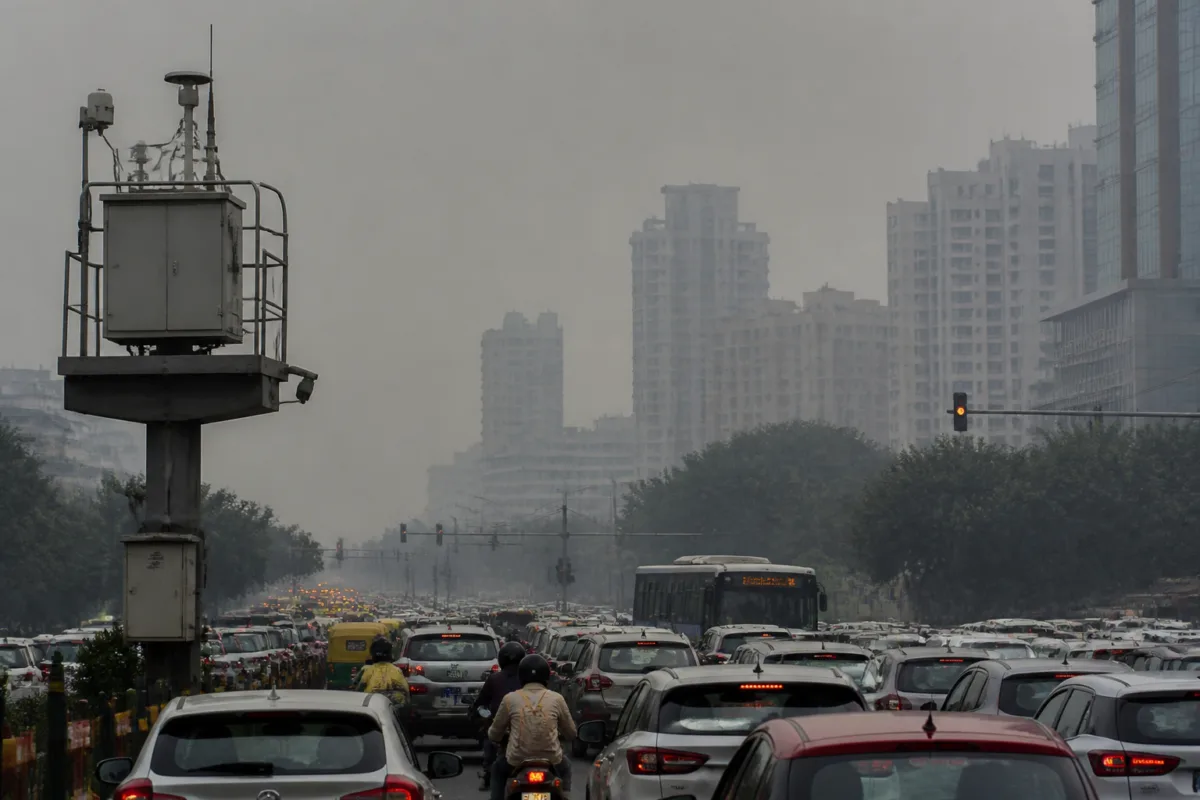
Delhi’s air quality remained in the ‘very poor’ category on Saturday, with the city recording a 24-hour average Air Quality Index (AQI) of 367, while forecasts indicated that rain over the next two days could bring only a modest improvement.
The Central Pollution Control Board (CPCB) recorded a slight day-on-day decline in Delhi’s average AQI, from 373 on Friday to 367 on Saturday. Despite the six-point improvement, pollution levels remained firmly within the ‘very poor’ range, indicating that the change was not large enough to provide broad relief across the capital.
The distribution of readings across the city’s monitoring network showed that pollution remained severe in several locations. Of the 59 monitoring stations reporting data on Saturday, 17 recorded air quality in the ‘severe’ category. Another 38 stations reported ‘very poor’ air, while three stations recorded ‘poor’ air and one recorded ‘moderate’ air quality.
The station-level data shows why the citywide average does not fully capture conditions experienced across different neighbourhoods. Although the average AQI improved marginally, most of the monitoring locations remained in either the very poor or severe categories, leaving large parts of Delhi exposed to elevated pollution levels.
Particulate matter was the main concern on Saturday, with PM10 identified as the prominent pollutant. According to the Decision Support System assessment cited in the report, the transport sector contributed the largest share of Delhi’s pollution at 20.5 percent.
The transport contribution places road-based emissions at the centre of the city’s continuing air-quality challenge. However, the figures reported for Saturday describe the contribution of one sector within the wider pollution mix and do not indicate that transport was the sole cause of the city’s poor air. The report does not provide a full sector-wise breakdown of all sources for the day.
The Air Quality Early Warning System forecast a decline in PM2.5 and PM10 levels over the following two days, while the India Meteorological Department indicated a possibility of rain. Rain can temporarily reduce airborne particulate matter by washing some pollutants out of the atmosphere, but the extent of any improvement will depend on the actual weather conditions.
The expected relief therefore remains conditional. The report stated that the real impact would become clear only after weather conditions change. A forecast of lower pollutant concentrations does not yet establish how long cleaner air would last or whether the improvement would be uniform across Delhi’s monitoring locations.
For residents, the immediate picture remains one of widespread poor air quality rather than a citywide recovery. The next two days of monitoring will show whether the anticipated rain produces a meaningful fall in PM2.5 and PM10 levels and whether the number of stations reporting severe or very poor air declines.

