


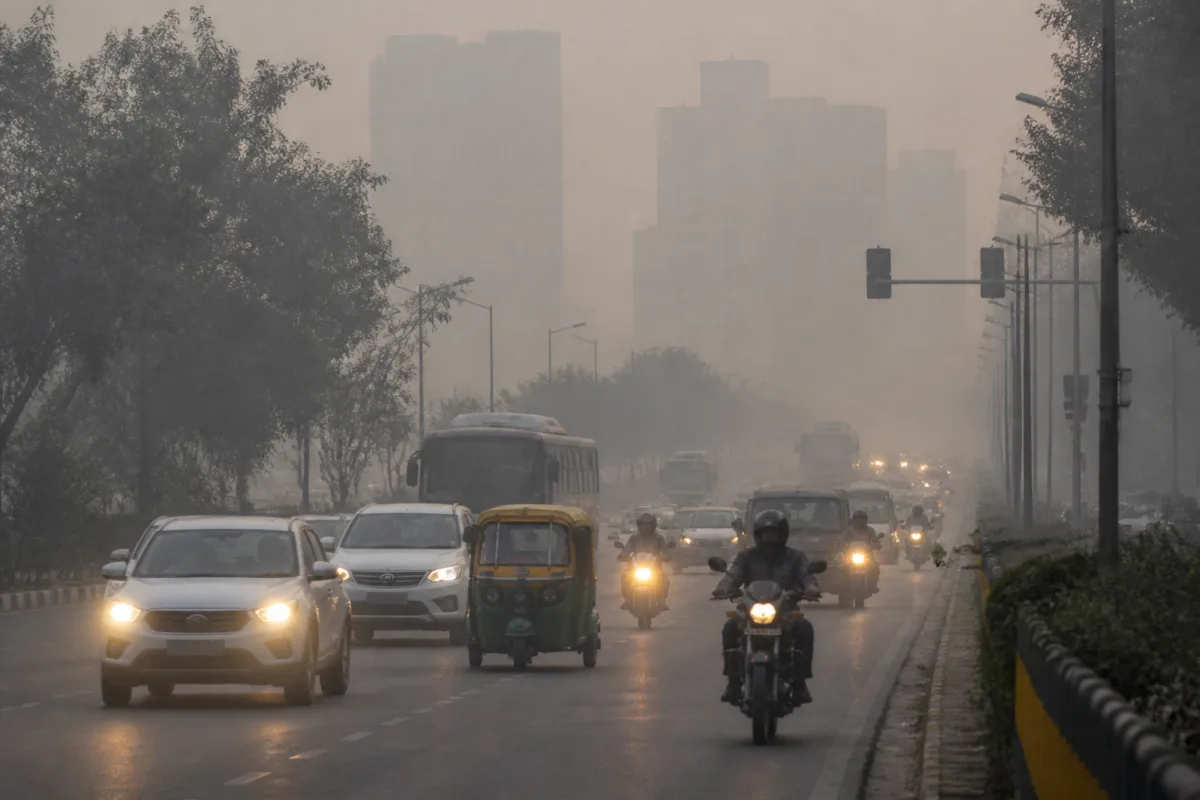
Delhi’s air quality crossed into the severe category for the first time this season on Friday, with the city’s average AQI reaching 403 by 6 am and remaining at that level at 8 am and 9 am, according to data cited from the Central Pollution Control Board’s Sameer application. Dense smog reduced visibility in several areas as residents travelled through the city, while the possibility of stricter GRAP-4 curbs came closer.
Of the 58 monitoring stations reporting data by 8 am, 33 recorded air quality in the severe category and 24 reported very poor air. Only one station recorded moderate air quality, according to the report. The IIT Delhi station recorded the highest AQI at 488, followed by Chandni Chowk at 479 and Delhi University’s North Campus at 478.
Other locations reporting severe air quality included Burari Crossing at 456, ITO and Jawaharlal Nehru University at 451, Jahangirpuri at 430, Wazirpur at 427, Anand Vihar at 419, Rohini at 413, IGI Airport Terminal 3 at 403 and Tikri Kalan at 402. Earlier in the morning, IIT Delhi’s AQI had reached 487 at 6:05 am, while North Campus and Chandni Chowk recorded 476 each. Pusa recorded 468 and NSUT Jaffarpur 461.
The readings have significance for Delhi’s graded pollution-response system because the third stage of the Graded Response Action Plan is already in force across the National Capital Region. The Commission for Air Quality Management introduced GRAP Stage III on November 6, covering Delhi and parts of the NCR, including Gurugram, Faridabad, Sonipat, Ghaziabad and Gautam Buddh Nagar.
Under the existing Stage III measures, several dust-generating construction and demolition activities are restricted. Stone-crushing and mining operations are also suspended, while restrictions apply to certain vehicle categories. BS-III petrol and BS-IV, as well as older diesel light motor vehicles, are barred from operating in Delhi and specified NCR districts. Entry of some older diesel goods vehicles into Delhi is also restricted.
GRAP Stage IV, the most stringent level, may be imposed if Delhi’s 24-hour average AQI crosses 450 and enters the severe-plus category. However, the final 24-hour average for Friday was scheduled to be released at 4 pm, meaning the morning readings alone did not confirm the immediate implementation of the fourth stage.
The difference between short-term station readings and the final citywide average is important for enforcement because GRAP stages are triggered by the prescribed 24-hour average rather than by an isolated reading at one monitoring location. Friday’s widespread severe readings nevertheless indicated a sharp deterioration across the monitoring network.
Delhi’s minimum temperature was recorded at 16.2 degrees Celsius, 2.7 degrees above normal. The report did not attribute the deterioration to a specific source but recorded dense smog and reduced visibility across parts of the city. The next formal trigger for additional restrictions was the Central Pollution Control Board’s final 24-hour average and the Commission for Air Quality Management’s subsequent decision on GRAP-4.

