


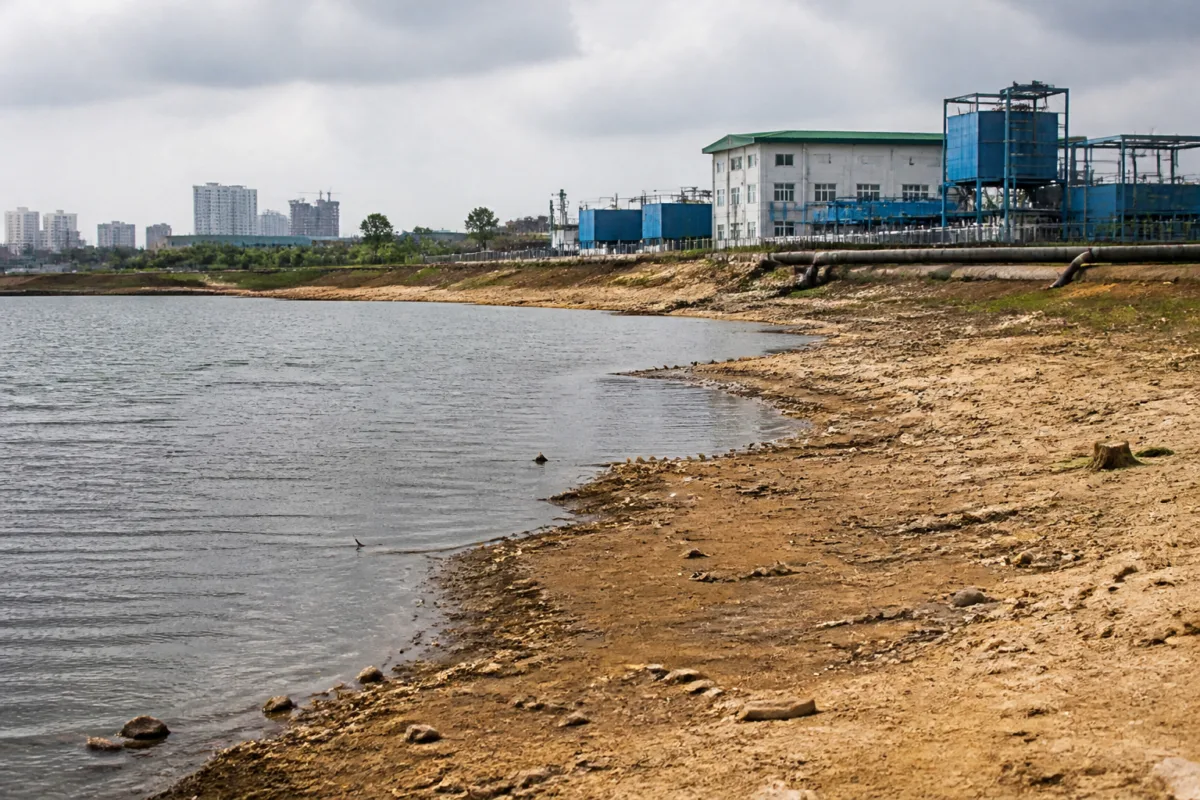
Chennai’s water crisis is becoming visible in two places at once: the reservoirs that supply the city and the groundwater beneath it. The five principal reservoirs held 4.79 thousand million cubic feet (tmcft) on Thursday, compared with 10 tmcft on the same day last year, while the average groundwater depth had fallen to 5.48 metres from 3.77 metres in October 2025. Together, the figures show why the city’s water security cannot be assessed through reservoir levels alone.
The immediate concern is the weak monsoon. The reservoirs—Poondi, Cholavaram, Red Hills, Chembarambakkam and Kannankottai-Thervoy Kandigai—were holding 41% of their combined 11.75 tmcft capacity. The storage level was 48% lower than at the same point last year, according to the report. Metrowater is therefore preparing for a situation in which demand continues while the principal surface-water sources remain under pressure.
A Metrowater official said the utility may have to consider “rationalising water supply” if there is no further rainfall, while relying on desalination plants. The statement is significant because it places supply management, rather than new source creation, at the centre of the city’s near-term response. Rationalisation could affect how regularly water is supplied, although the report does not specify whether any schedule or restriction has been finalised.
The groundwater numbers add a second layer to the problem. The average depth rose from 3.77 metres in October 2025 to 5.48 metres in October this year—a change of 1.71 metres, or about 45%. Madhavaram recorded the sharpest decline, with the depth moving from 5.80 metres to 10.81 metres. The report also notes that groundwater levels across the city had improved by nearly a metre from the previous month, indicating some short-term recovery even as the annual comparison remained worrying.
This combination matters for Chennai because a rainfall deficit does not only reduce the volume available in reservoirs. It can also limit the recharge of aquifers that households, institutions and local water systems depend on. The figures supplied in the report do not establish how much of the city’s total consumption is met by groundwater, nor do they quantify extraction by neighbourhood or user category. They nevertheless show that the underground reserve is not providing an unambiguous buffer against weak rainfall.
Desalination is the utility’s principal cushion. On Wednesday, the 110 million litres a day (mld) and 150 mld plants supplied 100 mld and 87 mld respectively. By Thursday, output from both plants had risen to more than 100 mld. A senior official said both Nemmeli plants could be operated at full capacity and that the Minjur plant, which has a 100 mld capacity, would yield at least 20 mld by February.
These numbers demonstrate the operational value of desalination during a supply shortfall, but they do not resolve the broader water-security question. Desalination adds treated water to the distribution system; it does not restore depleted reservoirs, recharge aquifers or reduce the city’s exposure to rainfall variability. The report also does not provide the plants’ operating costs, the energy required, the share of city demand they meet or the environmental monitoring arrangements associated with their operation. Without those details, desalination can be assessed as an emergency and supplementary source, but not as a complete account of Chennai’s water resilience.
Metrowater has expressed confidence that the situation can be handled. That position reflects the utility’s ability to increase desalination output and manage available sources. But the concerns raised by water experts point to a different measure of resilience: whether the city can retain and recharge rain when it arrives, protect groundwater from over-extraction and plan for both unusually wet and unusually dry periods.
S Janakarajan, a retired professor at the Madras Institute of Development Studies, said the situation was worrying and argued that desalination could harm the coastal ecosystem. He also pointed to evapotranspiration—the combined loss of water through soil evaporation and plants—as a factor that would become important during summer. His criticism was directed at the absence of what he described as a water-security plan, despite earlier warnings about El Niño.
The evidence in the report does not establish the precise contribution of El Niño to Chennai’s current rainfall or quantify the environmental impact of the desalination plants. It does, however, identify a planning problem: the city’s response is being judged against a short-term supply emergency while the underlying system depends on several linked and vulnerable components. Rainfall, reservoir storage, groundwater recharge, conservation, distribution and desalination are being treated as connected issues, but the public information supplied here does not show a single plan that brings them together.
Rainfall-harvesting enforcement is central to that gap. Sekhar Raghavan, founder of The Rain Centre, said Chennai should have received at least 140 cm of rainfall by the relevant point but had received 110 cm as of November 10. He called for third-party monitors because, in his assessment, some builders had not constructed rainwater-harvesting systems properly even though the Chennai Metropolitan Development Authority had approved them.
That claim places implementation, rather than policy announcement, at the heart of the debate. Chennai has relaunched its rainwater-harvesting initiative, but the effectiveness of such a programme depends on whether systems are correctly designed, built, maintained and connected to actual recharge points. The supplied report does not provide an audit of compliance, the number of deficient installations or the enforcement action taken against violations. It does show why the existence of a rainwater-harvesting rule cannot be treated as proof that recharge is occurring at the required scale.
The institutional responsibilities are also distributed. Metrowater manages the city’s water supply and is responsible for operating or coordinating key sources. The CMDA’s approvals affect how rainwater-harvesting systems are incorporated into buildings and developments. The state government sets the broader policy direction, including the relaunch of the rainwater-harvesting initiative. Experts quoted in the report are asking for independent monitoring and a preventive plan involving people with long experience of Chennai’s water system.
This division of responsibility creates a familiar urban-governance risk: each institution may perform a defined task while the city remains exposed to a system-wide failure. Reservoir operators can monitor storage, the water utility can increase desalination, planning authorities can approve building systems and residents can be asked to recharge groundwater. But unless these actions are measured together, the city may know how much water it is producing without knowing whether its natural storage is recovering.
The numerical trend is therefore more important than any single figure. Reservoir storage was at 4.79 tmcft against a combined capacity of 11.75 tmcft. Groundwater depth had worsened by 1.71 metres compared with October 2025, even though it had improved by nearly a metre over the previous month. Desalination plants were supplying more than 100 mld each by Thursday, while the Minjur plant was expected to contribute at least 20 mld by February. These are different measures of the system, and they should not be read as interchangeable.
A higher desalination output can improve the immediate supply position without changing the rainfall deficit. A month-on-month improvement in groundwater can coexist with a significant year-on-year decline. Reservoir capacity can remain available while stored water falls sharply. Reading the indicators together prevents the city from mistaking one operational improvement for a broader recovery.
The same evidence also shows why Chennai’s water debate repeatedly swings between floods and drought. Raghavan said both problems were “man-made”, linking them to failures to learn from experience and to inadequate preventive planning. That is an expert assessment, not a finding independently established by the supplied report. Its relevance lies in the question it raises: whether the city treats extreme water conditions as separate emergencies or as symptoms of the same weaknesses in land, drainage, recharge and storage management.
For residents, the immediate uncertainty is whether supply will be rationalised if further rain does not arrive. For the administration, the near-term task is to maintain supply through the available reservoirs and desalination capacity. The longer institutional test is whether rainwater-harvesting systems are independently checked, whether groundwater recharge is measured and whether the city develops a preventive plan that is credible before the next shortage or flood.
The report confirms a stressed water system, not an announced citywide shutdown or a final supply decision. Metrowater says desalination can cushion the shortfall and that it is confident of handling the situation. The opposing expert view is that desalination cannot substitute for water security planning and may create coastal risks. The developments that now deserve close monitoring are rainfall, reservoir storage, groundwater readings, desalination output, any decision to rationalise supply, and the enforcement of rainwater-harvesting requirements.

