


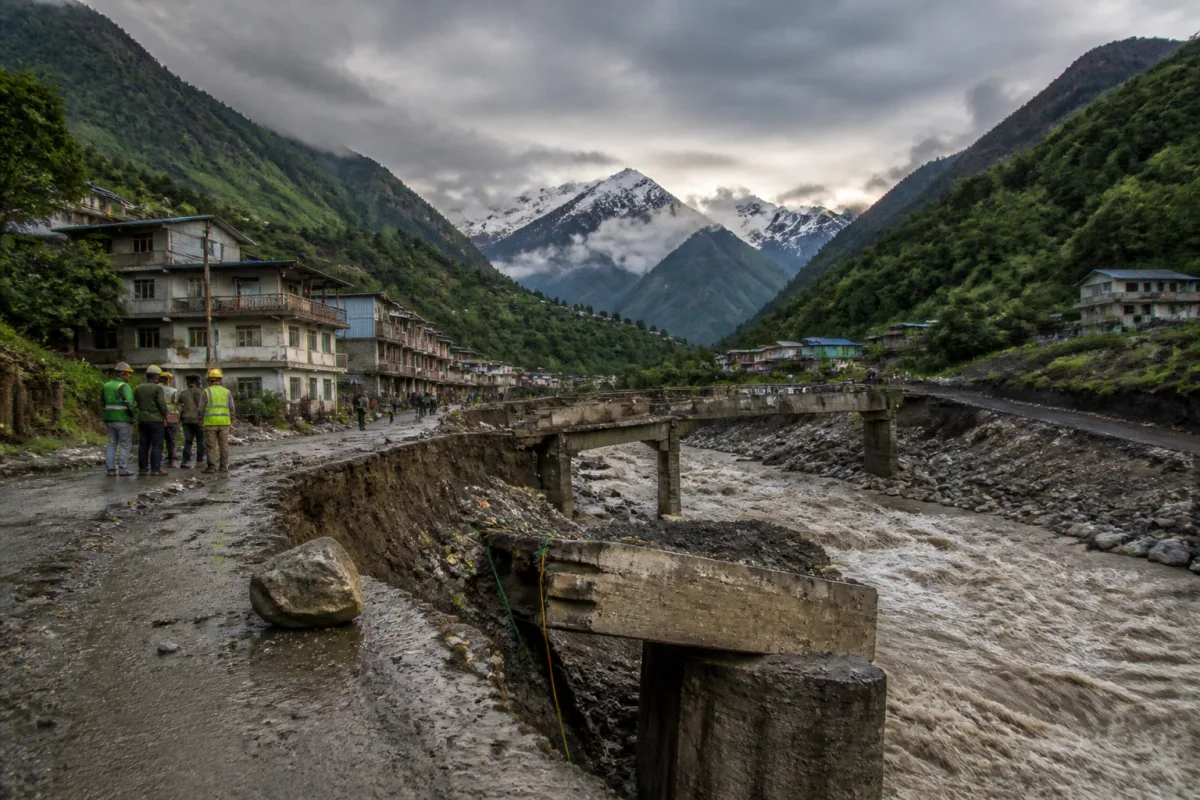
Himalayan climate disasters are no longer only a warning about melting glaciers or unstable mountain environments. They are also exposing a deeper failure in how the world finances adaptation, reconstruction and resilience in places that face severe climate impacts despite contributing little to global heating.
That is the central significance of remarks by Simon Stiell, executive secretary of the United Nations Framework Convention on Climate Change (UNFCCC), who said glacial collapse and flash floods in the Himalayas this year should push countries to act “faster and fairer” on climate change. Speaking to PTI on the sidelines of the UN Climate Change Conference, or COP31, in Antalya, Turkiye, Stiell connected the region’s disasters to two unresolved global tasks: moving away from fossil fuels through a just transition and delivering substantially more money for climate adaptation.
The immediate events are located in the Hindu Kush Himalayas, but their implications extend well beyond mountain slopes. Glacial systems, settlements, roads, bridges, hydropower assets and downstream communities are connected through the same watersheds. When a glacial collapse or flash flood damages a mountain settlement, the impact is not confined to the site of the disaster. Transport links can be cut, reconstruction costs can rise and access to essential services can be disrupted across difficult terrain.
The source report does not provide a consolidated account of the year’s Himalayan disasters, nor does it quantify their total damage. It does, however, establish the institutional concern around them. Stiell said scientists and local communities had warned for years that the Himalayas were at significant risk from climate change. His argument was that the latest disasters should move climate action from long-term pledges towards faster implementation, particularly for vulnerable countries with limited responsibility for the crisis.
This distinction between mitigation and adaptation is important. Mitigation addresses the causes of climate change, including the continued burning of coal, oil and gas and the destruction of forests. Adaptation addresses the ability of communities and institutions to withstand the effects that are already occurring or becoming more severe. For Himalayan countries, that can include preparing for floods, protecting settlements and infrastructure, strengthening early-warning systems and financing recovery after disasters. The report does not list specific projects or national adaptation plans, but it makes clear that Stiell sees finance as the condition for turning climate commitments into real-world outcomes.
The dispute at COP31 illustrates the gap between political recognition and formal decision-making. Proposals by Nepal and Bhutan, and separately by Kyrgyzstan, to secure formal agenda items on mountain-related issues did not receive the backing of major negotiating blocs. A standalone agenda item on tripling adaptation finance was also not formally adopted after consensus could not be reached during the opening plenary on November 9.
That procedural outcome matters because climate conferences do more than issue broad statements. Their negotiated decisions help determine which priorities receive formal attention, how commitments are monitored and whether financial promises are carried into implementation. The failure to adopt a standalone agenda item does not eliminate existing commitments, but it demonstrates how difficult it remains to convert the urgency of climate vulnerability into agreed negotiating outcomes.
Stiell pointed to the agreement reached at COP30 in Brazil the previous year to triple adaptation finance. He said that commitment must be delivered in full, alongside existing financial commitments by developed economies. He also called for better access to finance for vulnerable developing countries that, in his words, had done the least to cause the global crisis.
The question is not only how much money is promised, but how it reaches places where implementation is expensive and administratively difficult. Mountain regions often require infrastructure to be built across steep terrain, dispersed settlements and fragile ecological systems. Reconstruction after a flood or glacial event may involve roads, bridges, public buildings, utilities and housing at the same time. A financing system that treats each project separately may struggle to address the connected nature of the risk.
The report identifies the Fund for Responding to Loss and Damage as one part of the institutional response. Stiell said the fund had moved beyond its establishment phase, had raised and received funds, and was moving into delivery. He cited an initial provisional allocation of USD 21.6 million for Nepal as a positive step, while also stressing that the fund would need to be capitalised and deployed to the fullest extent possible. He added that the fund alone could not meet the scale of loss and damage.
That limitation is crucial. Loss and damage finance is designed to respond to climate impacts that cannot be avoided through mitigation or adaptation alone. Adaptation finance, humanitarian assistance, development finance and disaster-risk financing serve different purposes, but a major mountain disaster can require all of them simultaneously. Stiell said Nepal’s reported reconstruction needs underlined the need to mobilise finance at a much greater scale across these categories.
For urban and regional planning, the finance question is inseparable from the question of where and how infrastructure is built. The source material does not establish that any particular road, town or project failed because of climate change, and it does not provide a detailed assessment of land-use decisions in the Himalayas. But the pattern described by the UNFCCC official points to a planning challenge: climate risk must be incorporated into infrastructure decisions before disasters occur, while funding systems must also be capable of supporting recovery when protection measures are overwhelmed.
The same issue affects public administration. National governments may negotiate climate finance, while local authorities and communities are responsible for responding to hazards on the ground. The effectiveness of a global fund therefore depends not only on the amount committed but also on the institutions that can identify projects, manage money, coordinate agencies and deliver reconstruction. Stiell’s emphasis on access to finance highlights this implementation layer, even though the report does not specify the administrative arrangements being used in Nepal or other Himalayan countries.
The UNFCCC official also placed the Himalayan crisis within the broader trajectory of global heating. He said continued fossil-fuel use and forest destruction were driving warming, and argued that the COP process had helped bring projected global heating down from more than 4 degrees Celsius to 2.6 degrees Celsius if countries meet their climate pledges. These figures were presented by Stiell as evidence of the value of international cooperation, not as a claim that the climate risk facing the Himalayas has been resolved.
That distinction leaves a difficult policy reality. Even if countries fulfil existing pledges, adaptation will remain necessary because climate impacts are already affecting vulnerable environments. The region’s disasters therefore test both sides of climate policy: whether governments can reduce future warming by changing energy systems, and whether they can protect communities from risks that are already materialising.
COP31 is being presented by its organisers as a conference focused more strongly on practical delivery. Stiell said the negotiations and the Global Climate Action Agenda were intended to work as complementary tracks, bringing governments, businesses, investors, cities and regions together to accelerate progress. The Turkish presidency’s focus on electrification was cited as part of that effort. However, the report does not provide evidence of specific Himalayan projects emerging from this agenda or of new finance being released beyond the provisional Nepal allocation mentioned by Stiell.
The evidence supplied in the report therefore confirms an urgent institutional diagnosis but not a completed solution. Himalayan disasters have increased pressure for quicker climate action; mountain-related priorities have not secured formal backing at COP31; adaptation finance remains contested; and the loss-and-damage fund is beginning to move towards delivery while remaining far smaller than the needs described by the UNFCCC official.
The developments that deserve monitoring are concrete: whether the adaptation-finance commitment is delivered, whether the Fund for Responding to Loss and Damage receives further capital, how Nepal’s provisional allocation is deployed and whether mountain countries secure stronger formal recognition in future climate negotiations. The larger urban question is whether international climate finance can move quickly enough from conference language into safer settlements, resilient infrastructure and functioning public services in the Himalayan region.

