


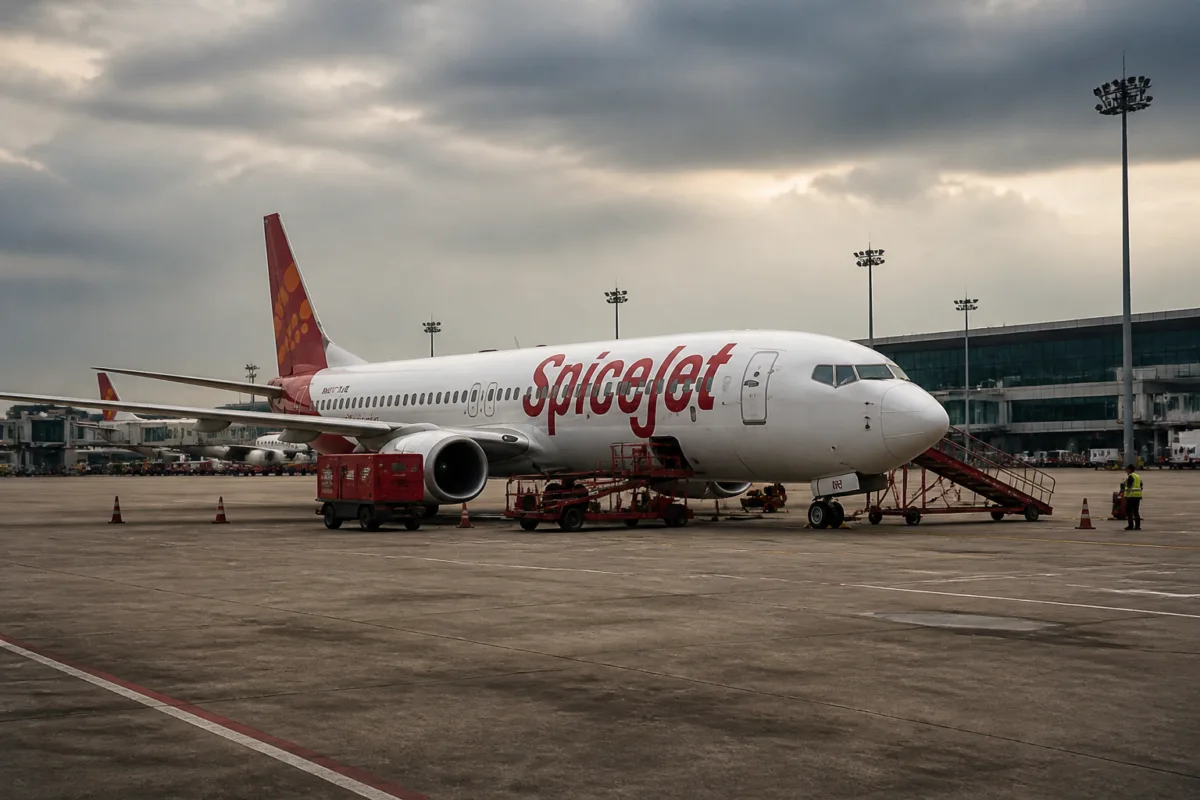
The SpiceJet crisis has moved beyond a routine airline downturn: the carrier’s shrinking active fleet, cancelled flights, unpaid employee dues and falling market share now show how financial weakness can quickly become a mobility and governance problem. According to a report by Aaj Tak Business, the airline was operating only about 12 to 13 aircraft by November 2026, while its domestic market share had fallen below 1% in September.
The immediate operational picture is stark. The report says SpiceJet cancelled 333 flights between November 5 and 9, an average of more than 66 cancellations a day during that five-day period. Its on-time performance was reported at 16.6%, a level that makes the airline an unreliable option for passengers even where flights technically remain available. The reduced fleet also meant that the airline carried only about 73,000 domestic passengers in September, according to the figures cited in the report.
These numbers matter because air connectivity is not only a consumer service. Airlines link smaller cities to major employment, education, medical and commercial centres. When an airline reduces its fleet or cancels flights, the effect is felt at airports, by passengers with limited alternatives, by airport operators dependent on traffic and by businesses that rely on predictable movement between cities. The central question raised by the SpiceJet crisis is therefore whether India’s expanding aviation market is being supported by financially resilient operators or by a fragile system of low fares, leased aircraft and delayed payments.
SpiceJet began flying in May 2005 and was once the country’s second-largest budget airline, the report says. Its current position illustrates the speed at which an airline’s market presence can contract when aircraft availability and cash flow deteriorate together. A smaller fleet reduces the number of flights that can be scheduled. Fewer flights reduce passenger volumes and revenue opportunities. At the same time, aircraft that remain grounded require money for engines, maintenance and spare parts before they can return to service. This creates an operational cycle in which financial stress and fleet weakness reinforce each other.
The report attributes the airline’s present problems largely to the financial pressure that followed the Covid-19 pandemic. It places SpiceJet’s total liabilities at more than Rs 4,500 crore, including dues to aircraft lessors, airport operators and employees. The report also says that several foreign lessors approached the National Company Law Tribunal after lease payments were not made on time and sought the return of their aircraft. For an airline operating leased planes, the ability to keep aircraft in service depends not only on passenger demand but also on regular payments to owners, maintenance providers and airports.
This is an important institutional feature of the airline business. A carrier can appear to have a large scheduled network on paper while having far fewer aircraft that are actually available for daily operations. When lessors recover planes, or when aircraft remain grounded because engines and parts cannot be procured, the published network loses practical meaning. Passengers experience this as cancellations, delays and uncertainty, while the underlying cause lies in a chain of contracts and payments that is difficult to see from the airport terminal.
The SpiceJet figures also expose the tension inside India’s low-cost aviation model. The report identifies aviation turbine fuel costs, the depreciation of the rupee against the dollar and intense low-fare competition as pressures that have affected airlines over the past decade. These pressures are especially significant for carriers that depend on high aircraft utilisation and narrow margins. A low fare can help fill seats, but it leaves less room to absorb a rise in fuel costs, foreign-currency obligations, maintenance expenses or airport charges.
The problem is not simply that airlines face occasional losses. The reported sequence suggests that a financially weak carrier can transmit its stress to several parts of the urban transport system. Aircraft lessors face unpaid dues and repossession decisions. Airports face uncertainty over operations and payments. Employees face delayed wages and statutory dues. Passengers face disrupted journeys. Cities that depend on air links face reduced connectivity. Each institution experiences a different part of the same operational failure.
Employee dues form one of the clearest indicators of this pressure. Aaj Tak Business reports that SpiceJet employees had not received salaries since June 2026. It also reports that the airline had not paid employee-related provident fund, tax deducted at source and goods and services tax obligations for more than a year. These claims are attributed to the report and have not been independently verified in the supplied material. If accurate, they indicate that the crisis extends beyond aircraft availability into the company’s ability to meet routine financial and statutory commitments.
The consequences of a shrinking fleet are also visible in the market-share data. The report says SpiceJet’s domestic share fell below 1% in September 2026, with approximately 73,000 passengers served during the month. This is a sharp contrast with the airline’s earlier position as one of India’s leading budget carriers. Market share is not merely a commercial measure in this context. It indicates how much of the passenger network remains operationally accessible through the carrier and how quickly demand may be shifting to competitors or disappearing from routes that are no longer served.
The wider history cited in the report shows that SpiceJet is not facing an isolated industry problem. Information provided to Parliament in March 2026, according to the report, stated that 11 airlines had stopped operating in India between 2016 and 2026 because of financial distress, aircraft unavailability and internal problems. The report also notes the merger of Vistara and AirAsia India with other Tata Group airlines. It lists the closure or failure of carriers including Jet Airways, Go First, Air Costa, Air Pegasus, Air Carnival, TruJet, Air Deccan’s relaunch, Air Odisha, Supreme Airlines, Zooom Air and FlyBig.
The list should not be read as evidence that every airline failure has the same cause. Jet Airways and Go First, for example, faced different combinations of debt, fleet and operational problems, while smaller regional carriers operated at a different scale. But the pattern is significant: airline exits can occur even as the number of air travellers rises. Demand growth alone does not guarantee that carriers will remain financially sustainable. A growing market can still lose operators if the cost structure, fleet arrangements and fare competition leave insufficient cash to maintain operations.
This is where aviation policy and urban connectivity intersect. The government has promoted wider access to air travel, including the idea that ordinary citizens should be able to fly. The report links this objective to the expansion of affordable air travel. But affordability for passengers and financial sustainability for operators are connected. If fares are kept low in a highly competitive market while fuel, foreign-currency, maintenance and leasing costs remain high, airlines may struggle to provide reliable service. When a carrier fails, passengers do not necessarily receive a durable low-cost alternative on the same route.
Regulation becomes more important when operational weakness begins to affect passengers at scale. The report says the Directorate General of Civil Aviation and the Ministry of Civil Aviation have intensified financial and operational audits of SpiceJet. The stated concern is whether the airline can continue to provide safe and reliable services. This separates two obligations that are often treated as one: an airline must be safe, but it must also be operationally dependable. A carrier may meet immediate safety requirements while still imposing substantial costs on passengers through cancellations and poor punctuality.
The reported on-time performance of 16.6% makes reliability a central regulatory and consumer issue. A low punctuality rate can disrupt onward travel, work schedules, medical appointments and airport transfers. It can also shift pressure to other airlines and surface transport systems when passengers seek alternatives at short notice. However, the supplied material does not establish how the reported performance figure was calculated, which airports or flights it covered, or how it compares with the wider domestic market. Those details would be necessary for a fuller performance comparison.
The report also places SpiceJet’s share price at around Rs 8 and its market capitalisation at about Rs 1,320 crore. These market indicators reflect investor confidence but do not by themselves establish the airline’s ability to operate safely or recover financially. The more direct operational evidence lies in the active fleet, cancellations, punctuality, passenger volumes and reported payment arrears. Together, these indicators show a carrier under pressure, but they do not establish whether a specific rescue, restructuring or revival plan will succeed.
The larger urban question is how India should manage connectivity when private airline capacity becomes unstable. Airports, state governments, regulators and passengers may all depend on operators whose financial condition can change faster than transport planning cycles. A city may invest in airport access and regional mobility while the airline serving the route loses aircraft. A passenger may have a ticket but no dependable journey if the operator cannot maintain its schedule. This makes airline financial health part of the practical infrastructure of urban India.
What the available evidence confirms is that SpiceJet’s crisis is simultaneously a fleet problem, a cash-flow problem, an employee-relations problem and a passenger-reliability problem. The report also shows that airline closures have been a recurring feature of India’s aviation market over the past decade. What remains unclear from the supplied material is the precise status of SpiceJet’s liabilities, the outcome of the reported regulatory audits, the number of aircraft that can be returned to service and whether new capital has been secured. Those are the developments that will determine whether the current contraction is temporary or becomes another permanent exit from India’s aviation network.

