


Russia’s diesel exports nearly doubled in October after US President Donald Trump announced a deal with Russian President Vladimir Putin to increase fuel supplies, but none of the additional cargoes had reached the United States by the time of the report. The development shows how a fuel agreement can expand supply on paper while being reshaped by sanctions, legal challenges, shipping decisions and refinery disruption before it reaches consumers.
Data provider Kpler estimated that Russia exported around 271,000 barrels of diesel per day in October, up from 135,000 barrels per day in September. The increase followed Trump’s October 9 announcement that Russia would supply additional diesel to the United States and global markets. Yet the extra fuel was redirected to markets including Brazil and Turkey, according to a report by the Financial Times cited by the Times of India.
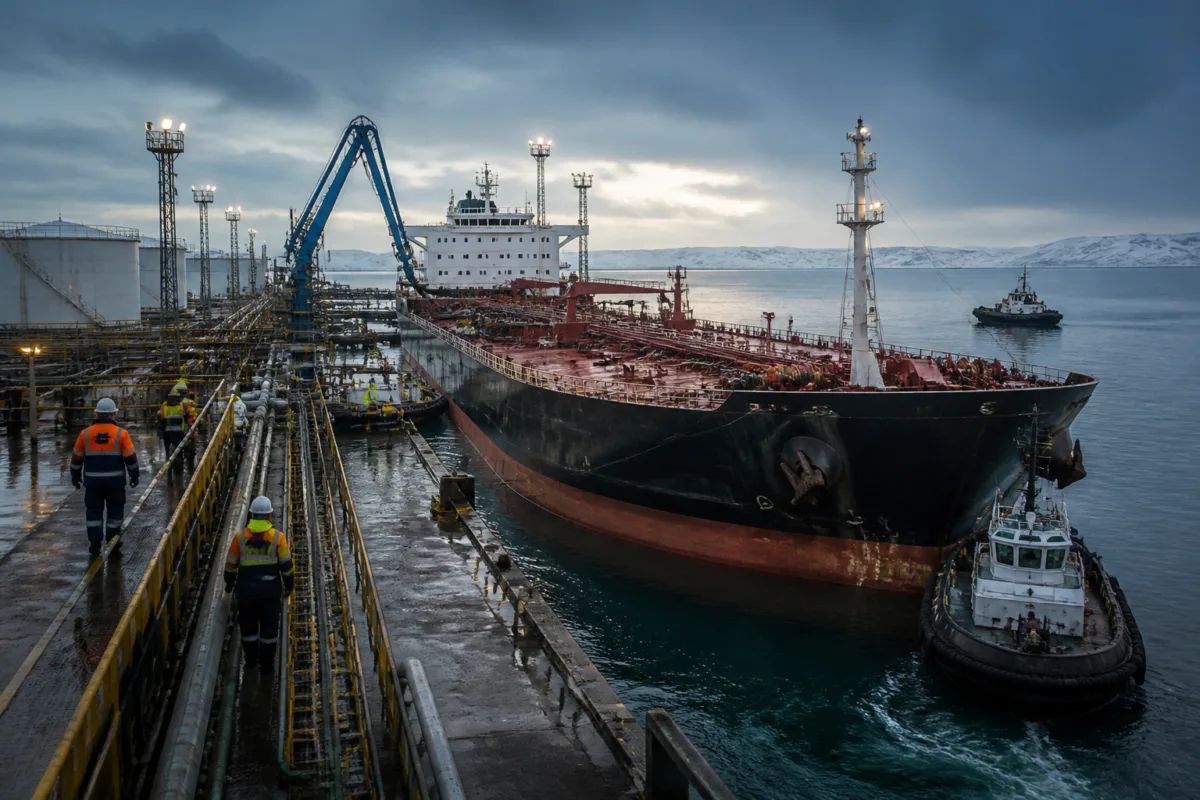
At least two tankers that had initially been headed for the United States changed course in recent weeks. Another vessel, the Agioi Fanendes, remained off the US East Coast while awaiting a buyer. The White House said negotiations with the vessel’s owner were continuing. The immediate result was a split between the stated objective of the agreement—adding diesel to global markets—and the more specific political promise of bringing Russian fuel into the United States.
That distinction matters because diesel is not consumed only by private motorists. It is used by freight operators, agricultural machinery, construction equipment, buses, backup power systems and other activities that support urban economies. When diesel prices rise, the effects can move through logistics costs, food distribution, construction transport and municipal or commercial operations. The supplied evidence does not establish a direct change in Indian fuel prices or urban transport costs, but it illustrates the international supply chain through which disruptions can affect fuel availability and pricing.
The proposed arrangement emerged during a period of pressure on US diesel prices. The original announcement said Russia had agreed to supply more than 300,000 tonnes of diesel immediately, followed by another 500,000 tonnes in November and one million tonnes after that. Trump also said Russia would deliver another three million tonnes within a short period. The stated aim was to increase global supply and reduce prices for American consumers and the wider world.
To facilitate the proposed shipments, the US Treasury Department’s Office of Foreign Assets Control issued General License No. 135 on October 9. The licence temporarily authorised transactions involving the sale, delivery and import of Russian diesel that would otherwise have been restricted under US sanctions. According to the supplied report, it was issued for six months and would allow such transactions through April 2027.
A White House official told the Financial Times that the agreement was intended to add diesel to the global market even if the fuel did not reach the United States directly. “As the President has said, this is a deal for the world. This deal was made to add diesel supply to the global market — lowering prices for Americans and the world — which is exactly what will be done,” the official said.
The movement of the cargoes suggests that the practical operation of the deal depends on more than the volume announced by political leaders. Buyers, vessel owners, ports, terminals, insurers and financial institutions must also determine whether transactions can proceed within the applicable legal and sanctions framework. A licence may permit certain transactions, but it does not guarantee that every commercial participant will accept the associated legal, financial or reputational risk.
The controversy also reflects a conflict between executive action and legislation. The US Congress had been pursuing additional economic pressure on Russia over its war in Ukraine. The Lindsey O. Graham Sanctioning Russia and Iran Act of 2026, signed by Trump on September 18, provided for additional sanctions against Russia and tariffs on Russian goods, along with duties on imports from major buyers of Russian oil and gas and countries accused of facilitating sanctions evasion.
On October 16, Trump issued an executive order waiving the application of these measures, citing national interests and the need to pursue a peace agreement between Russia and Ukraine. The order allowed tariffs of up to 100% on countries buying Russian oil. The shifting position created a policy environment in which fuel supply objectives, sanctions enforcement and wider foreign-policy goals were operating at the same time.
A separate legal challenge was raised by New Jersey Governor Mikie Sherrill. In a November 2 letter, she argued that the Treasury Department’s October 9 licence conflicted with the Ending Importation of Russian Oil Act, passed by Congress in April 2022. That law prohibits imports of Russian energy products, including diesel, according to the report.
Sherrill argued that the 2022 law did not give the president or the Treasury Department blanket authority to waive the import prohibition through a licence. She also said the administration had not met the conditions required to lift the ban and warned port and terminal operators that accepting Russian diesel could expose them to civil and criminal penalties. The challenge means that the route from a sanctioned producer to an American port is not simply a question of whether cargo is available; it also depends on how the governing law is interpreted and enforced.
For cities, the broader issue is the dependence of urban systems on fuel networks that operate far beyond municipal boundaries. Public transport fleets, goods vehicles, construction sites and emergency or backup generators may function locally, but their operating costs are influenced by refinery output, shipping routes, international restrictions and geopolitical decisions. A tanker changing course can therefore be part of the same chain of events that eventually affects the cost of moving goods or completing infrastructure work, even when the connection is not immediately visible at street level.
The October export figures also do not establish a stable recovery in Russian diesel supply. The increase occurred after Washington pressed Ukraine to pause attacks on Russian oil refineries and Trump announced the October 9 agreement. Ukraine resumed attacks on Russian refineries on October 30 after a two-week pause. Russia has also extended its diesel export ban until the end of January, although some exceptions will be allowed.
Richard Bronze, head of geopolitics at consultancy Energy Aspects, attributed the rise partly to Russian refineries’ ability to increase production during the pause in Ukrainian attacks. He said the increase could be linked to US pressure and Trump’s announcement of an energy ceasefire, but expected Russian diesel exports to be “very lacklustre” in the coming months.
Kpler analyst Sumit Ritolia said Russian refinery operations remained under significant pressure. “We expect them to remain constrained around 4mn b/d in the near term, with limited prospects for a meaningful recovery as attacks continue,” Ritolia said, according to the report. The comment underlines the difference between a short-term increase in exports and a durable expansion of supply capacity.
The data therefore presents three separate measures of the deal’s performance. Russia’s diesel exports rose sharply in October. The United States had not received any of the additional shipments by the time of the report. And the continuation of higher exports remained uncertain because refinery operations, attacks and Russia’s own export restrictions could alter the flow. Treating these as one measure would obscure the difference between production, international trade and delivery to a specific market.
The institutional responsibilities are similarly divided. The Treasury’s Office of Foreign Assets Control determines the scope of the licence; the White House defines the political rationale; Congress sets statutory restrictions; courts may assess legal challenges; and private companies decide whether to charter vessels, purchase cargoes or receive fuel at ports and terminals. The result is a supply chain governed simultaneously by market incentives, sanctions rules, executive orders and legal risk.
The proposed diesel arrangement is thus less a straightforward import deal than a test of whether political commitments can be converted into reliable physical supply. The October numbers show that Russian exports responded quickly after the announcement, but the diverted vessels show that additional production does not automatically translate into deliveries to the intended buyer. For urban economies, that gap is important because fuel availability depends on the entire chain, not simply on a headline volume.
The evidence confirms a sharp rise in Russian diesel exports during October, while showing no additional Russian diesel shipments reaching the United States by the time of the report. The developments to monitor are the legal challenge to the Treasury licence, the status of the Agioi Fanendes, the extension of Russia’s export restrictions and the effect of renewed attacks on refinery operations. Together, these will determine whether the October increase represents a temporary release of supply or a sustained change in global diesel flows.

