


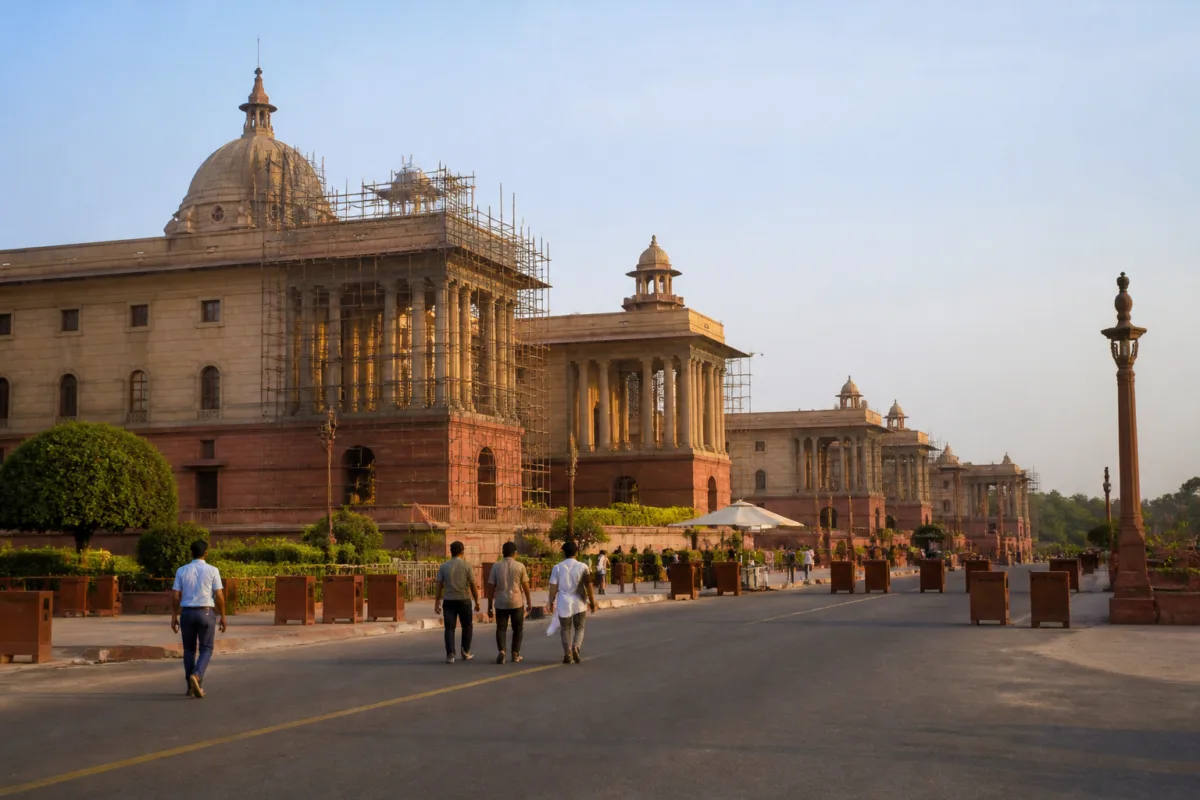
The Union government has cleared a ₹3,230-crore plan to convert Delhi’s North and South Blocks into the Yuge Yugeen Bharat Museum, a project that is expected to create one of the world’s largest museum display areas while transforming two former administrative buildings on Raisina Hill into a major public cultural destination.
The Cabinet Committee on Economic Affairs approved the Culture Ministry’s proposal on Wednesday, according to the Times of India. The museum complex will cover nearly 1.8 lakh square metres, equivalent to about 25 football fields, and will include a display area of 1 lakh square metres when complete. The report said this would exceed the stated display areas of the Louvre, at 73,000 square metres, and the British Museum, at 70,000 square metres.
The project involves North Block, which previously housed the Union home and finance ministries, and South Block, which was among the central government’s principal administrative buildings. Information and Broadcasting Minister Ashwini Vaishnaw said the museum would present India’s complete “civilisational journey” through modern technology while retaining the architectural integrity of the two historic structures.
The government’s stated plan is to open the museum to the public next year, while the wider project is scheduled for completion by March 2031. However, the supplied report contains two different timelines for the first gallery: it says the first gallery is expected to open by 2027, while also reporting that the Culture Ministry was working towards opening the inaugural gallery by the end of 2026. The precise opening schedule will therefore need clarification from the ministry.
The first planned gallery in North Block is expected to focus on “adornment”, presenting jewellery and decorative traditions associated with India’s cultural history. Officials said a modular approach was being developed so that additional galleries could be added progressively. The project’s content and collection analysis is currently under way.
Around 1.8 million objects have been identified for possible display, according to the report. These include collections from the National Museum and other museums under the Culture Ministry, 52 Archaeological Survey of India site museums, state museums and private collections. The museum is intended to use immersive experiences and technology to present subjects ranging from ancient knowledge systems, mathematics and astronomy to architecture, art, languages and spirituality.
The redevelopment will also require a new visitor-management and access system for the Raisina Hill precinct. A metro station planned near Rakabganj Gurdwara is expected to become operational by June 2029 and is projected to serve as an important link for museum visitors. Officials estimate that nearly 70% of visitors will enter through a gate behind North Block, making the future station and surface access arrangements significant to the complex’s long-term functioning.
An earlier proposal to connect North and South Blocks through an underground tunnel has been dropped. The two buildings will instead be connected at surface level, according to officials cited by the report. This decision will shape how visitors move between the two buildings while preserving the relationship between the historic structures and the surrounding public realm.
The museum is also expected to generate recurring revenue through ticket sales, food and beverage facilities, events, venue rentals, digital experiences, guided tours, retail outlets and other visitor services. The Culture Ministry has proposed annual revenue of around ₹163 crore from ticket sales, five auditoriums and event venues, seven food courts and related programmes.
The proposed ticket price is ₹100 for Indian visitors and ₹1,000 for foreign visitors. The project will have a separate director general and four additional director generals, while around 262 positions are expected to be created for curators and support staff.
The redevelopment marks a shift in the use of North and South Blocks from government administration to public cultural infrastructure. Its delivery will depend not only on the conservation and adaptation of the buildings, but also on gallery preparation, collection management, visitor circulation, public transport connectivity and the phased opening of facilities. The Culture Ministry’s next steps are to begin laying out the inaugural gallery and continue the collection and content analysis for the wider museum.

