


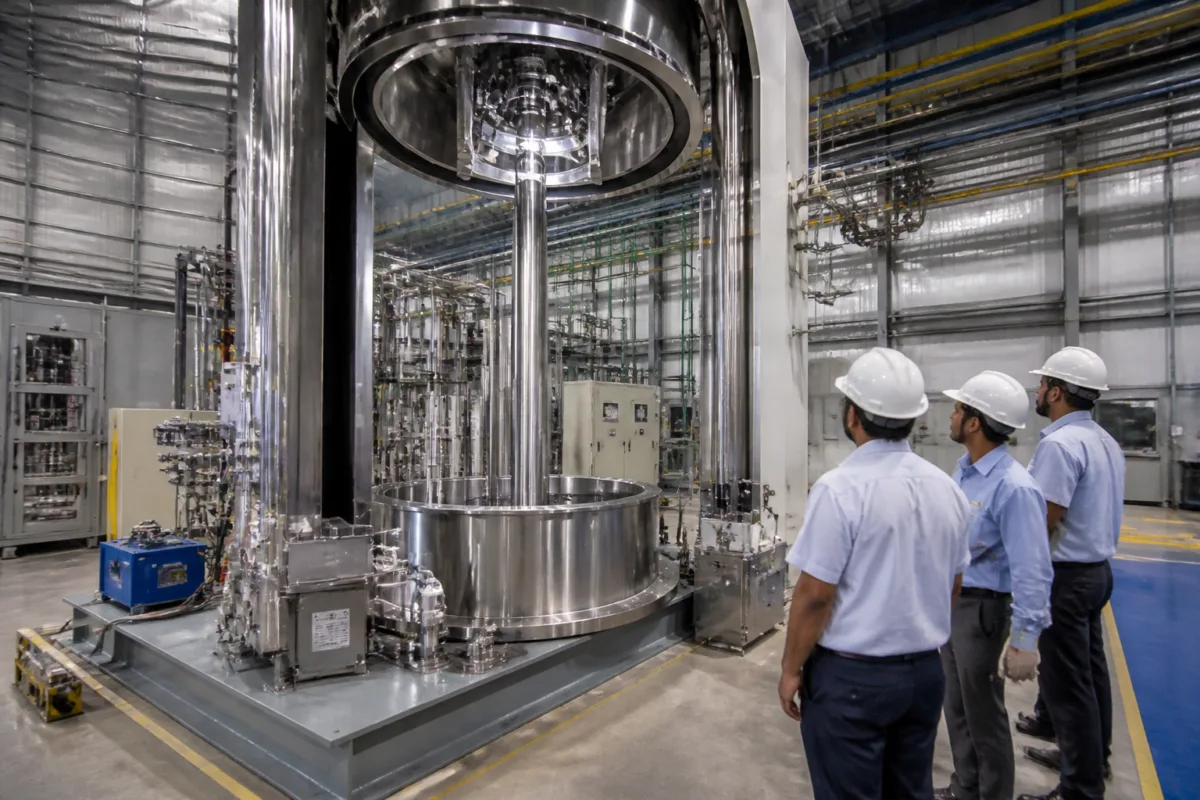
Swelect Energy Systems’ decision to sign a pre-purchase agreement for indigenous Czochralski machines places a relatively specialised piece of equipment at the centre of India’s attempt to build a deeper solar manufacturing supply chain. The agreement with Hosur-based Raana Semiconductors is for 12-inch systems for a planned 1GW ingot manufacturing facility, but its significance extends beyond one equipment order: India’s ability to make solar modules domestically will increasingly depend on whether it can also produce the materials and machinery that sit upstream of the module factory.
Swelect, through its subsidiary Swelect HHV Solar Photovoltaics Ltd, is expanding into ingot and wafer manufacturing after operating in the solar module segment. Raana is developing indigenous CZ systems used to produce single-crystal silicon ingots. These ingots are sliced into wafers, which are then used in solar cells and modules. The arrangement therefore connects an Indian equipment start-up with a solar manufacturer seeking to move into an upstream part of the value chain.
The Czochralski process is a critical stage in the production of high-purity silicon ingots. In broad terms, it involves converting purified silicon into a single crystal that can subsequently be processed into wafers. The same basic technology has applications beyond solar cells, including chips and sensors, although the agreement described by the companies is focused on solar wafer production.
Raana said it would provide more than the machines themselves. According to a social media post cited in the report, the company will support Swelect’s team with process optimisation and recipe development, train personnel at its pilot facility, and help the plant operate and maintain the crystal growers with limited downtime. That emphasis is important because the performance of an ingot facility depends not only on equipment availability but also on process control, operating expertise, yield and maintenance.
For Swelect, the immediate project is still at an early stage. Arulkumar Shanmugasundaram, the company’s managing director and chief executive officer, said locally sourcing critical components could give the solar sector a significant boost. At the same time, he noted that Raana’s CZ system remains under development. The machine is projected to deliver better performance and output than imported alternatives, but the company’s commercial deployment will determine whether that promise translates into reliable industrial production.
Swelect is also evaluating possible locations for its proposed ingot facility. Tamil Nadu is being considered because the company is based there, while other states are also under review. The location decision will affect the project’s connection to power, industrial land, logistics, skilled labour, suppliers and downstream manufacturing. The supplied report does not establish a final site, investment amount or commissioning date for the 1GW facility.
That uncertainty is significant because upstream solar manufacturing is more demanding than simply adding module assembly capacity. An ingot plant requires specialised equipment, consistent access to high-purity inputs, process knowledge, quality control and dependable utilities. It must also achieve commercially viable yields. A domestic machine can reduce import dependence, but it does not by itself establish a complete domestic chain for polysilicon, ingots, wafers and cells.
The agreement nevertheless addresses one of the less visible dependencies in India’s solar ambitions: the machinery used to make the components. India has expanded its module manufacturing base, but the upstream stages of production have historically remained more dependent on imported materials, equipment and technology. The development of an Indian CZ system is an attempt to localise part of that industrial infrastructure rather than only assemble the final product.
The timing adds a strategic dimension. The report says China, the dominant global supplier of these machines, has initiated plans to restrict exports. It does not provide details of the proposed restrictions, their implementation status or their expected effect on Indian companies. But the possibility highlights how concentrated equipment supply can become a constraint when several manufacturers are simultaneously planning new ingot and wafer capacity.
Multiple Indian solar module makers, including Grew Solar, Vikram Solar and Swelect Energy, are reported to be developing ingot or wafer manufacturing capacity. This suggests that the industry’s focus is shifting towards greater vertical integration. The shift is not simply a matter of adding factories. It requires a domestic network of equipment developers, component suppliers, process engineers and manufacturers capable of operating at consistent scale.
The government’s proposed policy direction could reinforce that shift. The Ministry of New and Renewable Energy has proposed including solar ingots and wafers under the Approved List of Models and Manufacturers from June 1, 2028. If implemented as described, the requirement would enforce local sourcing of these components for module manufacturers. The proposal therefore creates a future demand signal for domestic ingot and wafer production, while also raising the importance of whether planned facilities can become operational and meet required standards by the time the rule takes effect.
The ALMM framework is an administrative mechanism that determines which models and manufacturers are eligible for use in specified government-linked solar projects. Extending such requirements upstream would make the origin and eligibility of ingots and wafers more consequential for module producers. It could encourage investment in domestic capacity, but the supplied material does not establish the final policy text, compliance conditions, exemptions or enforcement arrangements for the proposed 2028 inclusion.
This is where the distinction between announced capacity and functioning capacity matters. Swelect’s planned facility is described as a 1GW project, but the report does not say that the plant has been commissioned or that production has begun. Similarly, Raana expects to launch its first commercial-grade 12-inch CZ single-crystal machine for solar cell wafers within 10 to 12 months, but that is a projected timeline rather than evidence of completed commercial deployment.
For the solar industry, machine performance will be judged through operational measures such as output, yield, reliability, maintenance requirements and the time taken to stabilise production. Raana’s proposed hand-holding and operator training indicate that the companies recognise the difficulty of moving from equipment development to industrial use. The project will need to demonstrate that locally developed systems can support production at the quality and scale required by a large ingot facility.
The location question also shows why solar manufacturing is an urban and infrastructure issue, not only an industrial one. A large upstream facility requires land, power, water, transport links, industrial services and a workforce with specialised skills. Whether the project is eventually located in Tamil Nadu or another state will shape local infrastructure demand and determine how effectively it connects with other parts of the manufacturing ecosystem.
India’s proposed upstream sourcing requirements also place pressure on coordination between policy and industrial readiness. A mandate can create demand for domestic products, but manufacturers need functioning suppliers before compliance deadlines arrive. Equipment developers, solar companies and government agencies will therefore be operating against linked timelines: Raana’s commercial machine development, Swelect’s site selection and plant construction, the development of other ingot and wafer projects, and the proposed ALMM change in 2028.
The evidence currently confirms a strategic move, not a completed transformation. Swelect has signed a pre-purchase agreement for Raana’s 12-inch CZ systems; Raana is developing the equipment; Swelect is planning a 1GW ingot facility; the location has not been finalised; and the policy framework for adding ingots and wafers to the ALMM remains proposed in the supplied material. The next meaningful indicators will be the launch of Raana’s commercial-grade machine, Swelect’s location and project milestones, and evidence that indigenous equipment can deliver reliable yields at industrial scale.

