


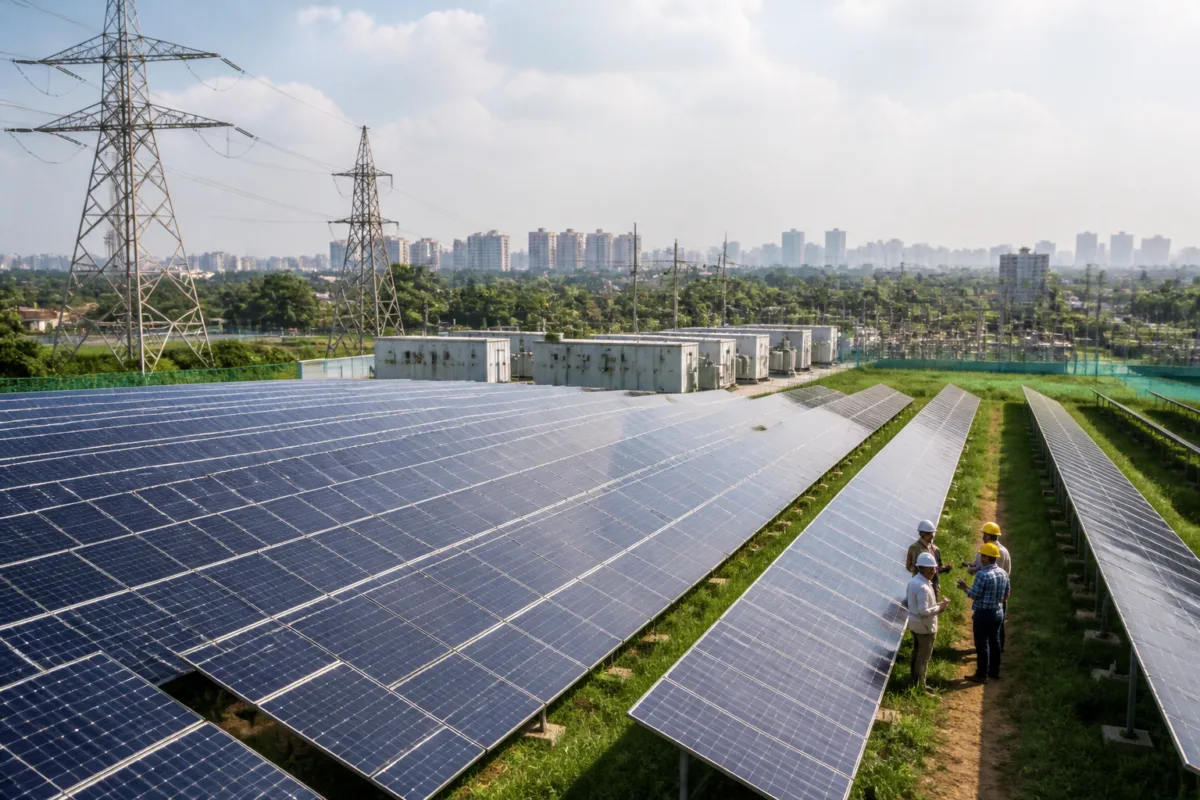
India clean energy investment received a large political and financial signal at the Bharat Renewable Energy Summit and Expo, where investors at a chief executive officer roundtable made preliminary commitments worth $400 billion, according to Minister for New and Renewable Energy Pralhad Joshi. But the figure is not yet a portfolio of sanctioned projects. The ministry is still working out the identities of individual investors, the sectors involved and the proposed investment details.
That distinction is central to understanding what the announcement means for India’s cities, industries and electricity consumers. The commitment covers renewable energy, green hydrogen, energy storage and transmission infrastructure, all of which are necessary if India is to expand clean power without leaving the grid unable to absorb it. Yet the announcement also shows that the clean-energy transition is moving through several unresolved institutional questions: how proposals will be vetted, how domestic manufacturing capacity will support deployment, and how storage will manage the variability of renewable generation.
Joshi told reporters that fund managers had collected the details of the commitments made at the CEO roundtable and that the ministry would work out the particulars. The ministry is therefore at an early assessment stage rather than an implementation stage. There is no detailed public breakdown in the supplied account of how much of the $400 billion is intended for generation, hydrogen, batteries, pumped hydro, transmission or other activities. Nor are individual company commitments identified.
For urban India, the significance is not limited to the construction of solar and wind projects outside city boundaries. Transmission lines, substations and storage facilities determine whether renewable electricity can reach industrial clusters and urban distribution networks. Green hydrogen could create new industrial demand and infrastructure requirements, while grid-scale storage could influence the reliability and timing of power supplied to households, commercial buildings and manufacturing units. The announcement brings these connected systems into a single investment conversation, but does not yet establish how they will be coordinated.
The government’s handling of the Approved List of Models and Manufacturers framework illustrates the tension between expansion and domestic capability. Joshi said the ministry would consult stakeholders over the next 10 to 15 days before deciding whether to extend a relaxation for solar projects under the framework for solar cells. The government had earlier extended the relaxation until December 31 because of concerns about inadequate domestic manufacturing capacity.
According to the minister, India’s domestic solar-cell manufacturing capacity is around 47 GW. Manufacturers have indicated that this could rise to 70 GW by December 31. The difference between current capacity and the indicated future level is important because the scale and timing of manufacturing influence the speed at which solar projects can be supplied and commissioned. However, the account does not establish how much of the potential 70 GW capacity is already operational, contracted or available for particular project requirements.
The ALMM discussion also exposes a policy trade-off. Extending a relaxation may help projects proceed when domestic supply is insufficient. At the same time, the government is trying to build a domestic manufacturing base. The minister said some stakeholders wanted the relaxation extended while others did not, and that the government would hear their views before deciding. The next step is therefore consultation, not a confirmed policy change.
Storage is the other major link between investment commitments and everyday electricity reliability. The Union Cabinet has approved ₹14,500 crore in viability-gap funding for grid-scale energy storage, covering pumped hydro and battery storage projects. Such support is intended to help projects that may not otherwise be financially viable at the required scale. The minister connected the funding to the problem of fluctuations in renewable power generation.
The source also records a recent round-the-clock renewable-power tender at ₹5.25 per unit, which Joshi cited as evidence that competitive bidding and storage infrastructure can help make renewable electricity economical for consumers. The figure is a tender price, not a universal retail tariff, and the supplied report does not provide the project’s capacity, duration of supply or terms. It nevertheless indicates how storage is increasingly being treated as part of the power product rather than as a separate technical add-on.
That shift matters for urban electricity systems. Solar generation is not evenly available through the day, while household, commercial and industrial demand can rise during periods when solar output falls. Storage can move electricity across those periods, but the government’s funding approval does not by itself settle questions about project locations, operating models, distribution-company contracts or the eventual effect on consumer bills. Those details will determine whether storage improves reliability at scale or remains concentrated in selected projects.
Rooftop solar presents a different implementation challenge because it involves millions of individual premises and state-level electricity arrangements. Joshi said several state governments were considering decentralised battery-storage solutions for households to manage peak-hour demand. He clarified that these were proposals under consideration by states and not an announced Central government scheme.
That clarification is significant. Household batteries would add another layer to rooftop-solar deployment, involving consumer financing, equipment standards, installation, maintenance and the rules governing electricity fed back into the grid. At present, the supplied report establishes only that state governments are considering such solutions. It does not establish a common national programme, an approved subsidy structure or a confirmed rollout timeline.
The PM Surya Ghar programme is also approaching a stated milestone. Joshi expressed confidence that it would reach its target of one crore households by March, while indicating that any expansion of the target would require further consultation. The programme’s household focus links national renewable-energy policy to the physical realities of urban and rural buildings: roof ownership, structural suitability, distribution connections, installation quality and the ability of households to use or export the electricity generated.
Taken together, the minister’s comments describe a clean-energy system being built across several administrative layers. The Centre is assessing investment proposals, deciding on the continuation of a manufacturing-related relaxation, funding grid-scale storage and monitoring a household rooftop programme. States are considering decentralised storage options, while private investors and fund managers are shaping the pipeline of proposed projects. Each layer has a different responsibility, and the $400 billion figure will acquire practical meaning only when these responsibilities are translated into identifiable projects and contracts.
The announcement also arrives against an international investment backdrop shaped by the West Asia conflict. Asked whether global capital could be diverted towards rebuilding damaged energy infrastructure, Joshi said investors continued to view India as an attractive destination. That is an official assessment of investor sentiment, not evidence of how much capital will ultimately be committed or deployed. The immediate policy task remains the same: converting interest into proposals that can be examined, financed, permitted, manufactured and connected to the grid.
The evidence currently confirms a substantial preliminary commitment, a ₹14,500-crore storage funding approval, solar-cell capacity of around 47 GW and a possible increase to 70 GW by the end of December. It does not yet provide a project-wise investment list or establish the final treatment of the ALMM relaxation. For India’s cities and energy consumers, those pending details will matter more than the headline total because they will show whether the clean-energy push is producing dependable infrastructure, domestic supply and accessible rooftop power.

