


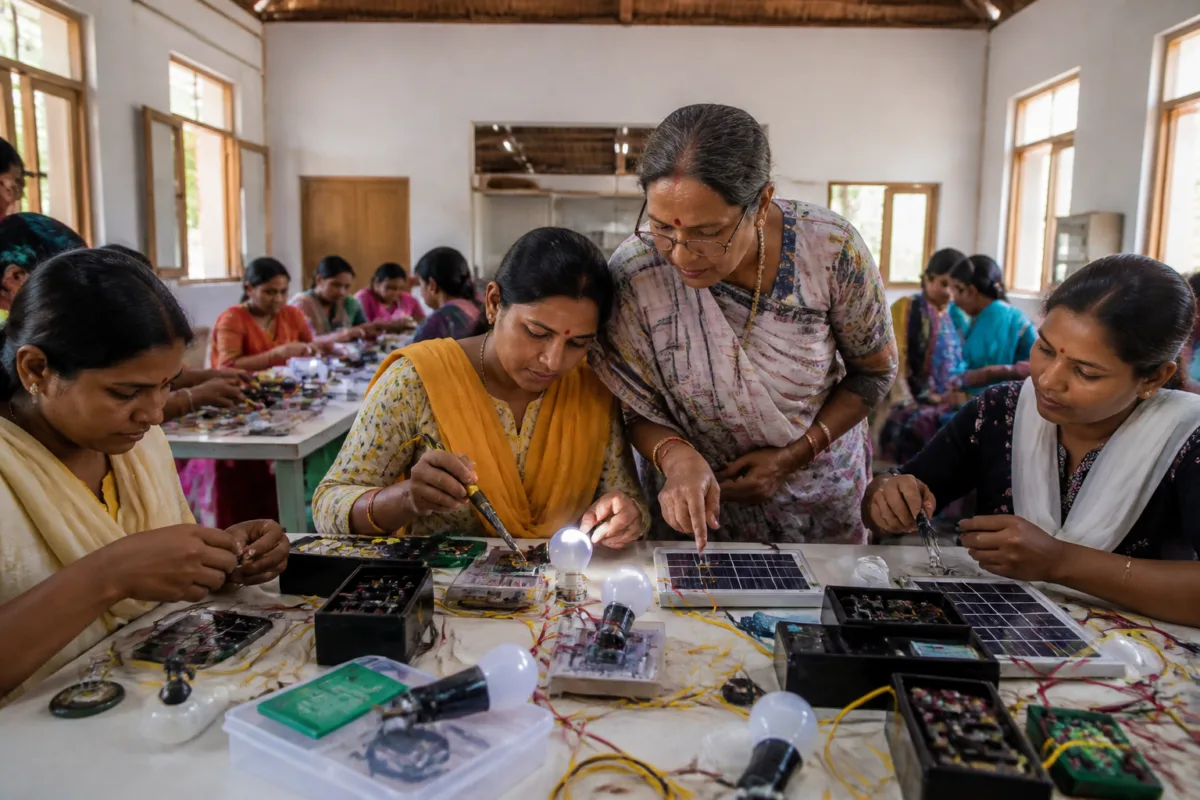
Barefoot College’s Solar Mamas programme shows how energy access can be expanded without waiting for conventional electricity networks to reach every settlement. From its training centre in Tilonia, Rajasthan, rural women are taught to assemble, install and repair solar lighting systems, then return to communities where basic power remains unreliable or unavailable.
The programme, launched by Sanjit Bunker Roy in 2000, is built around a practical proposition: women with little or no formal education can become solar technicians when training is designed around demonstration, repetition and local problem-solving rather than textbooks and complex equations. According to the account published by the Times of India, women from 96 countries have participated in the programme’s international network.
That approach makes the initiative more than a skills-training exercise. It treats electricity access as a community capability rather than only as a network-extension problem. The women trained at Barefoot College are expected not only to understand solar equipment but also to maintain it, explain its use to others and support systems after returning to their villages.
The experience of Cathy, a Solar Mama from Papua New Guinea, illustrates the difference between receiving a device and gaining the ability to sustain it. In a video message shared with the Times of India by Barefoot College staff, Cathy said solar lights had reached a local library where children could study after dark, as well as several homes. She described the change as improving safety, security and livelihood opportunities.
Her account also identifies the limits of conventional energy access in remote communities. Cathy said that in the darkest region of her country, even a few hours of electricity was a luxury, while kerosene remained the primary source of light. She linked that dependence to extreme poverty and serious health hazards. The supplied report does not provide independent measurements of those impacts, but her testimony demonstrates how the absence of reliable lighting affects education, household safety and household expenditure at the same time.
The Solar Mamas model responds to that gap at the level where infrastructure is actually used: the home, the village institution and the local repair network. In Tilonia, women work in a two-hall workshop with wires, electronic components, batteries, LED bulbs and soldering irons. Many reportedly handle electrical testing equipment for the first time. Training begins with identifying components and connecting circuits, then moves to testing batteries and troubleshooting faults.
The six-month course is significant because solar systems do not become useful merely by being installed. Batteries need testing, wiring can fail and lights require maintenance. By training local women to identify and repair faults, the programme attempts to reduce dependence on technicians who may be far away or difficult to reach. The supplied material does not establish how many systems remain operational over time, but the training structure clearly places maintenance at the centre of the model.
This is an important distinction in decentralised energy planning. A centralised electricity network concentrates generation and distributes power through a large physical system. A village-level solar system works differently: it depends on smaller equipment, local knowledge and the ability to manage repairs close to the point of use. The Solar Mamas programme therefore combines a technology choice with an institutional arrangement for operating that technology.
Its selection of trainees is equally central to the model. Women are chosen from remote, non-electrified villages and return to communities that already know them. That local connection can make the technical system easier to explain and operate, although the supplied report does not claim that it removes all barriers to adoption or affordability.
Ateqa, another participant mentioned in the report, hopes to take solar lighting to her village and earn a livelihood by selling solar lights, batteries and cookers. Her plans show the programme’s second layer: solar technology is linked to income generation. The trainee is not described only as a beneficiary or end user but as a possible service provider within her community.
That distinction matters for infrastructure programmes in places where formal technical services are limited. A system that creates local work around sales, installation and repair may be more embedded than a one-time distribution campaign. At the same time, the available material does not provide figures on incomes, sales volumes, business survival or the number of households served by individual Solar Mamas. Those outcomes remain outside what can be established from the report.
Barefoot College also extends training beyond solar technology. Participants learn stitching, basic health awareness and water harvesting and conservation, including traditional Indian techniques for collecting and managing rainwater. This broader curriculum reflects an integrated understanding of rural infrastructure, where energy, water, health and livelihoods are closely connected in daily life.
The connection between these areas is practical rather than theoretical. Lighting can affect when children study or when household work is performed. Water harvesting can influence how communities manage a scarce resource. Livelihood skills can determine whether a technical intervention becomes part of a household’s economic life. The programme’s design places these concerns in the same training environment, although the supplied account does not measure the relative impact of each activity.
The model also raises a question about how development institutions define expertise. Traditional technical systems often rely on formal qualifications, specialist contractors and centralised maintenance structures. Barefoot College takes a different route by using hands-on instruction and locally selected trainees. Its workshops replace conventional classroom barriers with colour-coded diagrams, demonstrations and repeated practice.
That method is particularly relevant to infrastructure deployment in remote areas because the challenge is not only whether equipment can be delivered. It is whether users can understand it, repair it and adapt its operation to local conditions. The programme’s emphasis on women who are already part of the communities being served attempts to address that operational problem through social trust and local presence.
The international reach described by the Times of India also suggests that the model has been adapted beyond Rajasthan. Women from 96 countries have participated in the network, while Cathy’s testimony places the programme’s effects in Papua New Guinea. However, the report does not explain how the training is modified for different national regulations, climatic conditions, equipment standards, financing systems or supply chains. Those are important unanswered questions for assessing how transferable the model is.
The same limits apply to the question of scale. The supplied account establishes that the programme has trained women from many countries and that solar lights have reached homes and a library in at least one community. It does not provide a total number of installations, households served, systems maintained, emissions avoided or costs compared with other electricity-access options. Those figures would be necessary to evaluate the programme as a large-scale infrastructure solution rather than as a community-based model with international reach.
Even without those measurements, the programme makes the institutional mechanics of energy access visible. Equipment is only one part of the system. Training determines who can operate it; local livelihoods may determine who can maintain it; and community institutions such as libraries can determine whether the benefits extend beyond individual households.
The experience described in Papua New Guinea also shows why energy access cannot be assessed only through grid connection figures. A community may remain beyond the reach of conventional power networks while still gaining access to lighting through decentralised solar systems. Such systems do not necessarily replace a broader electricity network, and the supplied material does not claim that they do. They provide a different route to basic energy services where network access remains limited.
For urban policymakers and infrastructure planners, the lesson is not that every energy problem can be solved through a single training programme. It is that the success of infrastructure depends on institutions and users as much as on physical assets. The Solar Mamas programme places local women inside the delivery and maintenance chain, making community participation part of the infrastructure itself.
What the evidence confirms is a distinctive model: women from remote, non-electrified communities receive practical training in solar assembly and repair, along with livelihood and resource-management skills, and carry that knowledge back home. What remains unclear from the supplied account is the programme’s measurable scale, long-term maintenance record and comparative cost. Those are the next questions for assessing whether the model’s international network can translate into durable energy access across different communities.

