


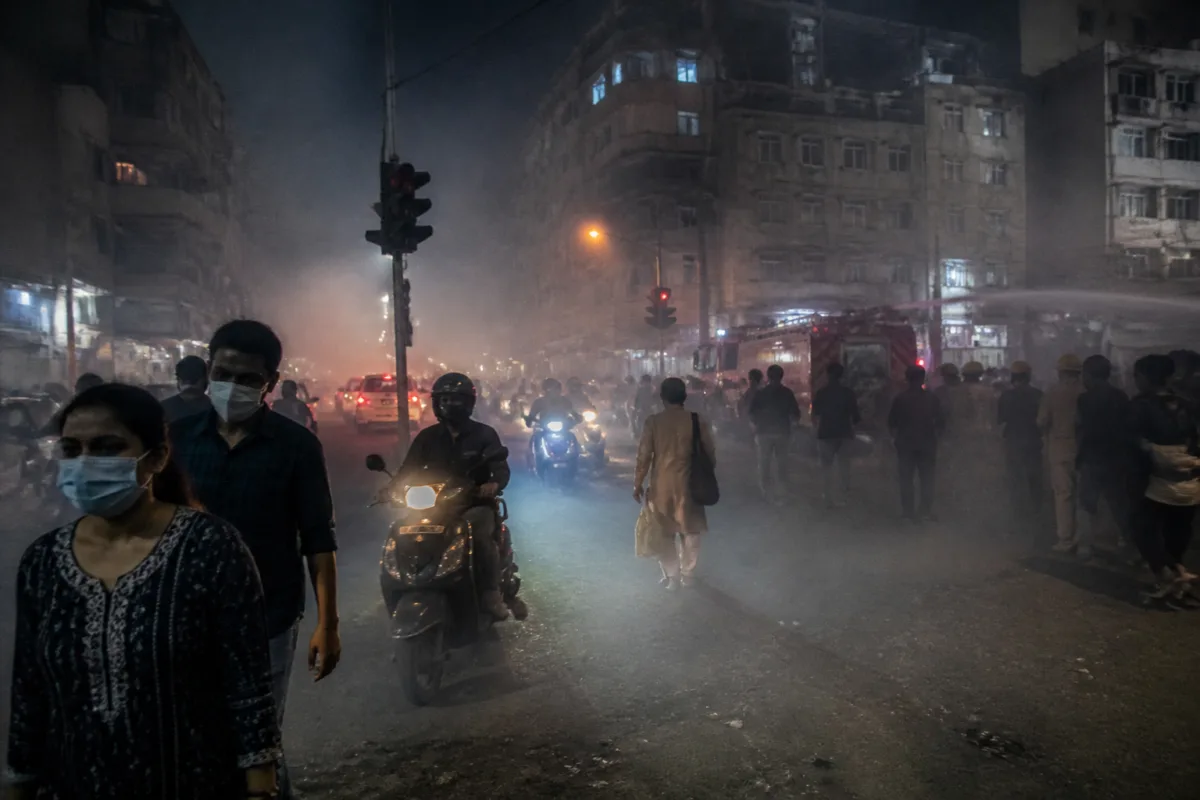
Pune faced a sharp Diwali air-pollution spike after intense firecracker use on Lakshmi Pujan night, with reported air-quality readings reaching hazardous levels and dense smoke covering residential areas, roads and commercial streets for nearly 12 hours. The Pune Fire Brigade also recorded 94 fire incidents during the night, keeping emergency crews occupied until the early hours.
The heavy firecracker activity began after 7 pm, despite relatively little noise being reported in the city until around 6.45 pm. By about 8.30 pm, smoke had spread across several neighbourhoods, obscuring buildings and reducing visibility from rooftops. Residents reported difficulty breathing even after closing windows and doors.
The report said air quality in Pune rose into the 281-to-551 microgram-per-cubic-metre range, although the readings varied across monitoring systems. According to observations from the Indian Institute of Tropical Meteorology’s Pune air-quality early warning system, the city’s average air-quality reading reached 218 at 9 pm. At Shivajinagar, the reading was recorded at between 256 and 281 around 10.10 pm, placing the air in the ‘poor’ category.
Air quality was measured hourly and remained in the ‘very poor’ category for about 12 hours, according to the report. Smoke continued to hang over the city until early Monday morning, when residents saw smog instead of the usual fog. Conditions began to improve after 8 am.
The readings cited in the report differed significantly by monitoring source. The Central Pollution Control Board figure was reported in the range of 281 to 300 micrograms per cubic metre, while an American monitoring service was cited at 451 and Google’s listing at 850. The report also listed a reading of 113 for the Pune University area. These differences reflect the use of different monitoring systems, locations and reporting formats, and the figures should therefore be read with their respective source labels.
Laxmi Road was among the areas where breathing became difficult, with dense layers of smoke reported between 7 pm and 11.30 pm. People were described as using masks and even two cloths over their noses while attempting to move through the area. The smoke affected not only open streets but also homes in surrounding buildings.
The simultaneous occurrence of severe smoke accumulation and 94 fire incidents placed additional pressure on the city’s emergency-response system. The reported incidents followed widespread use of firecrackers, including firecracker chains, loud explosive devices and aerial fireworks in residential lanes and other parts of the city.
The episode highlights the difficulty of managing short-duration pollution surges in a dense urban environment, where emissions from multiple neighbourhoods accumulate over several hours. The report’s monitoring data and fire-incident count provide the immediate measures of the night’s impact; further official assessment would be required to establish the final citywide pollution profile and the causes of individual fires.

