


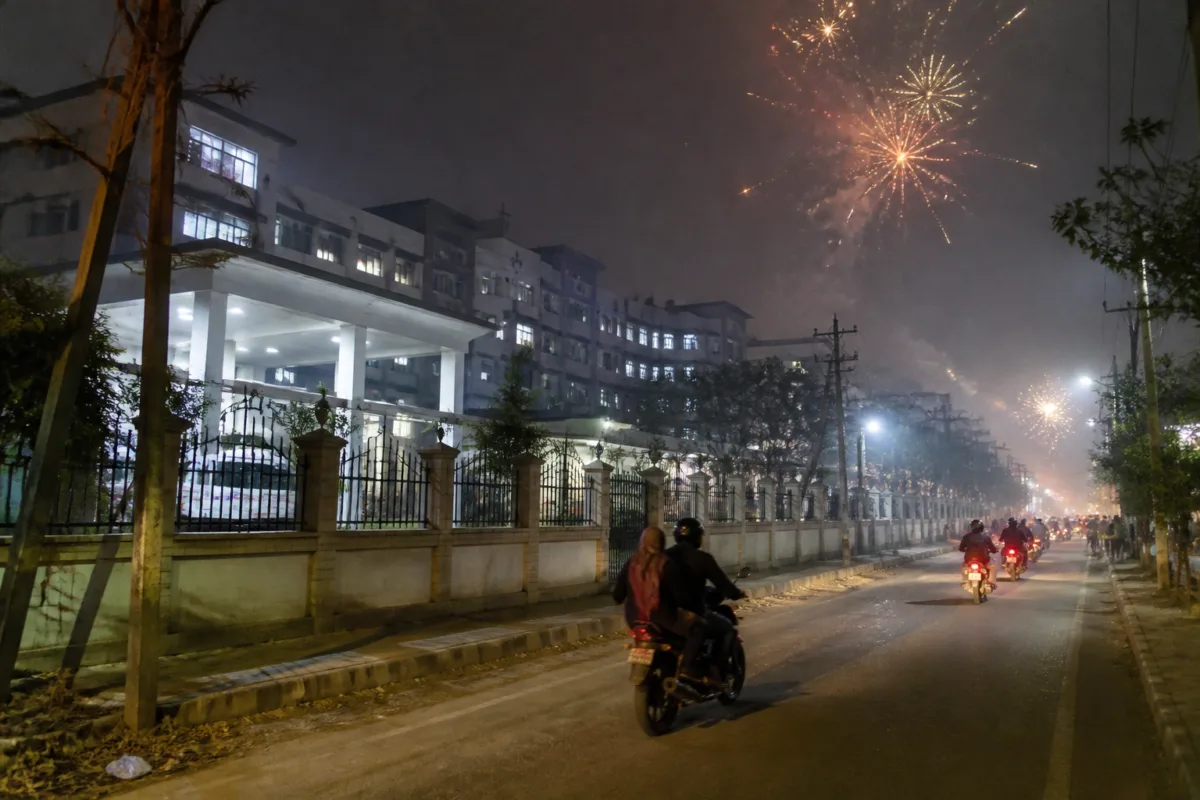
Ranchi’s Diwali noise levels breached statutory limits across silence zones, residential areas and industrial locations, according to data released by the Jharkhand State Pollution Control Board (JSPCB). The sharpest breach was recorded near Sadar Hospital, where the average noise level reached 73.5 dB(A) overnight, far above the 40 dB(A) limit applicable to institutional silence zones at night.
The reading was recorded between 10pm on Sunday and 6am on Monday, during a period of continuous firecracker bursting. Sadar Hospital is classified as a silence zone, where the permissible daytime noise limit is 50 dB(A) and the night-time limit is 40 dB(A). The monitoring data indicates that the area’s protected status did not prevent sustained noise exposure during the festival.
A 100-metre commercial area outside the hospital also exceeded its prescribed limit. The location recorded a daytime noise level of 68.5 dB(A), against a permissible daytime limit of 55 dB(A). The report said the commercial area’s night-time threshold is also 55 dB(A).
The JSPCB data showed that mixed-use neighbourhoods faced substantial breaches as well. The board’s head office, located in a residential-cum-commercial area, recorded 65.4 dB(A) during the day before the level rose to 70.5 dB(A) overnight. These readings exceeded the applicable limits for both categories, including the residential night-time ceiling of 45 dB(A) and the commercial night-time ceiling of 55 dB(A).
Noise levels also crossed the permissible limits in Ranchi’s Tupudana industrial area. The monitoring station there recorded 76.8 dB(A) during the day and 71.4 dB(A) at night. Industrial areas are allowed higher limits of 75 dB(A) during the day and 70 dB(A) at night, but both readings still exceeded the applicable benchmarks.
The figures are measured in A-weighted decibels, or dB(A), a unit designed to reflect the frequency sensitivity of the human ear and commonly used to assess community noise pollution. The JSPCB readings document the extent to which firecracker use pushed sound levels beyond the limits set for different urban land-use categories.
The breach near Sadar Hospital is particularly significant because silence-zone limits are intended to protect sensitive institutional environments, including hospitals. The recorded overnight average was 33.5 dB(A) above the applicable night-time limit. The data also shows that the impact was not confined to one location, with residential-cum-commercial and industrial monitoring points recording excess noise during both daytime and night-time periods.
The JSPCB’s release provides the latest monitoring record cited in the report. It does not detail any enforcement action, penalties or additional measures taken against violations at the monitored locations. The reported readings therefore establish the scale of the exceedance, while the next steps for enforcement and protection of silence zones remain with the pollution-control authorities.

