


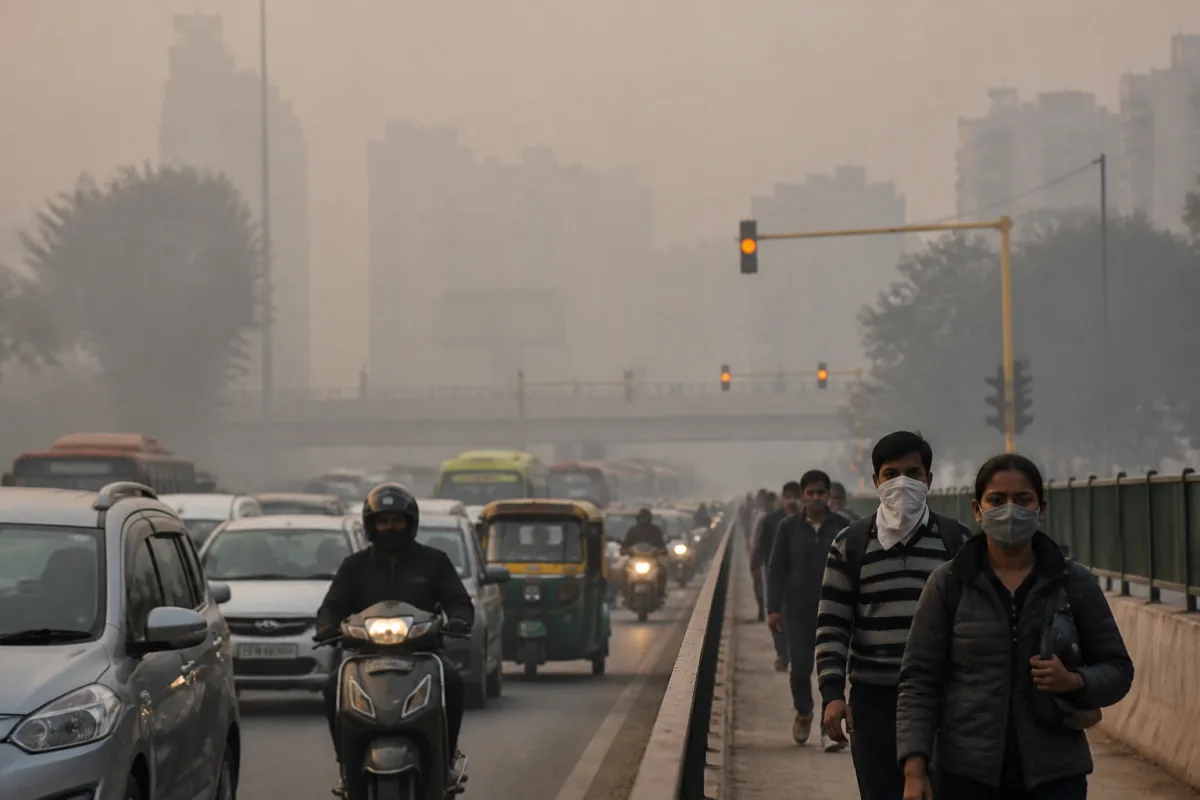
Delhi air pollution has once again moved beyond a public-health concern into a test of urban governance, after Congress MP Shashi Tharoor described the capital’s air quality as a “national disgrace” and questioned the government’s political will to address it. The Central Pollution Control Board recorded Delhi’s average AQI at 389 at 8 a.m., placing the city in the “very poor” category, while the effects were reported to be reaching sporting events as well as daily life.
The immediate episode is familiar: deteriorating air, emergency measures under the Graded Response Action Plan, political criticism and renewed demands for stronger standards. But the evidence in the report points to a wider problem. Delhi’s pollution is not only a seasonal city-management challenge. It is also a regional air-quality problem, a standards problem and an implementation problem involving multiple governments and agencies.
Tharoor told news agency ANI that Delhi’s air quality was a national embarrassment and said he had raised the issue for years. He also said he had personally funded roundtable discussions on air pollution in Delhi for a decade, but had lost hope that governments would act on the issue. His criticism was directed at what he described as the absence of sufficient political will to resolve the problem.
The significance of that statement lies less in the political exchange itself than in the gap it identifies between discussion and implementation. Air pollution has received sustained public attention, yet the measures described in the report remain largely episodic: monitoring the AQI, activating emergency response measures and undertaking activities such as water sprinkling. These actions may be necessary during severe pollution episodes, but they do not by themselves establish whether the sources of pollution are being reduced over time.
The reported impact on sport adds another dimension to the city’s air-quality crisis. Tharoor said cricket teams were reluctant to play in Delhi during this season and that other sporting competitions were also being affected, with some people withdrawing from events. The report does not provide details of specific cancelled matches or withdrawals, so those claims remain attributed to Tharoor. Even so, the statement indicates how air quality can affect urban functions that are not usually treated as part of pollution policy, including event planning, outdoor activity and the operation of major sporting venues.
For residents, the most direct consequence remains exposure to polluted air. The report describes Delhi’s air as difficult for people to breathe and records the AQI at 389. The AQI number provides a snapshot rather than a complete explanation of exposure. It does not, on its own, identify which sources contributed to the reading, how pollution varied across neighbourhoods or how long the conditions would persist. Those distinctions matter because a city-wide average can conceal significant local differences and can make a recurring problem appear to be a single daily emergency.
The regional evidence cited in the report makes the limits of a Delhi-only response clearer. Congress leader Jairam Ramesh referred to an analysis by the Centre for Research on Energy and Clean Air, saying that three of the country’s most polluted cities, measured by monthly average PM2.5, were in Uttar Pradesh: Baraut in Baghpat, Khoda in Ghaziabad and Gajraula in Amroha. He also said that PM2.5 levels exceeded national ambient air-quality standards in 13 cities in Uttar Pradesh, 11 in Haryana, three in Gujarat, and two each in Madhya Pradesh, Punjab and Rajasthan.
These figures, as cited in the report, shift the policy question from how Delhi should respond to a bad-air day to how several states should manage an airshed that crosses administrative boundaries. Pollution does not stop at a municipal boundary, state border or the jurisdiction of one agency. Yet environmental enforcement, transport policy, construction controls, industrial regulation and local government operations are distributed across different institutions. The result can be a system in which responsibility is widely shared but accountability is difficult to locate.
The National Clean Air Programme is central to that discussion. Ramesh said the programme, launched around eight years ago, needed immediate changes and a review based on current requirements. The report does not specify which programme targets or mechanisms should be altered, but the demand for a review reflects a basic institutional question: whether a national framework can deliver cleaner air when implementation depends on state governments, urban local bodies, pollution-control authorities and other agencies operating across different jurisdictions.
The same concern applies to the National Ambient Air Quality Standards. Ramesh called for an update and said the standards related to safe PM2.5 levels needed review. Standards are important because they define the benchmark against which pollution is measured and regulatory performance is assessed. If the benchmark does not reflect current scientific or public-health needs, the classification of an area as compliant or non-compliant may not fully communicate the risk faced by residents. However, the report does not provide the existing limits, proposed revisions or a timetable for any update.
The Graded Response Action Plan illustrates another feature of the current system. According to the report, Delhi was operating under Stage II of GRAP, with measures including water sprinkling continuing. GRAP is designed as a graded response, linking worsening air quality with progressively stronger restrictions and operational measures. Such a system can help authorities respond quickly to deterioration. Its limitation is that it is principally an emergency-response framework. It does not replace long-term controls on the sources that cause pollution or determine how responsibility is shared across the wider region.
That distinction is important for urban administration. Water sprinkling may address dust on selected roads or sites, but it cannot resolve every contributor to PM2.5. Similarly, restrictions activated during a pollution episode may reduce activity temporarily without changing the underlying pattern of emissions. The supplied report does not quantify the contribution of road dust, vehicles, industry, construction, waste burning or other sources, so no source-specific conclusion can be drawn from it. What can be established is that the existing response combines emergency action with continuing demands for structural reform.
The numbers cited in the report also reveal a measurement challenge. Delhi’s AQI of 389 is a daily city-level reading, while the CREA figures cited by Ramesh concern monthly average PM2.5 levels in cities across several states. These are different indicators and time scales. A daily AQI reading captures the severity of conditions at a particular point, whereas a monthly PM2.5 average indicates a longer exposure pattern. Both are useful, but they answer different questions. Public communication and policy evaluation need to keep that distinction clear.
The report therefore presents a three-level governance problem. At the city level, Delhi must implement measures under GRAP and manage pollution-related risks to residents and public activities. At the regional level, neighbouring states and cities must address pollution that moves across administrative boundaries. At the national level, programmes and standards must be reviewed to determine whether they remain adequate for current conditions. A failure at any one level can weaken the response at the others.
The reported reluctance of sporting teams to play in Delhi is also a reminder that air quality has operational consequences. Cities depend on predictable environmental conditions to host public events, run outdoor facilities and support everyday mobility. When pollution reaches levels that discourage participation, the impact extends beyond health warnings. It affects the confidence of institutions, event organisers and residents in the city’s ability to provide a safe public environment. The supplied material does not establish the scale of this effect, but it records the concern as part of the current debate.
What the evidence confirms is that Delhi’s air pollution remains severe enough to trigger Stage II GRAP measures and draw criticism from political leaders, while pollution concerns extend across multiple cities and states. What it does not establish is the precise contribution of individual sources, the effectiveness of the measures already taken or the timeline for revising the National Clean Air Programme and air-quality standards. Those are the gaps that future official data, programme reviews and agency action will need to address.
The next test is therefore not only whether Delhi can manage the current episode, but whether authorities can translate emergency responses into a coordinated regional system with measurable, enforceable and updated standards. Until that institutional question is answered, each worsening AQI reading will continue to reopen the same debate about political will, administrative coordination and the limits of short-term action.

