


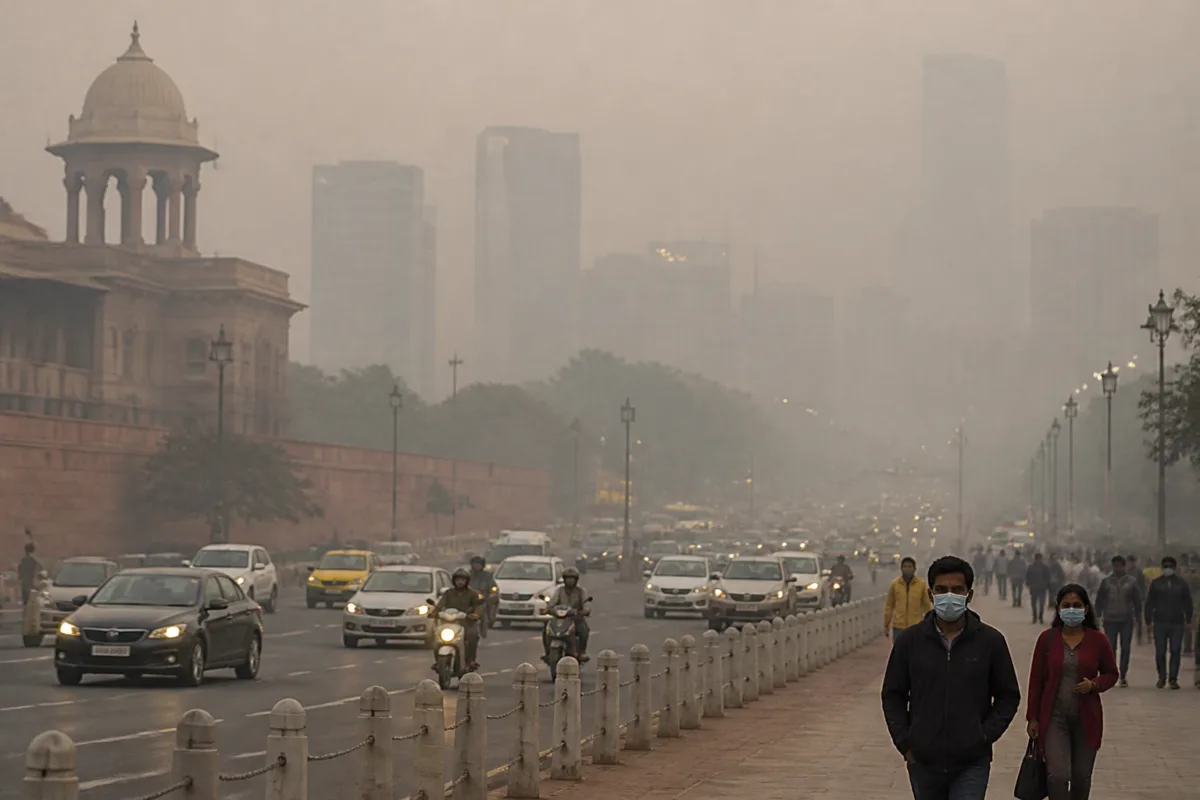
Delhi’s air pollution reached the severe category on Diwali, with the Central Pollution Control Board recording an AQI of 421 near AIIMS at around 7 am and readings close to or above 400 in other prominent parts of the city.
The AQI near India Gate stood at 398, while the area around the Akshardham temple recorded an AQI of 344. Under CPCB’s classification, readings between 401 and 500 fall in the severe category, while readings from 301 to 400 are classified as very poor.
The deterioration followed a day of already hazardous air quality across the capital. Delhi’s average AQI was recorded at 369 on Saturday, compared with 382 on Friday. Although the average improved marginally, it remained close to the threshold for the severe category.
The source reported that the air quality had worsened amid low visibility and dense smog on the eve of Diwali. Of the 59 monitoring stations in Delhi, 16 recorded air quality in the severe category on Saturday, while 29 stations reported very poor air. The highest station-level AQI was 452 near the Indian Institute of Technology, Delhi.
The worsening conditions coincide with the start of Diwali celebrations, when emissions from firecrackers can add to the pollution already generated by road traffic and regional sources. The source also cited the peak period of stubble burning in neighbouring states as a factor that could contribute to rising pollution levels.
Delhi’s air quality early-warning system had forecast that conditions could remain in the severe category on November 8 and 9. Its outlook for the following six days indicated that air quality could fluctuate between the severe and very poor categories.
The ability of the city’s atmosphere to disperse pollutants has also been limited by weather conditions. According to the early-warning system data cited in the report, a ventilation index below 6,000 square metres per second and average wind speeds below 10 kilometres per hour are restricting the effective dispersal of pollutants.
Weather and air-quality experts cited in the report attributed the deterioration to a combination of unfavourable meteorological conditions, vehicle emissions, Diwali-related activity and crop-residue burning in neighbouring states. These factors can overlap during the late autumn period, when weaker winds and limited atmospheric ventilation allow pollutants to remain concentrated near the ground.
The CPCB scale classifies AQI readings from zero to 50 as good, 51 to 100 as satisfactory, 101 to 200 as moderate, 201 to 300 as poor, 301 to 400 as very poor and 401 to 500 as severe. The latest readings place several monitored locations at the most serious end of that scale.
The early-warning system’s forecast indicates that Delhi’s air quality will be monitored through the next several days as weather conditions, local emissions and regional pollution sources continue to influence the city’s readings.

