


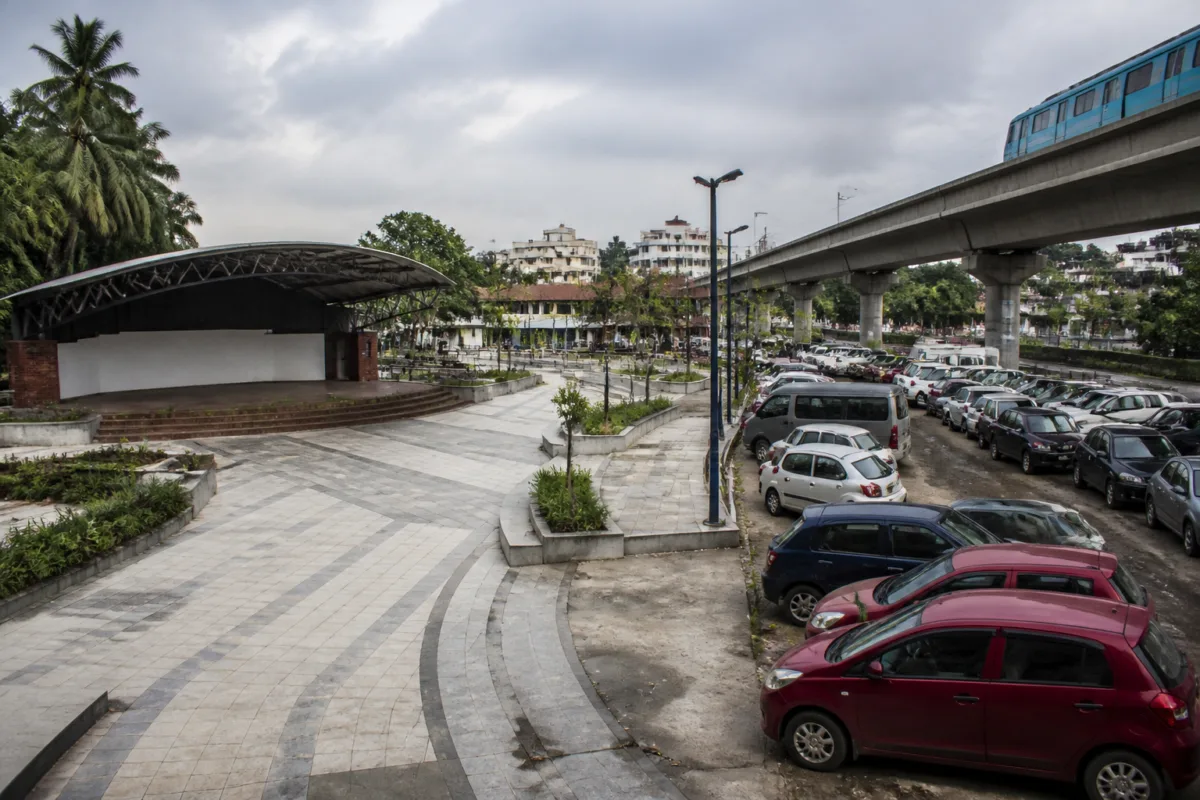
Kochi’s Metro and Water Metro networks were conceived as more than transport systems. Their surrounding open-air stages, walkways, cycle tracks, kiosks and other public amenities were intended to support urban renewal and create places where residents could gather. The current condition of several of these spaces reveals a difficult contradiction: infrastructure designed to improve public life is being left unused, poorly maintained or redirected towards commercial parking as transit agencies seek additional income.
The issue is not simply that a few facilities have failed to attract users. It is that the financial model of urban transport is beginning to shape the use of public land and civic infrastructure. Kochi Metro Rail Ltd (KMRL) and Kochi Water Metro Ltd (KWML) face high operating costs and loan repayments. At the same time, passenger numbers remain below initial projections, according to former mayor K J Sohan, increasing pressure on the agencies to find revenue outside fares. In that setting, a public stage or waterfront amenity can be treated less as a civic asset and more as a property capable of producing rent.
That shift is visible at Tripunithura Metro station, where a purpose-built open stage is reportedly used infrequently. Jayendran, identified in the report as a local resident or stakeholder, said the facility’s charges were too high for small users and argued that nominal fees could attract cultural programmes and community gatherings. The criticism points to a design and management problem rather than a lack of possible demand: a facility can technically be available while remaining practically inaccessible if its pricing, booking process or operating rules do not match the needs of local users.
A similar tension has emerged at Jos Junction. An open-air theatre owned by KMRL and developed for cultural programmes is being used for private parking, according to the report. Social activist Cheshire Tarzan described the commercial diversion as unacceptable and said activists planned to seek permission for a children’s programme at the venue on November 14. They also intended to submit a memorandum to the mayor, Greater Cochin Development Authority officials and elected representatives, seeking the transfer of the facility to Kochi Corporation. Councillors, Tarzan said, had assured activists that the matter would be raised at the next council meeting.
KMRL’s response explains why these spaces are vulnerable to such a change in use. The company said properties that generate income are legally rented or leased and that temporary parking at Jos Junction was tendered to secure steady revenue. It also said the location remains available for cultural bookings and public events on request. KMRL linked this approach to its responsibility to repay substantial project loans and interest, and said alternative revenue sources were essential to making the Kochi Metro network profitable.
This creates an important distinction between nominal availability and meaningful public access. If a space can be booked for an event, it has not formally disappeared from the public realm. But if regular use is discouraged by high charges, weak publicity, complicated permissions or the more dependable income from parking, the original public-purpose function can still erode. The result is a facility that remains publicly described as a cultural amenity but operates primarily as a commercial asset.
The Water Metro network presents a different version of the same problem. At the High Court terminal, eight food and beverage kiosks remain unopened. The report attributes the delay to unresolved arrangements involving KWML, the Greater Cochin Development Authority and Kochi Corporation. The disagreement concerns tax payments, building certificates and revenue sharing. A senior GCDA official said the corporation had insisted on tax payment and had declined to provide building certificates without a revenue-sharing agreement with KWML. The official said the matter would be discussed at the next council meeting and that the agreements would then be entered into.
The closed kiosks show how public-space activation depends on institutional coordination beyond the transport operator itself. A terminal may be physically complete, but its supporting economic and social functions cannot begin until responsibilities are settled. Taxation, approvals, revenue allocation and building documentation are administrative details, yet they determine whether passengers encounter a lively public destination or an unfinished edge around a transport facility.
Fort Kochi demonstrates another aspect of the challenge. Public spaces connected to the Water Metro remain idle for much of the year outside the Kochi-Muziris Biennale period, according to the report. A former Water Metro official said early plans sought to draw on international transit hubs such as Brussels and Paris by encouraging street performances and art exhibitions. The comparison is less about copying a foreign model than about recognising that transport infrastructure can also provide a platform for public activity, local culture and informal urban interaction.
The evidence supplied in the report does not establish how many passengers use each facility, what the approved charges are, how frequently cultural bookings are requested or how much revenue parking generates. Those gaps matter because they prevent a direct comparison between the financial returns from commercial use and the social value of keeping the spaces active. They also make it difficult to determine whether underuse results mainly from pricing, management, location, programming, permissions or insufficient demand.
What is clear is that the original planning logic has come under pressure. The spaces were intended to complement mass transit by making stations and terminals more attractive, accessible and integrated into city life. Open stages, walkways and cycle tracks are not independent decorative additions. They influence how residents approach stations, how long they stay, whether local events can use the area and whether a transport node becomes part of its neighbourhood rather than an isolated piece of infrastructure.
The institutional structure complicates that objective. KMRL controls or manages some Metro-linked properties, while KWML, GCDA and Kochi Corporation have overlapping roles around Water Metro facilities. The High Court terminal dispute shows that ownership, approvals, taxation and revenue sharing can become barriers to activation. At Jos Junction, the proposal to transfer the facility to the corporation reflects a broader question: should a transport agency remain responsible for managing public cultural spaces, or should municipal institutions take over once the infrastructure is created?
There is no simple answer in the supplied evidence. Municipal control could align the spaces more closely with local programming, but it could also introduce another layer of administrative responsibility. Retaining them with transit agencies may preserve a direct connection to station planning, but revenue obligations can make commercial use more attractive. The central issue is therefore not only ownership. It is whether the operating framework gives public use a defined priority, affordable access and a clear budget rather than treating it as an optional activity after revenue targets are met.
Sohan’s criticism captures the financial contradiction. He argued that public spaces were created to improve urban life, preserve heritage and encourage community activities, but were later diverted for other purposes in the name of revenue generation. He also said revenue should come from passenger ridership, while acknowledging that lower-than-projected passenger numbers had forced operators to depend more heavily on alternative income. The report does not provide the projections, actual ridership figures or debt-servicing amounts, but the institutional pressure is evident in the statements from both critics and KMRL.
This is the larger urban question raised by Kochi’s experience: how should public transport projects account for the civic functions they are expected to perform? A station plaza, cultural venue or waterfront kiosk may not generate fare revenue, yet it can support the broader purpose of making transit useful, visible and socially embedded. If such facilities are assessed only through immediate financial returns, their non-financial contribution to urban life can disappear from decision-making.
The immediate developments to monitor are the next Kochi Corporation council discussion on the Jos Junction facility, the proposed November 14 children’s programme, and the agreements required to open the High Court terminal kiosks. These decisions will indicate whether Kochi’s Metro and Water Metro public spaces are managed as active civic infrastructure or continue to move between public-purpose planning and short-term commercial use.

