


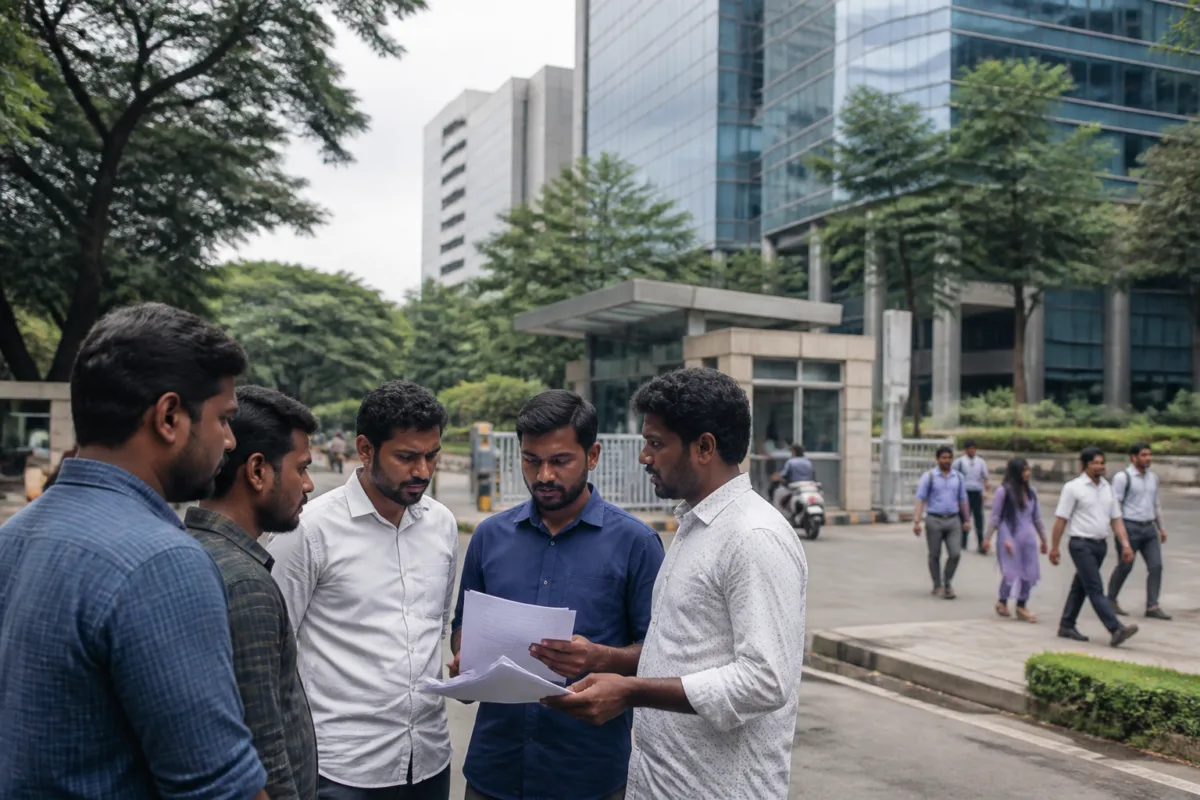
The Karnataka Rakshana Vedike’s Agraha Abhiyana has turned a long-running grievance about local access to Bengaluru’s economic growth into an organised information-gathering campaign. Since its launch on November 1, KRV teams have visited more than 400 companies, including IT firms, banks and hospitals, seeking details about workforce composition, recruitment practices and the representation of Kannadigas.
The campaign is significant not only because of the number of establishments being approached, but because it places a difficult urban question before the state: how should a city that has become a national and global employment centre distribute the benefits of that growth among its local population? The answer is not straightforward. It involves questions of skills, language, birthplace, identity, privacy, corporate recruitment systems and the responsibilities of a state government that has promoted Bengaluru as an investment destination.
KRV president T A Narayana Gowda told Deccan Herald that around 300 IT companies in Bengaluru had received memorandums within the first three days of the campaign and that the exercise would extend to all 31 districts. Each team comprises around 10 members, and the organisation has said that major establishments beyond the technology sector will also be covered.
KRV has claimed that preliminary information gathered by its teams shows Kannadigas forming between 7% and 8% of the workforce in some companies, while their representation in most establishments is allegedly between 18% and 20%. These figures remain claims made by the organisation; the report does not provide an independently audited dataset, a methodology for calculating the percentages or a common definition of who qualifies as a Kannadiga.
That lack of a clear measurement framework is central to the debate. Workforce representation can be assessed through several possible indicators, including place of birth, domicile, language, family origin or education in Karnataka. These categories do not necessarily produce the same result. An employee may be born outside Karnataka, raised in the state and fluent in Kannada. Another may be born in Karnataka to migrant parents but identify differently. The campaign’s demand for workforce information therefore raises a data question before it becomes a quota question: what exactly is being counted?
A senior official at a multinational company, quoted by Deccan Herald, questioned whether companies possess the information KRV is seeking in a usable form. The official also cited employee contracts restricting the sharing of personally identifiable information and asked whether a Kannadiga would be identified by language or birthplace. These concerns point to a structural tension between public demands for transparency and the private-sector rules governing employee data.
Companies may be asked to demonstrate whether their recruitment practices exclude local candidates, but employee records are not automatically designed to answer questions about regional representation. If businesses are required to disclose such information, the government would need to establish the legal basis, the categories to be used, the safeguards for personal data and the authority responsible for assessing the results. The supplied report does not indicate that such a framework currently exists.
The campaign also exposes the limits of treating Bengaluru’s employment debate as a simple conflict between local residents and outside workers. The city’s technology economy has developed as a multicultural labour market, and an IT firm director cited in the report warned that employment concerns could create perceptions of linguistic or regional divisions inside workplaces. At the same time, activists argue that Bengaluru’s emergence as a global technology hub has not translated into proportionate opportunities for Kannadigas.
Both positions reflect the way the city has grown. Bengaluru’s expansion has been powered by a large concentration of technology companies and other service-sector employers, but that growth has also intensified pressure on housing, transport, land and public infrastructure. KRV’s argument is that companies benefiting from Karnataka’s land, infrastructure and resources should respond to local employment aspirations. This frames hiring as part of the broader social contract of urban growth rather than as an internal corporate matter alone.
The policy history adds another layer. Activists have pointed to the recommendations of the Sarojini Mahishi Committee, which proposed measures to improve employment opportunities for locals in government, public-sector and private establishments. According to the report, these recommendations have not been implemented. The current campaign is therefore presented by Kannada organisations as part of a longer struggle for regional representation, rather than as a response only to recent political statements.
The state government’s position, as described in the report, has been cautious. Deputy Chief Minister D K Shivakumar acknowledged complaints that Kannadigas were being overlooked in Bengaluru’s IT sector but also appealed to Kannada organisations not to visit companies directly or take the law into their own hands. His intervention places responsibility for addressing the grievance with the government, while drawing a boundary around direct pressure on private establishments.
That boundary matters because the campaign is taking place at the workplace level. Memorandums and information requests can remain part of a civic debate, but visits by activist teams can also create uncertainty for employees and employers if the purpose, authority and limits of the exercise are unclear. The report says companies had not filed complaints with the police at the time of publication, according to Bengaluru City Police Commissioner Seemant Kumar Singh. It also records industry concerns that confrontational visits could prompt companies to approach the police.
There is a recent precedent for this risk. The 2023 signboard agitation showed how a campaign around a legitimate policy demand could escalate into vandalism and arrests. The current campaign has been described as more organised and measured by industry representatives, but KRV has also warned that protests could spread if the government does not take positive action. The difference between an information-gathering exercise and disruptive mobilisation may therefore depend on how the state responds and whether a formal channel for engagement is created.
The campaign’s reach beyond technology companies is also important. Banks, hospitals and other major establishments employ large numbers of people and are closely tied to everyday urban life. Yet each sector has different recruitment systems, qualification requirements and regulatory conditions. A common regional representation formula may not capture these differences. The report provides no evidence that the same alleged employment pattern applies across IT companies, banks, hospitals and other establishments.
The central institutional gap is that the grievance has political visibility but no clearly established administrative process. KRV plans to compile the information it gathers and submit a report to the government. The organisation has said it will give the government time to take policy action before considering widespread protests. What remains unclear is whether the state will treat the proposed report as evidence, commission its own study or develop a formal mechanism to examine recruitment outcomes without exposing individual employee information.
The debate also tests how Karnataka defines local employment in a city shaped by migration. A policy based on domicile, language or birthplace would have different consequences for workers and employers. It could also create uncertainty for people whose connections to the state do not fit a single category. The questions raised by the MNC official are not merely technical objections; they point to the difficulty of translating a cultural and political identity into an enforceable employment classification.
For Bengaluru, the larger issue is not whether local employment concerns exist. The supplied report records complaints from political leaders and activists, while also documenting industry claims that major technology companies recruit on the basis of skills and merit. The unresolved question is how those competing claims can be tested through transparent evidence rather than mobilisation, assumption or anecdotal experience.
KRV’s campaign has made that question impossible to ignore. It has also shown that the distribution of economic opportunity is becoming part of Bengaluru’s infrastructure debate, alongside transport, housing and public services. The next decisive step will be the government’s response to the organisation’s proposed report, including whether it can establish credible definitions, protect personal data and assess regional representation without allowing workplace visits to become a substitute for public policy.

