


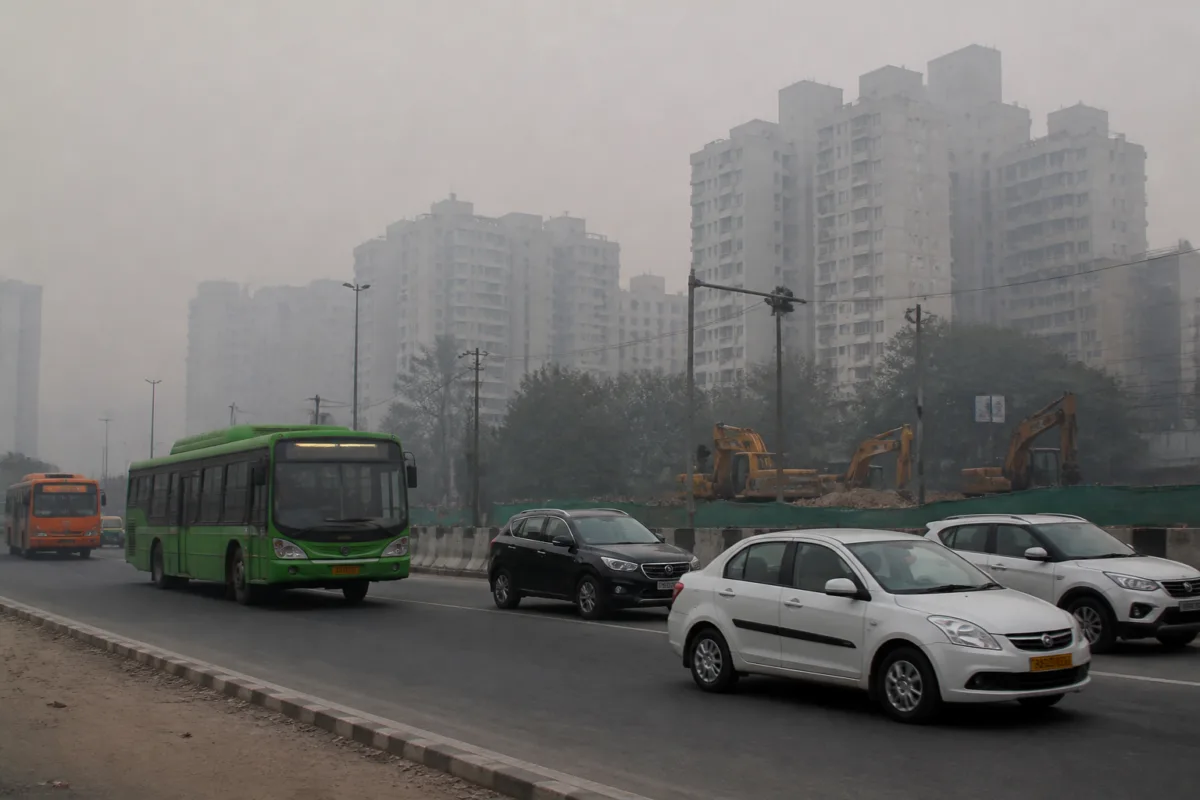
GRAP-3 restrictions have moved Delhi-NCR from broad pollution-control measures to a more disruptive phase in which vehicle access, construction activity, school operations and workplace arrangements can all change. The Commission for Air Quality Management, or CAQM, imposed the third stage after rising air pollution, with the framework linking GRAP-3 to an air quality index between 401 and 450. GRAP-2, which was imposed earlier, remains in force alongside it.
The significance of the escalation lies in how it reaches beyond pollution-monitoring stations and into the daily functioning of the region. A restriction on an older vehicle affects commuting and freight. A construction halt affects project schedules and workers. Hybrid schooling changes how families organise childcare and travel. Work-from-home provisions, where adopted, alter office attendance and peak-hour movement. GRAP-3 is therefore not a single prohibition but a temporary operating framework for a large, interconnected urban region.
The revised framework for Delhi-NCR, referred to in the report as having been issued by CAQM on 29 September 2026, sets out the additional measures that apply when the region moves from GRAP-2 to GRAP-3. The structure is cumulative: measures under the earlier stage continue, while further controls are added as pollution worsens. This is important because residents do not move from one isolated rulebook to another. The restrictions already operating under GRAP-2 remain relevant when GRAP-3 is activated.
The sharpest mobility impact under the third stage is on older private light motor vehicles. BS-III petrol and BS-IV diesel four-wheelers, or vehicles older than those standards, face restrictions on roads across Delhi-NCR, according to the report. The framework provides an exemption for vehicles belonging to persons with disabilities when the vehicles have been modified for their use and are being used only for private purposes.
The commercial vehicle provisions extend the intervention beyond private commuting. Delhi-registered BS-IV and older diesel medium goods vehicles are restricted from operating on the roads. BS-IV and older diesel medium goods vehicles registered outside Delhi are not permitted to enter the capital. The entry of older diesel light goods vehicles registered outside Delhi is also restricted. These rules place the burden of compliance on both vehicle owners and the region’s freight system, even though the supplied material does not quantify the number of vehicles affected.
The distinction between private and commercial traffic is significant for the way Delhi-NCR functions. Private vehicle restrictions influence individual travel choices, while goods-vehicle controls affect the movement of supplies between the capital and neighbouring parts of the National Capital Region. The report establishes the categories covered by the restrictions, but it does not provide details of enforcement levels, penalties, diversion routes or the expected duration of the measures. Those details will determine how the rules are experienced on the ground.
Construction is the other major urban activity affected by GRAP-3. The stage calls for a complete halt to construction and demolition work, with an important qualification: not every form of construction is automatically stopped. Activities that generate less pollution or less dust may continue. This distinction matters because the construction sector contains a wide range of operations, from demolition and earthwork to activities with relatively limited dust generation. The report does not list every exempt activity, leaving project-level interpretation and enforcement important to the outcome.
The change from GRAP-2 to GRAP-3 is not simply a stronger version of the same construction rule. Under GRAP-2, construction and demolition sites are expected to implement dust-control measures. Under GRAP-3, the default position becomes a halt to covered work, subject to the framework’s provisions for lower-pollution activities. That changes the responsibility of project authorities from demonstrating dust control at an active site to determining whether the work can continue at all.
For the built environment, the effect is operational as well as environmental. Construction schedules, demolition plans and material movement can be interrupted, but the supplied report does not establish how long the restrictions will last or how projects will account for the pause. It does, however, show the policy tension at the centre of emergency air-quality management: the same construction activity that supports housing and infrastructure can become a source of dust during severe pollution episodes.
Schools face a different type of adjustment. Under GRAP-3, classes for students up to Class 5 are to be conducted in hybrid mode in Delhi-NCR where online teaching is possible. Schools can therefore combine physical and online classes rather than shifting automatically to a fully remote system. The arrangement recognises differences in institutional capacity, because the provision applies where online classes can be offered. The report does not specify how schools will assess that capacity or how attendance, examinations and families without reliable digital access will be handled.
The school provision also demonstrates that pollution control is being treated as a public-health and mobility issue, not only as an environmental one. Reducing the number of younger children travelling to school can limit exposure and daily movement, but hybrid education also transfers part of the adjustment to households and schools. The supplied material records the policy provision but does not establish its implementation across individual districts or institutions.
Workplace arrangements under GRAP-3 are similarly framed as a decision for authorities rather than an automatic private-sector shutdown. Delhi and NCR governments are required to consider arrangements in which 50 per cent of staff in government, municipal and private offices work from home and the remaining 50 per cent attend in person. The report states that this is not mandatory for private companies. The Centre may take a separate decision for its offices in Delhi-NCR.
This division of authority is central to understanding the framework. CAQM activates the pollution-response stage, but several consequences depend on decisions by Delhi, NCR state governments, municipal bodies, the central government, schools and private employers. The result is a layered administrative system in which the same GRAP stage can produce different workplace and school arrangements depending on the institution involved. The report does not indicate which authorities have issued specific office orders after the latest escalation.
Public transport does not face a separate new restriction under GRAP-3, according to the report. Restrictions under GRAP-1 continue to apply, while the material does not identify a new GRAP-3 prohibition on public transport services. This creates an important difference between private mobility and shared transport: older private and commercial vehicles face specified controls, while public transport remains outside the additional GRAP-3 restrictions described in the report.
That distinction makes the availability and reliability of public transport particularly relevant to how residents experience the escalation, although the supplied source provides no information on service frequency, capacity or ridership. It also shows why pollution emergency plans can have uneven effects. A resident with access to a compliant vehicle, a nearby transit service or a job that permits remote work may face a different set of constraints from someone dependent on an older vehicle, site-based employment or a school that cannot provide online classes.
The move to GRAP-3 ultimately reveals the limits of treating air pollution as a single-sector problem. The formal trigger is an air-quality range, but the response operates through transport regulation, construction controls, school administration and employment arrangements. Each measure is managed by different institutions and affects different groups. The supplied report confirms the rules and their broad implications, but not the compliance data, enforcement record or pollution reduction achieved after implementation.
For now, the immediate urban question is how consistently the restrictions are translated into operational orders. The framework provides the escalation from dust-control measures to construction stoppages, from normal school attendance to hybrid provision for younger children, and from regular office attendance to possible 50 per cent work-from-home arrangements. The next developments to monitor are the decisions of Delhi-NCR governments, municipal bodies, schools, employers and the central government, along with any subsequent CAQM direction on continuing or withdrawing GRAP-3.

