


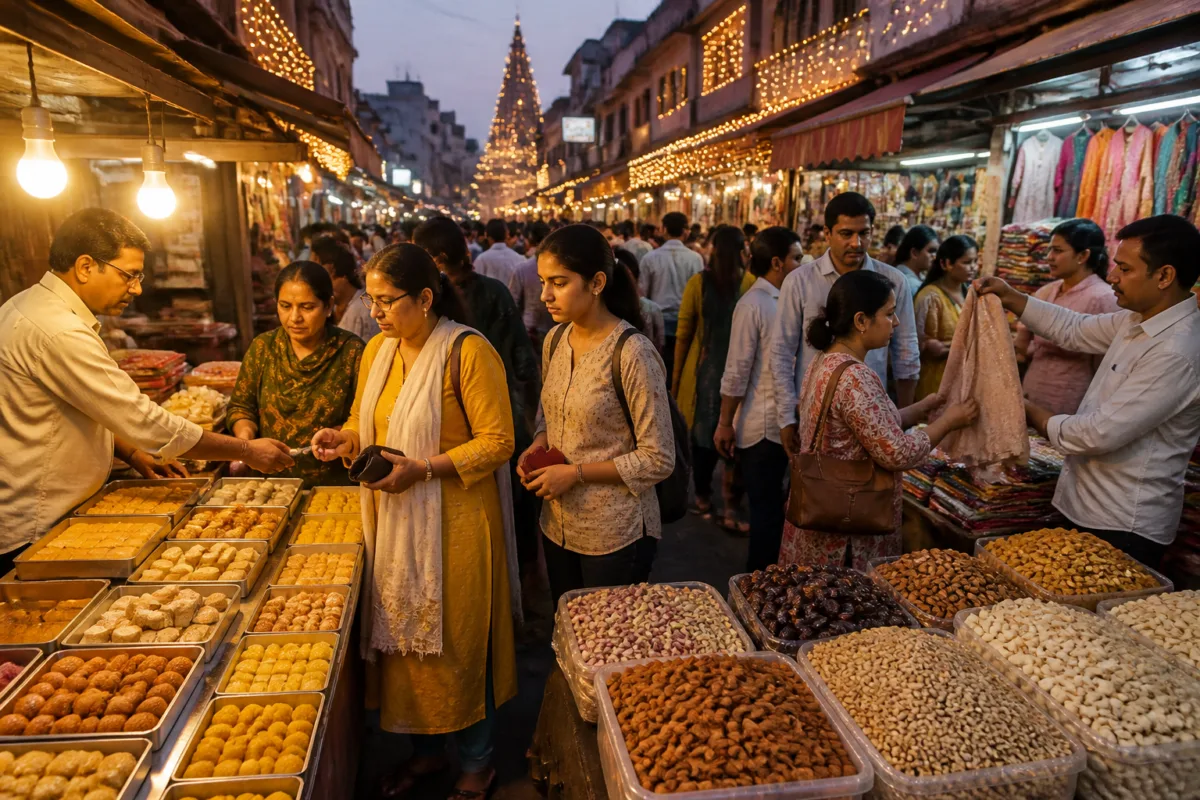
Pune’s Diwali markets are crowded, but the spending pattern behind the crowds is changing. Traders across sweets, clothing, jewellery, two-wheelers and appliances have reported weaker demand, with sales in some categories down by 20 to 30 percent compared with last year. The evidence in the report points to a festival economy under pressure: households are still spending, but they are comparing prices more closely, reducing quantities, postponing large purchases and relying increasingly on savings.
That distinction matters for understanding Pune’s urban economy. A busy market does not necessarily indicate strong consumption. Last-minute shoppers may create visible footfall while purchasing less, choosing lower-priced alternatives or moving between stores before making a decision. For retailers, the result can be a marketplace that appears active but produces lower volumes and weaker margins.
The report cites a survey that projects festive spending to fall by 6 percent, from Rs 2.2 lakh crore in 2025 to Rs 1.97 lakh crore this year. Average household spending is expected to remain around Rs 20,000, while nearly 85 percent of households are expected to use savings for Diwali purchases. More than 30 percent of families are reportedly planning to avoid discretionary purchases altogether.
These figures describe a form of financial caution rather than a complete withdrawal from consumption. Families continue to prioritise clothing, travel and selected household purchases, but the order of priorities has changed. Spending is being directed towards items and experiences that households consider important, while upgrades and other non-essential purchases are being deferred.
The pressure is especially visible in products associated with festive gifting. The report says appliance prices have risen by 4 to 7 percent and sweets by 16 percent. Dry fruits have recorded sharper increases, with almond prices rising from about Rs 800 per kg last year to Rs 1,200 this year, according to Kantilal, a sweet shop owner quoted in the report. Pistachio prices, he said, had increased from around Rs 1,000 per kg in 2025 to Rs 2,200 this year.
For sweet shops, the effect is not limited to the cost of ingredients. Higher input prices force businesses to choose between passing the increase on to customers, reducing product quantities or accepting lower margins. Kantilal told the publication that his sales had declined by 25 to 30 percent and that customers were moving from one shop to another in search of better prices.
The same price sensitivity is visible in clothing markets. Hasan Rajputwala, a cloth shop owner, said the price of grey cloth had increased from Rs 70 per metre to Rs 100. He also described a shift in purchasing behaviour: customers who traditionally bought fabric weeks before Diwali and had it stitched by tailors are increasingly choosing ready-made garments.
That change has implications beyond individual retail counters. A move from tailored clothing to ready-made purchases changes how festive demand moves through the city’s economic network. Tailors and small stitching businesses may receive fewer orders even when clothing remains one of the most popular spending categories. The report cites survey data showing that 71 percent of respondents were interested in festive clothing and fashion purchases, but strong interest did not necessarily translate into the same kind of local spending as in previous years.
Gold jewellery has also been affected. Anjali Kakde, a salesperson at a jewellery store on Laxmi Road, said gold sales had fallen by around 20 to 30 percent, while prices had increased marginally. Jewellery is often treated as both a festive purchase and a form of household saving, but higher prices can make buyers postpone purchases or reduce the quantity they buy.
The two-wheeler market presents a different combination of pressures. Anup Tendwani, a manager at a showroom near Pune railway station, said sales were lower than last year. He pointed to the timing of the festivals as one factor: Dussehra and Diwali had fallen in the same month last year, supporting sales, while the festivals are spread out this year. He also cited increases of around 6 to 7 percent in petrol prices and two-wheeler rates.
This account shows why year-on-year comparisons need context. A fall in sales may reflect not only household affordability but also the timing of festivals, the distribution of promotional periods and the sequencing of major purchases. For dealerships and other businesses, the calendar can alter demand even when the broader economy remains unchanged.
Appliances show another important pattern: revenue can remain stable even when the number of products sold falls. Prasad Shrigoad, a manager at an appliances showroom near Pune railway station, said the store had met its monetary target but sold fewer units. He attributed this partly to higher prices, including increases in air-conditioner prices. He also said some television brands had revised prices and that premium smartphone prices had affected spending.
This divergence between value and volume is central to reading the market correctly. If businesses maintain revenue because each product costs more, the result should not automatically be interpreted as stable demand. Households may be buying fewer refrigerators, air-conditioners, televisions or phones while paying more for each purchase. For consumers, that represents a reduction in quantities and choice even when headline sales revenue appears unchanged.
The report also connects consumer sentiment to uncertainty surrounding the war in West Asia. Shrigoad said the uncertainty and panic had affected buying decisions. The article does not establish the precise scale of that effect, but the observation is consistent with the broader pattern described by traders: households are reluctant to commit to purchases that can be postponed.
Travel is the major exception to the slowdown in conventional festive shopping. According to a Business World survey cited in the report, spending on Diwali holidays has risen by 60 percent, with average expenditure on a festive trip increasing to about Rs 55,000 from Rs 35,000 in 2024. The report says 46 percent of households are planning holiday-related spending, making travel the second most preferred category after clothing and fashion.
This does not necessarily mean that households are becoming more generous with their budgets. It suggests that the composition of festive spending is shifting. Consumers may be avoiding a new appliance or reducing the size of a purchase while continuing to spend on travel, family visits or experiences. The report says budget hotel bookings have risen by 200 percent, indicating that some travellers are trying to preserve the trip while reducing accommodation costs.
Travel demand also has a strong connection to the geography of Indian cities. Increased bus bookings point to continued movement from Pune and other urban centres to hometowns during the festival period. The report says bookings from Pune have risen by more than 75 percent, while bookings from Delhi have increased by 79 percent and those from Mumbai by 58 percent. These figures are attributed to the report and its cited sources; the supplied material does not provide the underlying booking base or methodology.
The travel pattern therefore combines two forms of mobility: trips for family reunions and trips for leisure. Group travel reportedly accounted for 65 percent of October bookings, while international holidays made up 40 percent of travel preferences. Bangkok was identified as a leading overseas destination, and Udaipur, Goa and Jaipur were listed among popular domestic destinations. The report also notes a 130 percent rise in flight bookings to Agatti in Lakshadweep.
Taken together, the reported trends show a selective rather than uniform contraction in festive demand. Products whose purchase can be delayed are facing pressure. Categories linked to clothing, family movement and experiences continue to attract buyers, although customers are also seeking lower-cost options. The difference is important for Pune’s retail and service economy because it determines which businesses receive money and which parts of the local consumption chain lose income.
The dependence on savings is the most significant structural concern in the report. Nearly 85 percent of households are expected to draw on accumulated savings for Diwali purchases, and for 35 percent of these households, savings will cover only about 25 percent of festive expenditure. The figures do not establish whether households will face financial stress after the festival, but they indicate that current consumption is not being funded entirely by regular income.
For local businesses, this creates uncertainty after the festive period. Retailers may record strong footfall during the final days before Laxmi Pujan while still experiencing lower sales volumes. Travel operators may benefit from higher bookings even as hotels and transport providers compete on affordability. Tailors, jewellery stores, appliance dealers and vehicle showrooms may experience different effects from the same inflationary environment.
The central evidence supports a cautious conclusion. Pune residents are not abandoning Diwali spending, but they are reallocating it. Price increases have reduced the quantity that household budgets can buy, while uncertainty has made postponement more attractive. At the same time, travel and family-related mobility remain resilient, particularly where consumers can control costs through group bookings, budget accommodation or selective purchases.
What remains unclear from the supplied report is how these reported changes compare across Pune’s income groups, neighbourhoods and formal and informal markets. The cited surveys also do not provide their full methodologies in the available material. Even so, the market accounts offer a clear urban signal: festive consumption remains active, but household purchasing power is being expressed through smaller baskets, delayed upgrades and tighter control over savings.

