


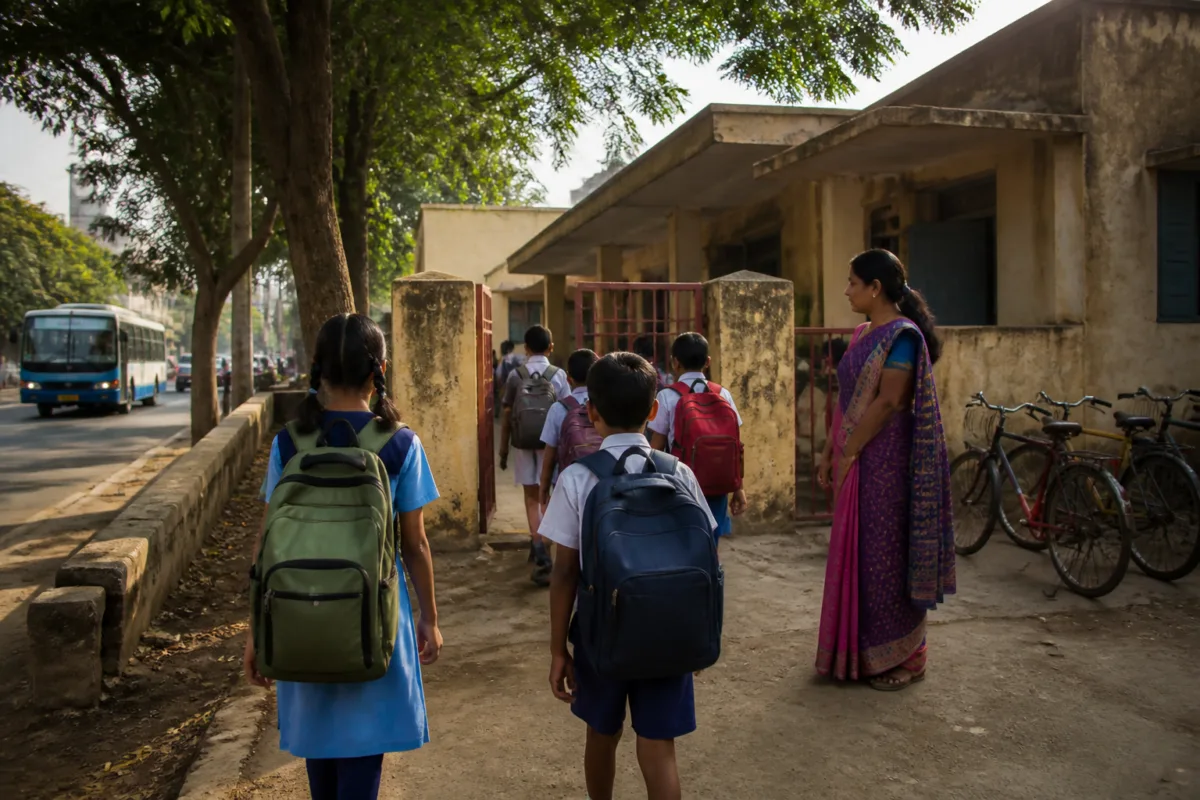
Government schools in Karnataka have come under renewed scrutiny after writer S.G. Siddaramaiah criticised the reported practice of associating state-run schools with private institutions, warning that it could weaken Kannada-medium education and the language’s position in public administration.
Siddaramaiah made the remarks at an awards ceremony organised by the Kannada Sahitya Parishat and the Bengaluru Metropolitan Transport Corporation on Friday. He said the government was committing a serious injustice to Kannada by linking government schools with private organisations.
He also questioned the impact of Karnataka Public Schools on the availability of Kannada schools. According to Siddaramaiah, Kannada schools were being reduced through the Karnataka Public Schools model, while the transfer of government schools to private organisations was not appropriate.
He argued that the future of Kannada as an administrative and state language depended partly on its presence in primary education. “If Kannada does not survive in primary schools, it will not survive as the language of administration either,” he said, according to the report.
Siddaramaiah said the government still had time to protect Kannada schools and urged it to act on the recommendations of a committee appointed in 2017 to examine the strengthening of government schools. The report did not provide details of the committee’s recommendations or specify the number of schools affected by private associations or the Karnataka Public Schools programme.
The remarks place the debate over school management within a wider question of how Karnataka delivers public education in growing cities such as Bengaluru. Government schools are not only education facilities; they are also publicly funded neighbourhood institutions that serve families who depend on accessible schooling. Any change in their management or language structure can therefore affect how communities access primary education, although the report did not record a government response to Siddaramaiah’s criticism.
Transport Minister Byrathi Suresh, who presented the awards, spoke at the same event about Karnataka’s social and cultural openness. He said people arriving from other states and countries were attracted by the state’s culture, values and hospitality, and that Kannada society had developed an inclusive outlook.
The event combined the presentation of the Nrupatunga Literary Awards for 2023, 2024 and 2025 with the Mayuravarma Literary Awards. Siddaramaiah, Moodnakoodu Chinnaswamy and Sarjoo Katkar received the Nrupatunga awards for the respective years. Several other writers were presented with the Mayuravarma awards.
Chinnaswamy also described public buses as symbolic of equality in a secular country, saying passengers from different social and economic backgrounds travel together without separate seating arrangements based on caste or class. His comments connected the public transport system with the broader idea of shared civic institutions.
No new government order or policy change was announced at the event. The immediate issue raised by Siddaramaiah is whether the state will review the implementation of its government-school strengthening measures and consider the 2017 committee’s recommendations, particularly in relation to Kannada-medium primary education.

