


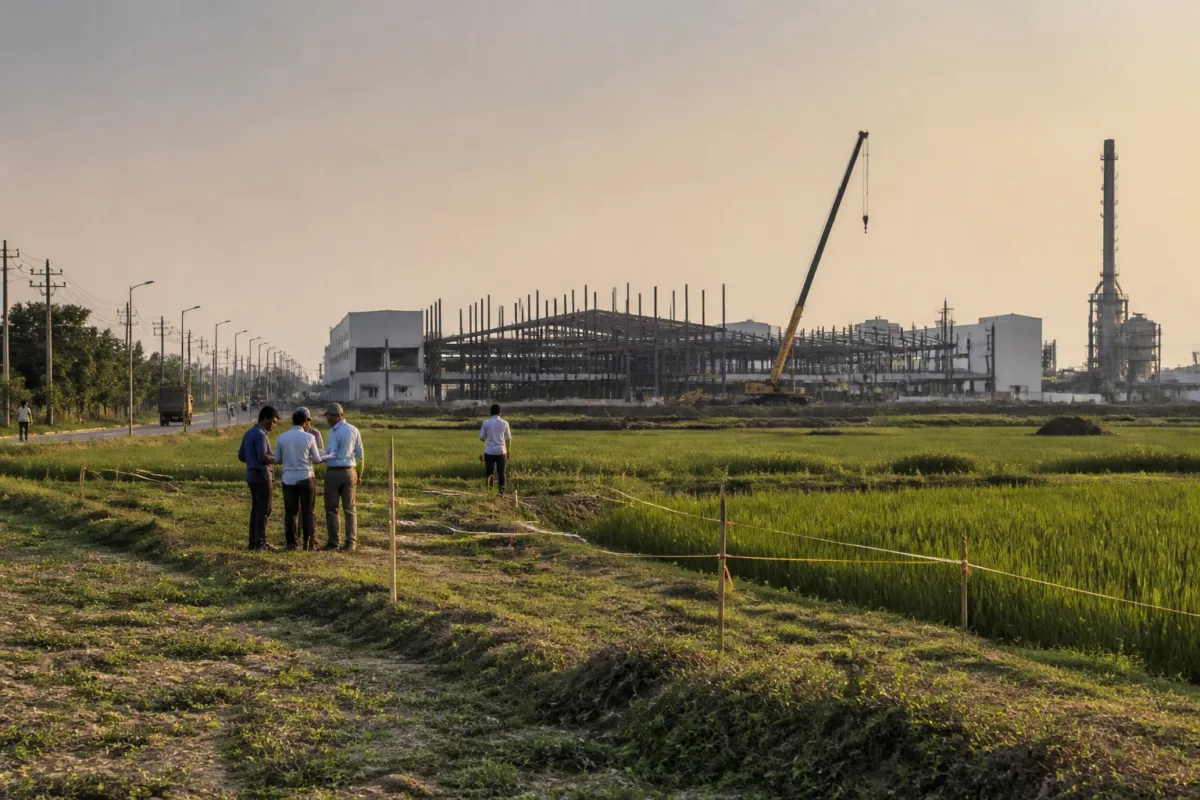
West Bengal chief minister Suvendu Adhikari has signalled a new approach to industrial land in Bengal, saying the government will purchase land for companies without using force, while disclosing that talks are under way with Ashok Leyland over Singur. The remarks were made on Thursday at the unveiling of the state’s new investment promotion policy.
“We will do something about Singur. Talks are on with Ashok Leyland,” Adhikari said in response to a question about the site that became the centre of Bengal’s anti-land-acquisition movement nearly two decades ago. He said the government would not use police to forcibly acquire land or permit violence, but would purchase land itself for industrial projects.
The chief minister said the state was in discussions with HUDCO, NABARD and the Asian Development Bank for funds to buy land. He also said the government had handed over land to companies in Panagarh and Haringhata, while officials were examining land-purchase, land-pooling and development policies followed by Andhra Pradesh, Gujarat, Maharashtra and Uttar Pradesh.
The 34-page investment promotion policy released by the Bengal government does not specifically mention land, although land availability has been one of the most contentious issues in the state’s industrial expansion efforts. The Left Front government’s forcible acquisition drive at Singur and Nandigram helped trigger a political backlash, while the subsequent administration largely left industrial land purchases to private companies.
Adhikari said the government had, over the previous six months, facilitated land arrangements for 33 business groups, including Amul, Vedanta Group, Campa Cola and Reliance, for new plants or expansions. He also referred to arrangements for proposals involving the Sanjiv Goenka Group in Haldia and the recovery of plots belonging to closed industrial units in the Barrackpore industrial belt.
The chief minister said Bengal could facilitate investments worth around Rs 1 lakh crore over the next few months. However, he also said the financially constrained state government was not currently in a position to clear industrial incentive dues estimated at Rs 50,000 crore. He attributed the accumulation of the dues to the previous government’s failure to clear between Rs 7,000 crore and Rs 8,000 crore annually, and said the state could consider settling them only after becoming financially surplus.
The proposed land-purchase role marks a departure from the hands-off position associated with the years after the Singur movement. It also places the government between private companies seeking industrial sites and landowners whose consent and compensation remain central to any acquisition or pooling process. The policy’s success will therefore depend not only on identifying land, but also on financing purchases, securing clearances and completing transfers without reviving the conflict associated with earlier acquisition attempts.
Sidharth Pansari, managing director of Primarc and former president of CREDAI Bengal, described the investment policy as a positive move. He said additional industries could create jobs and increase demand for homes, offices, retail spaces and supporting infrastructure beyond Kolkata, particularly in emerging growth centres across the state. He also said easier land availability and faster clearances could support investment and real estate development.
Ajay Jain, chairman of the board of IIM Calcutta Innovation Park, said the policy’s provisions for research and development could strengthen connections between academic research, technological innovation and industrial applications. He said support for industry-led research and start-up commercialisation could help create more technology-driven enterprises in West Bengal.
The government’s next steps include continuing discussions with potential investors, studying land policies in other industrial states and pursuing financing discussions with HUDCO, NABARD and the Asian Development Bank. The proposed engagement over Singur will be closely watched as Bengal attempts to expand industrial land availability without returning to compulsory acquisition.

