


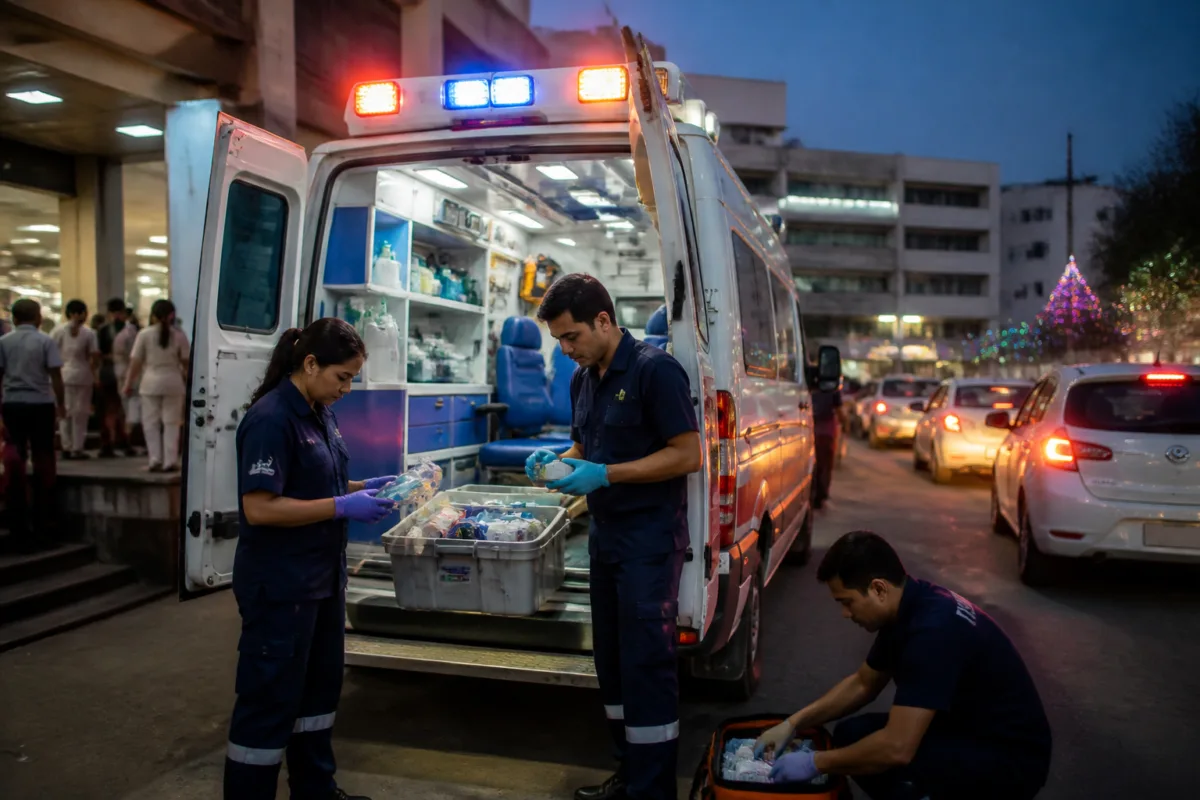
Gujarat’s 108 Emergency Medical Services has placed its statewide ambulance network on high alert for Diwali after forecasting a sharp rise in emergency cases between 8 and 11 November 2026. More than 6,000 emergency incidents are expected on each of the three key festival days, with road accidents, burns and physical assault cases projected to increase substantially over normal daily levels.
The service expects 6,111 emergency cases on Diwali, 8 November, representing a 16.44% increase over the average of 5,248 cases recorded on ordinary days. The forecast rises to 6,776 cases on New Year’s Day, 10 November, a 29.12% increase, and 6,453 cases on Bhai Beej, 11 November, up 22.96%.
Road accidents are expected to account for a significant share of the additional emergency demand. Against an average of 646 vehicle accident cases on normal days, 108 has projected 1,216 cases on Diwali, an increase of 88.24%. The forecast rises to 1,556 cases on New Year’s Day, up 140.87%, and 1,016 cases on Bhai Beej, up 57.28%. Two-wheeler accidents are expected to form the largest share of these incidents.
Burn-related emergencies are also expected to rise sharply during the festival. The service has projected 73 burn cases on Diwali, compared with an average of 11 on normal days, an increase of 563.64%. Physical assault cases are forecast to rise from an average of 204 to 567 on Diwali, an increase of 177.94%, and to 570 on New Year’s Day.
The 108 service has prepared a fleet of 1,494 ambulances to handle the expected rise in demand across Gujarat. Its emergency response centre has introduced a zero-leave arrangement and restricted weekly leave for staff, with duty rosters being implemented for the festival period. Field staff have been deployed at hospitals, while ambulances have undergone pre-service checks and additional stocks of medicines have been arranged.
The service’s current average response time is 12 minutes and 53 seconds. Residents can contact 108 for emergency medical assistance and can also use the Dial-112 Janrakshak service when required.
The forecast identifies Anand, Aravalli, Banaskantha, Bharuch, Dahod, Gir Somnath, Kutch, Morbi, Narmada, Panchmahal, Porbandar, Surat, Vadodara and Valsad as districts where emergency cases could be higher than usual. The expected peak period is between noon and 11 pm, with particularly high demand projected from 8 pm to 11 pm on Diwali night and from midnight to 5 am.
The chief operating officer of Gujarat’s 108 Emergency Medical Services advised residents to exercise caution while driving, using fireworks and consuming food during the festival. The service has asked people to call 108 without delay in an emergency.

