


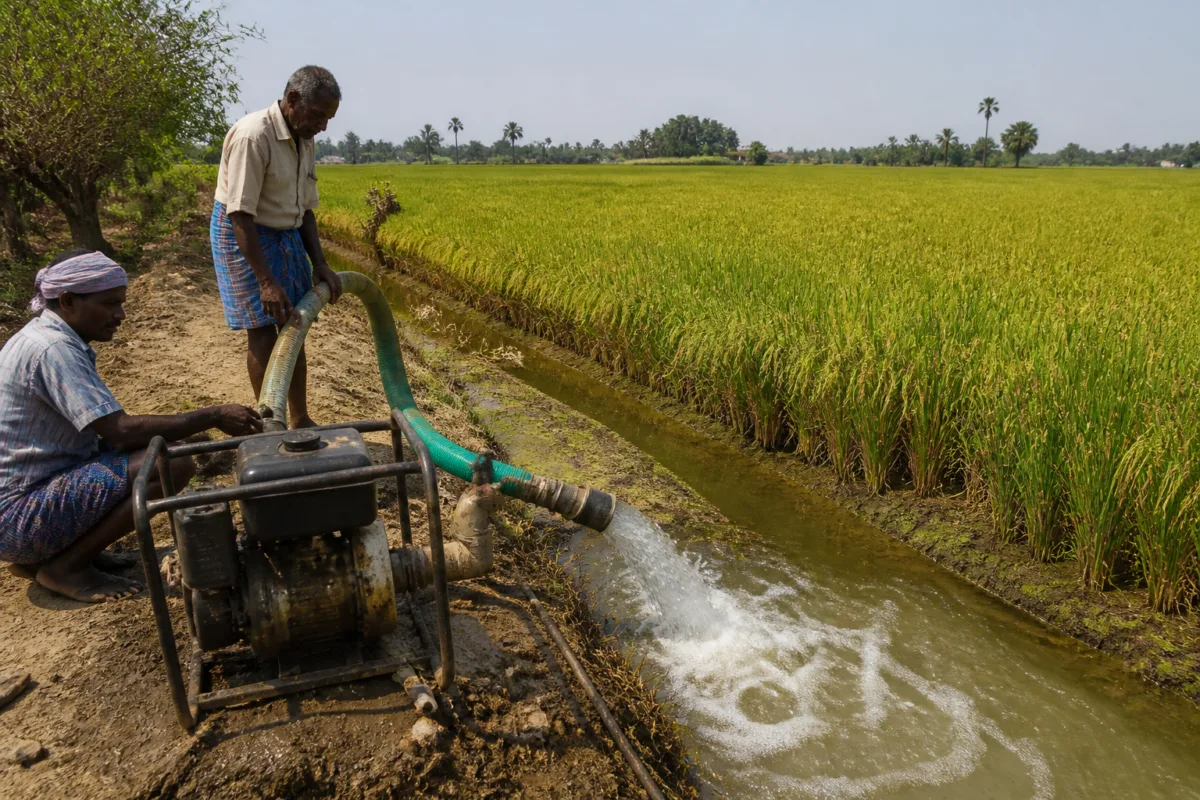
A Cauvery Delta water shortage has forced farmers in Tamil Nadu to use generators, oil motors and Kubota machines to pump stagnant canal water into their fields and prevent paddy crops from drying out, according to a report by Dinamalar.
The affected farmers are cultivating samba and thaladi paddy in parts of the Cauvery Delta, where irrigation releases have reportedly been reduced for the past 15 days. The flow from the Mettur dam is currently limited to 1,000 cubic feet per second, leaving only a small quantity of water moving through the main canals, the report said.
Farmers said the available water is not reaching their fields. As temperatures have risen in the Delta in recent days, the demand for water from paddy crops has increased. With the plants beginning to wilt, cultivators have started drawing water that has collected in canals and directing it to their fields using hired generators, oil-powered motors and Kubota equipment.
The situation follows the decision by farmers to take up samba and thaladi cultivation after announcements on water releases for the season. Water was released from the Mettur dam on September 1 and from the Kallanai on September 6, with an assurance that water would be made available for 45 days, according to the report. Farmers proceeded with transplanting and direct sowing based on the expected irrigation supply.
The Tamil Nadu government and the Agriculture Department had also advised farmers to undertake samba and thaladi cultivation, while anticipating rainfall from the northeast monsoon during November and December. The report said cultivation across the Delta currently covers about five lakh acres, in a season when kuruvai cultivation was not taken up.
Farmers told Dinamalar that they had invested thousands of rupees in cultivation despite the water shortage. They said the failure of canal water to reach their fields was now putting the standing paddy crop at risk, forcing them to incur additional expenses for generator rentals, oil motors and other machinery.
The emergency pumping is shifting part of the burden of irrigation management to individual cultivators. Instead of relying solely on canal flows, farmers are paying to lift and move water locally, even as the broader release from the Mettur system remains restricted. The immediate impact is higher cultivation costs and an increased risk to crops in fields that cannot access the stagnant water.
Farmers have asked the Tamil Nadu government to introduce a special relief package to protect cultivators during the shortage. The report did not provide details of any government response or confirm a revised schedule for increasing water releases. The next developments will depend on irrigation decisions, canal-level water availability and rainfall during the northeast monsoon period.

