


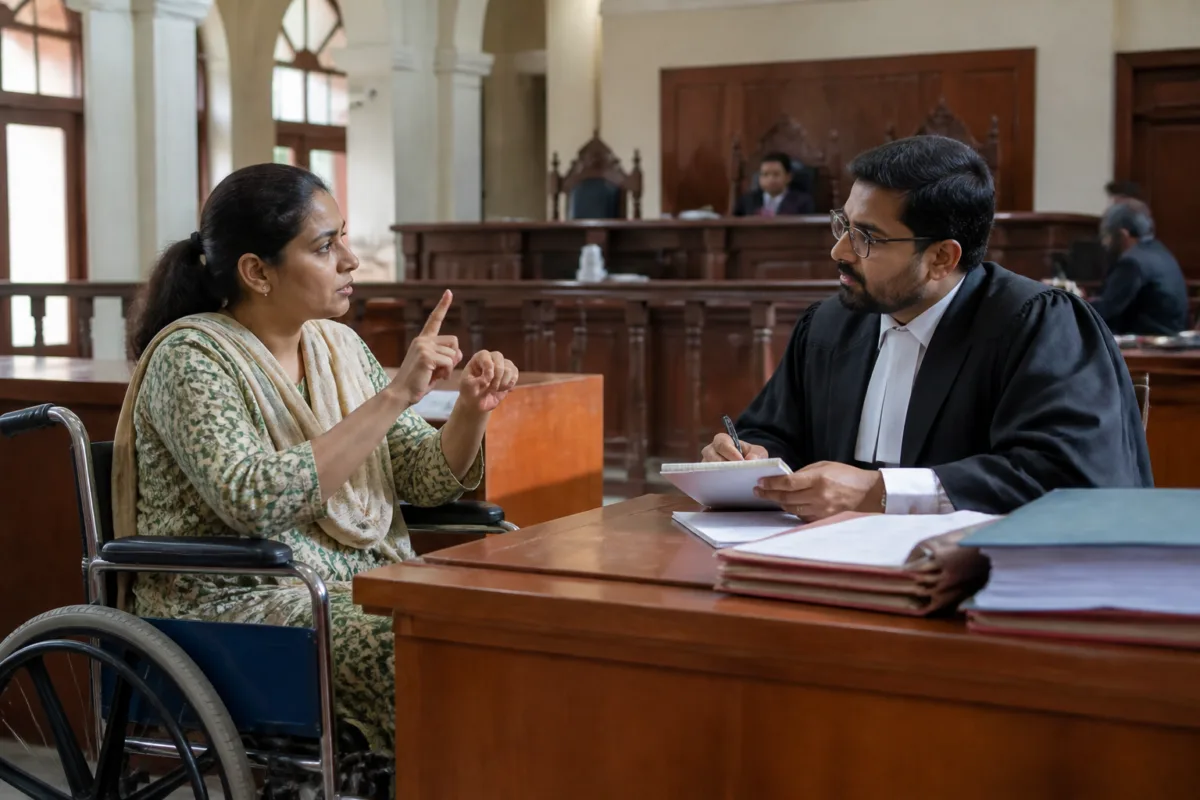
The Chhattisgarh High Court’s ruling that deafness and speech impairment cannot, by themselves, prevent a person from defending legal interests addresses a question that extends beyond one civil dispute: whether institutions mistake a communication barrier for an inability to participate. By refusing to appoint a woman’s husband as her “next friend” solely because she could not hear or speak, the court placed the focus on legal capacity, communication support and evidence of mental infirmity.
The decision arose from a civil suit concerning a 1.21-hectare land parcel in Bastar district. The suit sought specific performance of an agreement to sell and a declaration that a sale deed was null and void. The woman was the defendant in that case. She had asked that her husband be appointed as her “next friend”, arguing that her hearing and speech impairment prevented her from effectively communicating her case before the court.
The application had already been rejected by the trial court. The woman challenged that order before the High Court. During an October 30 hearing, a single bench of Justice Sachin Singh Rajput declined to interfere with the trial court’s decision and dismissed the writ petition. The court found that the material before it did not show that the petitioner suffered from mental illness or any debilitating impairment of her mental faculties.
The distinction made by the court is central to the ruling. Physical disability and mental incapacity are not interchangeable legal categories. The bench held that the petitioner’s deafness and inability to speak, considered on their own, did not satisfy the statutory requirement for appointing a next friend under Order XXXII Rule 15 of the Code of Civil Procedure. That provision requires the court to be satisfied that a person is incapable of protecting their interests because of mental infirmity.
The record described by the Times of India said the petitioner was educated, had undertaken several property transactions and had engaged an advocate from the beginning of the proceedings. Those facts were relevant to the court’s assessment of whether she could understand and participate in the litigation. They did not remove the need for assistance, but they indicated that the available material did not establish the type of incapacity required under the provision.
The court also identified several ways in which a person with hearing or speech impairment can participate in proceedings. It said communication could take place through writing, gestures, an interpreter or legal counsel. The bench referred to Section 119 of the Indian Evidence Act, which permits a person unable to speak to give evidence in writing or through sign language, while also providing for the assistance of an interpreter or special educator.
This is an institutional point as much as a legal one. A court proceeding is not accessible merely because a person is formally allowed to appear. Participation also depends on whether the institution can receive instructions, understand evidence and communicate with the litigant in a manner that recognises the person’s mode of communication. The judgment, as reported, does not treat assistance as evidence of dependency or incapacity. Instead, it separates the need for communication support from the legal test for appointing another person to represent the litigant’s interests.
That separation matters because a “next friend” is not simply a family member who helps a litigant navigate a difficult proceeding. The High Court clarified that assistance from a family member does not automatically give that person a right to be appointed as the litigant’s next friend. Appointment requires a judicial enquiry into whether the person is incapable of protecting their own interests because of mental infirmity.
The court further observed that Order XXXII Rule 15 does not prescribe a particular manner in which this enquiry must be conducted. This leaves the judge with responsibility for determining whether the evidence establishes incapacity, while also requiring the court to avoid treating a physical or sensory disability as conclusive proof that the person cannot make decisions or instruct counsel.
The case therefore illustrates two separate administrative tasks within the justice system. The first is to determine who can legally conduct or defend a case. The second is to provide the communication arrangements needed for the litigant to participate. The ruling indicates that the second task cannot be bypassed by assuming that the first has failed.
The High Court’s reasoning also places weight on the facts of the individual case rather than on a generalised description of disability. The petitioner’s education, property transactions and engagement of an advocate formed part of the circumstances considered by the bench. The court did not state that every person with a hearing or speech impairment will be able to conduct proceedings in the same manner. Its conclusion, as reported, was that this petitioner’s physical disability alone did not meet the statutory threshold for appointing a next friend.
That case-specific approach is significant for institutional decision-making. A disability may affect how a person communicates, gives evidence or receives information. It does not automatically answer whether the person understands the dispute, can provide instructions or can protect their interests. Those questions require examination of the individual’s circumstances and the assistance available to them.
The judgment also shows how property disputes can expose gaps in access to justice. The underlying litigation involves land in Bastar district, a sale agreement and a disputed sale deed. The High Court was not deciding the substantive ownership or contractual questions in the writ petition described by the report. It was deciding whether the defendant needed representation through a next friend because of her disability. The immediate outcome leaves the trial court’s order undisturbed, while the civil suit itself remains the setting in which the property dispute is to be addressed.
For courts and litigants, the practical issue is therefore not only whether an interpreter, special educator or other communication aid is available. It is also whether the legal process records the person’s instructions accurately and gives them a meaningful opportunity to respond. The ruling’s reference to writing, gestures, sign language, interpreters and counsel identifies multiple channels through which that participation may occur. The supplied report does not establish how those arrangements were implemented in this particular case, so the judgment should not be read as evidence that every court currently provides them in the same way.
The institutional responsibilities described in the ruling are distributed across the judge, legal representatives and courtroom support system. The court must apply the statutory test for incapacity. Lawyers must communicate with their clients and present their instructions. Where necessary, interpreters or special educators may assist communication. Family members may provide support, but their involvement does not replace the court’s independent assessment of the litigant’s legal capacity.
This framework is narrower than a general declaration about disability rights, but its implications are wider than the property case that produced it. If a court treats deafness or speech impairment as sufficient reason to transfer control of a case to another person, the litigant’s agency may be displaced without proof that the statutory condition exists. If a court refuses assistance altogether, the litigant may be unable to communicate even while formally retaining the right to participate. The reported ruling addresses that tension by maintaining the distinction between support and substitution.
The decision also places judicial enquiry at the centre of the process. The High Court said an enquiry is required to determine whether a person is incapable of protecting their interests because of mental infirmity. At the same time, it noted that the law does not prescribe a single method for conducting that enquiry. This gives trial courts procedural flexibility, but it also makes the quality of the individual assessment important. The supplied report does not provide a detailed account of the enquiry undertaken by the trial court or the communication arrangements used during the proceedings.
What the ruling clearly establishes is limited but important. Deafness and inability to speak, without more, do not make a person legally incompetent to participate in a civil suit. A person may communicate through writing, gestures, sign language, an interpreter, a special educator or legal counsel. Appointment of a next friend requires the court to find the relevant incapacity under Order XXXII Rule 15, and family assistance alone is insufficient.
What remains outside the reported material is equally relevant to monitoring the case’s wider institutional significance. The report does not state whether the trial court used an interpreter or special educator, whether the petitioner gave evidence through sign language or writing, or how the civil suit will proceed after the writ petition’s dismissal. Those details would show how the legal principle operates in practice.
The Chhattisgarh High Court ruling therefore shifts the central question from whether a litigant has a disability to whether the legal system has assessed capacity properly and enabled communication. Its immediate effect is to leave the trial court’s order in place. Its broader significance lies in insisting that access to proceedings cannot be reduced to a presumption that a person who communicates differently is unable to defend their own interests.

