


Deccan Gold Mines’ preliminary estimate of more than four million tonnes of nickel-bearing ore at the Bhalukona block in Chhattisgarh is being presented as a step towards strengthening India’s domestic critical-mineral base. But the more important story is not the size of the headline figure. It is the gap between identifying mineralisation and proving that a deposit can become a viable, responsibly developed mining operation.
The Bhalukona nickel-copper-platinum group elements project in Mahasamund district covers 30 square kilometres. The company said preliminary geological modelling indicates an average nickel-equivalent grade of about 0.24%, combining nickel, copper, platinum and palladium. On that basis, the identified mineralisation contains more than 10,000 tonnes of nickel-equivalent metal.
Those figures provide an early indication of geological potential, not a confirmed mineable reserve. Deccan Gold has explicitly said that the current estimate is based on preliminary exploration-stage geological interpretations. It also clarified that the findings should not be treated as formally established mineral resources or reserves. Further drilling and exploration will be needed to establish the deposit’s full extent, quality and economic viability.
That qualification is central to understanding what has happened at Bhalukona. A mineralised corridor can be geologically significant without being commercially workable. Mining projects must ultimately establish the continuity of the deposit, the consistency of grades, the recoverability of the metals, the cost of extraction and processing, and the regulatory and operational conditions under which development could take place. None of those questions is settled by the current estimate.
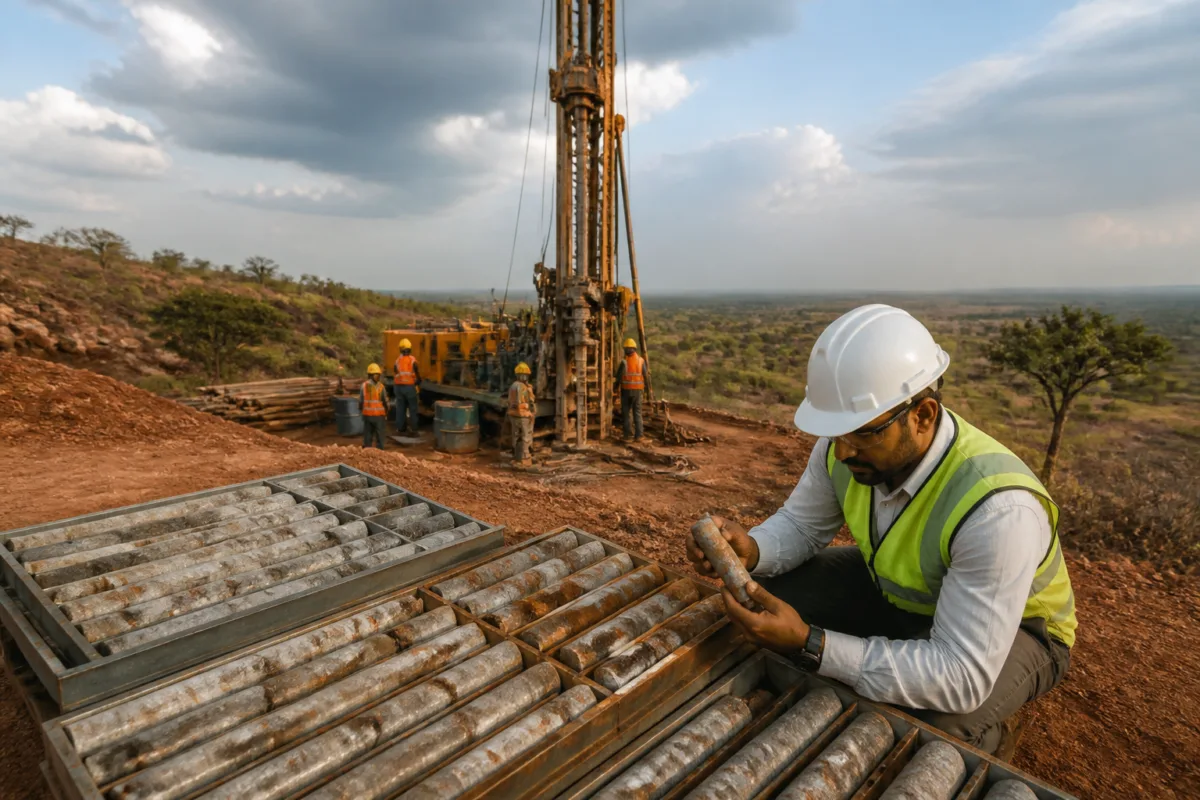
The company’s drilling programme nevertheless provides a more detailed picture than a single surface indication. Since March 2026, Deccan Gold has completed 15 diamond core drilling holes covering 2,773 metres. Reported intersections include 54 metres at 0.21% nickel equivalent in hole BJD-03, 34.2 metres at 0.31% in BJD-09, 29.8 metres at 0.26% in BJD-01 and 15 metres at 0.31% in BJD-02.
These intersections come from only part of the identified mineralised corridor. The company said the current estimate covers near-surface mineralisation across approximately 300 to 350 metres of a corridor extending for 1.3 kilometres. In other words, the estimate is geographically limited relative to the corridor identified so far. That creates the possibility of a larger resource definition programme, but it does not establish that the remaining area will contain mineralisation of comparable thickness or grade.
Drone-based magnetic and induced polarisation surveys have also indicated the possible repetition of the mineralised sequence towards the southeast, according to the company. This is an exploration signal rather than a confirmed extension. The next phase of drilling will determine whether those geophysical indications correspond to continuous and economically relevant mineralisation.
Bhalukona’s institutional significance comes from its place in India’s effort to develop domestic sources of strategic minerals. The block was granted to Deccan Gold in April 2025 and is described by the company as one of the first commercial nickel mining licences secured by a private company in India. The licence gives the company a formal position from which to explore and evaluate the block, but it does not by itself resolve the technical, financial, environmental or community issues involved in mine development.
That distinction matters for public administration as much as for geology. A mining licence is one stage in a longer chain of approvals, investigations and operating obligations. The supplied information does not establish that Bhalukona has received approvals for commercial extraction, completed a feasibility study or reached a decision to construct a mine. It also does not provide details of a proposed processing plant, transport arrangements, water requirements, waste-management systems or local employment plans.
Those missing details are not peripheral. Nickel-bearing ore is not the same as refined nickel or a finished industrial input. Between discovery and supply, a project must determine how the ore will be extracted, processed and transported, and where the associated infrastructure will be located. The future urban and regional footprint of a mining project would therefore extend beyond the 30-square-kilometre block itself, although no such development plan has been supplied for Bhalukona.
The company has linked the project to India’s broader need to reduce dependence on imported critical minerals. Managing Director Hanuma Prasad Modali said the discovery and systematic evaluation of domestic resources would be important for long-term resource security. That argument identifies the strategic rationale for exploration, but it should not be read as evidence that Bhalukona will soon replace imports or supply domestic industry. The current data do not establish a production timeline or expected output.
The project also demonstrates why resource security is ultimately an evaluation problem, not simply a discovery problem. India may identify mineral-bearing zones, but policymakers and companies still have to determine whether those zones can be developed at an acceptable cost and under enforceable environmental and social conditions. The supplied report does not include information on land ownership, affected settlements, ecological conditions, water availability or community consultations around Bhalukona. Those questions will become more important if exploration advances towards development.
For Mahasamund, the immediate change is the arrival of a more systematic exploration programme and the prospect of further drilling. The available information does not show that commercial mining has begun or that residents are already experiencing operational impacts. It does show that a licensed company has completed a significant initial drilling campaign and is using geological and geophysical evidence to decide where exploration should continue.
The numbers therefore need to be read in sequence. More than four million tonnes refers to the estimated quantity of ore identified in the preliminary model, not four million tonnes of refined nickel. The 0.24% figure is a nickel-equivalent grade that combines several metals, rather than a measurement of nickel alone. The more than 10,000 tonnes refers to nickel-equivalent metal within the identified mineralisation. These distinctions are essential because each describes a different stage of the resource picture.
The next test is whether additional drilling can convert a preliminary geological interpretation into a formally defined resource and, later, whether technical and economic studies can demonstrate a viable mining project. The company’s own statement makes clear that those stages have not yet been completed. The southeast extension suggested by magnetic and induced polarisation surveys will also require physical verification.
Bhalukona is consequently an encouraging exploration milestone, but not yet a mining outcome. Its importance lies in showing how India’s critical-mineral strategy is moving from policy ambition to block-level geological work. Its limits are equally clear: the estimate is preliminary, the mineralised area examined so far is partial, and the commercial and environmental conditions for development remain to be established.
The developments that deserve monitoring are further drilling results, a formal resource estimate, assessments of economic viability and any subsequent information on approvals, processing infrastructure and local impacts. Until those steps are completed, Bhalukona should be understood as a promising but early-stage mineral exploration project rather than an established domestic source of nickel.

