


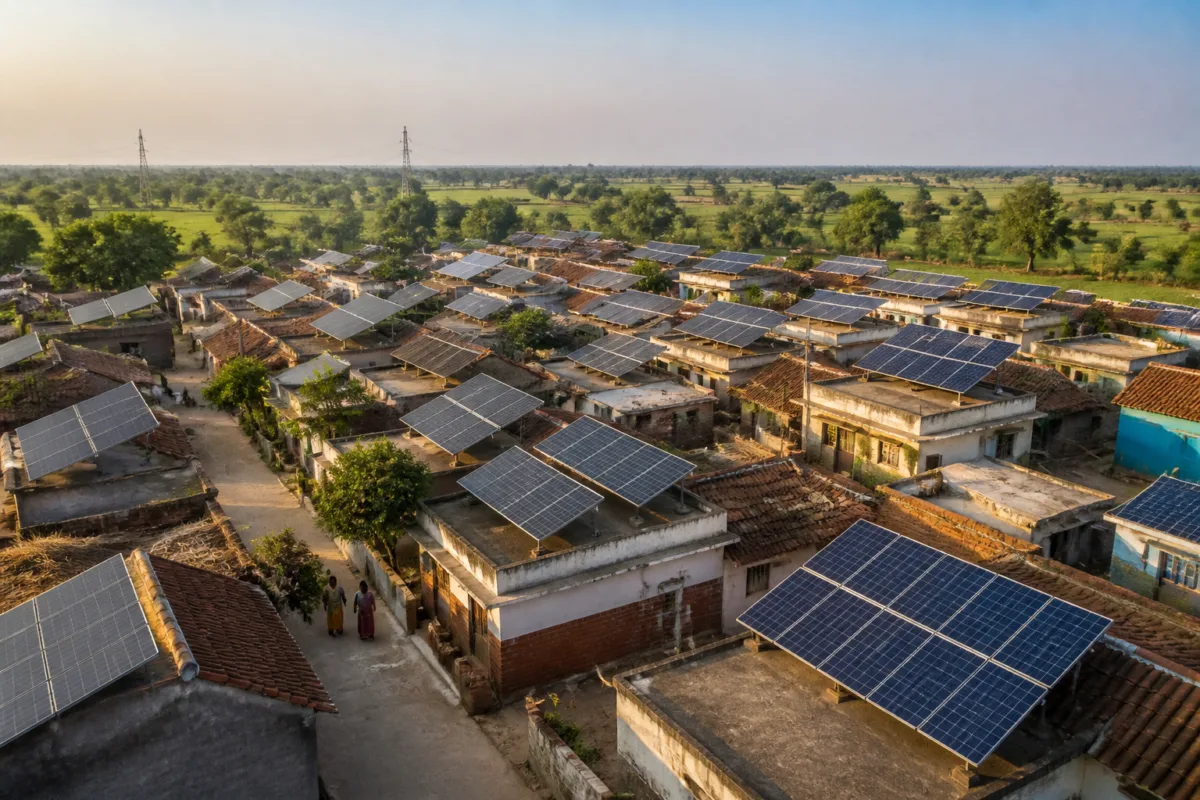
Khaira village in Chhattisgarh’s Rajnandgaon district has become the country’s first village to achieve 100% household coverage under the PM Surya Ghar: Muft Bijli Yojana, with all 141 homes receiving rooftop solar systems, officials told the Times of India.
The village, home to 889 people, now has a combined installed solar capacity of 282kW. Each household has been provided with a 2kW rooftop system. Under the net-metering arrangement, families can use the electricity generated at home and feed surplus power into the grid.
The entire installation cost was covered through central and state subsidies, supplemented by corporate social responsibility funding. This removed the upfront financial barrier that often prevents lower-income rural households from adopting rooftop solar systems.
The coverage includes 93 households that are beneficiaries of the Pradhan Mantri Awas Yojana-Gramin. Khaira’s 21 Scheduled Tribe families and four Scheduled Caste families are also covered under the initiative.
For residents dependent on modest incomes, the expected reduction in electricity costs has immediate significance. Shohgil Gond, a widow who lives alone and depends on a pension, told the newspaper that she no longer had to worry about paying her electricity bill. Kartik Yadav, who earns through domestic and wage work, also said the savings could help households manage essential expenses.
Rajnandgaon collector Jitendra Yadav attributed the coverage to a community-level mobilisation effort involving local women known as PM Surya Sakhis. The women, including Sangeeta Sahu, worked with the self-help group network associated with Padma Shri awardee Phoolbasan Bai Yadav to explain the scheme and address concerns about costs, documentation and banking procedures.
Sangeeta said many families initially wanted to know who would pay for the installation and whether there were hidden charges. The women visited households repeatedly, explained the process and helped residents complete the required forms. Phoolbasan Bai said face-to-face conversations helped build confidence because residents were more likely to trust neighbours than formal publicity.
Village sarpanch Bhupendra Yadav organised meetings to explain the programme. Banking camps were also held within Khaira to complete documentation and verification, reducing the need for residents to make repeated trips to bank branches.
The project changes the role of participating households within the local electricity system. Rather than remaining only consumers, families can generate power on their rooftops and send surplus electricity to the grid. Collector Yadav described the participating residents as “urjadata”, or energy providers.
The initiative’s longer-term performance will depend on the systems’ maintenance, the accessibility of repair support and the actual savings recorded by households. The Times of India report did not provide a consolidated figure for the village’s monthly electricity-bill reduction or details of the maintenance arrangement.
Khaira’s next test will therefore be operational: ensuring that all 141 systems continue to function and that households can access timely support as the installations age.

