


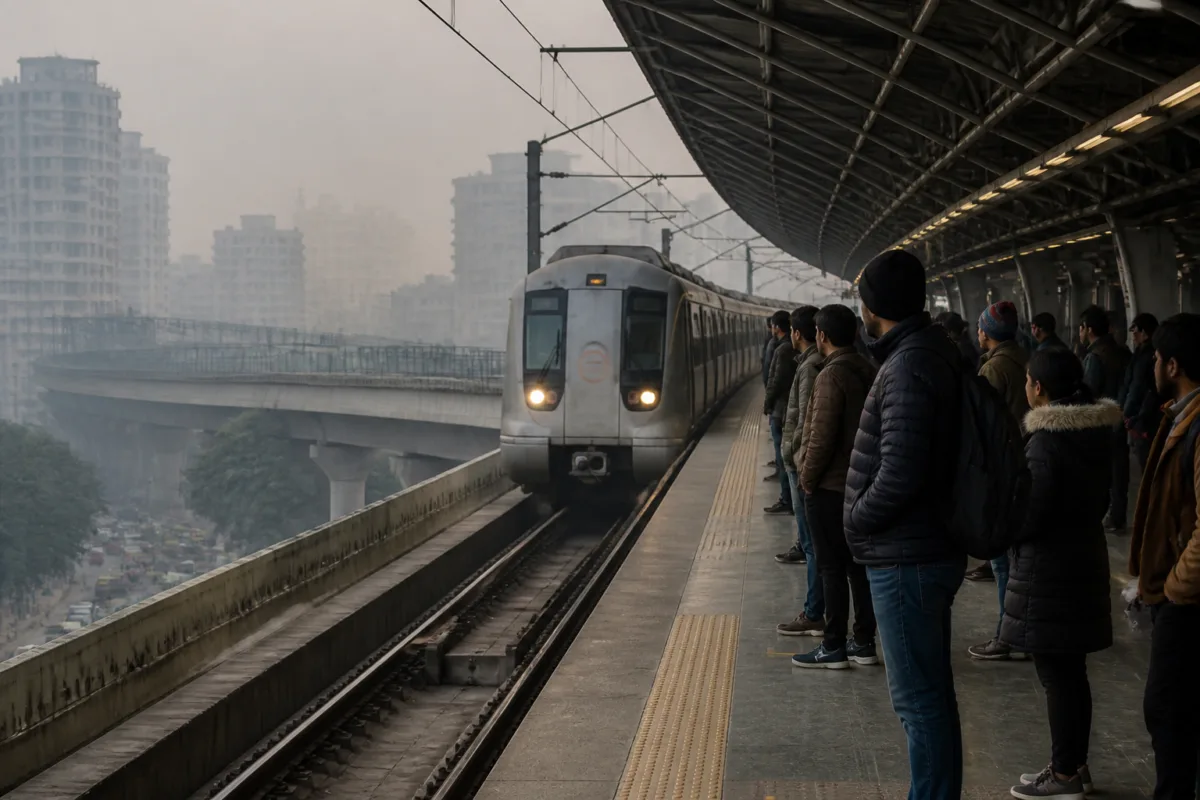
Delhi Metro will run 20 additional weekday trips from November 3 after the implementation of Stage II of the Graded Response Action Plan (GRAP-II), as parts of the capital recorded air quality in the severe category. The Delhi Metro Rail Corporation (DMRC) said the move is intended to encourage people to use public transport instead of private vehicles and help reduce pollution.
The additional services will operate on weekdays across the Delhi Metro network, according to information posted by DMRC on X. The corporation said the latest increase would take the total number of additional trips introduced during the current response to 40.
The announcement came after Delhi’s air quality deteriorated sharply on November 2. Three monitoring stations recorded severe air quality at 4 pm, with Jahangirpuri registering the highest Air Quality Index (AQI) at 436. Rohini recorded an AQI of 415, while Punjabi Bagh recorded 413. The city also experienced a layer of smog, with the season’s first very poor air quality reported before the severe readings were recorded at the three stations.
The metro service increase is one of the public transport measures being taken after GRAP-II came into force in the National Capital Region. The restrictions and measures under this stage include efforts to control dust pollution and promote public transport use. Authorities are expected to intensify mechanical road sweeping, water sprinkling and the deployment of anti-smog guns in dust-prone areas.
Parking fees will also be increased as part of the GRAP-II response, according to the report. The measures are intended to discourage the use of private vehicles while improving the availability of mass transit during a period of hazardous air quality.
The DMRC’s response adds capacity to an existing metro system rather than introducing a new route or a permanent timetable change. For commuters, the immediate implication is a higher number of weekday train movements, although the source information does not specify the corridors, timings or station-wise distribution of the additional trips.
The Commission for Air Quality Management revised the GRAP framework in September. Among the changes cited in the report was a provision under GRAP-III to extend restrictions in Sonipat, Haryana, on the use of BS-III petrol and BS-IV diesel light motor vehicles, or vehicles below the applicable standard. The framework links escalating pollution levels with progressively stricter measures across transport, dust control and construction-related activities.
DMRC’s additional trips are scheduled to begin on November 3, while road-cleaning, water-sprinkling, anti-smog and parking-related measures will be implemented by the relevant authorities under GRAP-II.

