


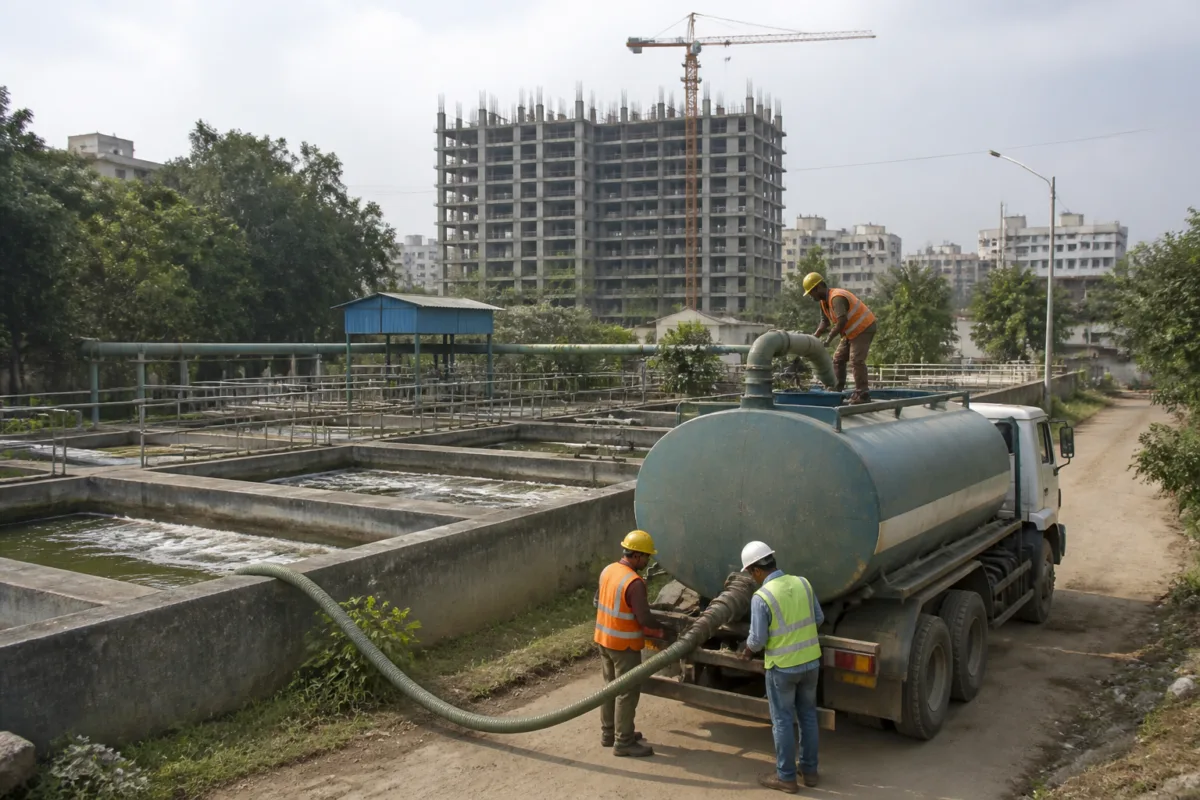
The Pimpri-Chinchwad Municipal Corporation plans to make treated wastewater mandatory for construction projects, in a proposed policy intended to reduce the use of drinking water and limit pressure on groundwater resources.
Municipal Commissioner Dr Vijay Suryawanshi said the condition would be included in the corporation’s construction-permission rules. A framework for the requirement is being prepared, according to a report by Lokmat. The proposal has not yet been described as an operational rule, and the report does not specify when the revised regulations will take effect.
Under the proposed system, developers would have to use 100% treated wastewater for construction. They would pay a charge into the treasury and receive water from the corporation’s sewage-treatment facilities. If additional water is required, it would be supplied from the treatment plants at the prevailing rate, the report said.
The corporation plans to provide treated water through tankers or pipelines. Construction companies would be responsible for arranging and paying for the tankers or pipeline connections needed to move the water from the treatment plants to their sites. The report said facilities for filling tankers are available at all sewage-treatment plants.
The municipal corporation currently has about 50 million litres per day (MLD) of treated wastewater available at its sewage-treatment plants, according to the report. Some treated wastewater is already being used in selected gardens. The proposed construction mandate is intended to expand that reuse and reduce dependence on drinking-water supplies.
The move comes as Pimpri-Chinchwad continues to face water-supply pressure. The report said the city has had alternate-day water supply for eight years, while population growth has increased demand on available water sources. Construction sites currently draw water from borewells and wells near the river, a practice the corporation says affects groundwater levels.
The proposed rules would also include penalties for people or organisations that do not use treated wastewater for construction. However, the report does not provide the proposed penalty amounts, inspection process, water-quality standards or details of how the corporation will verify compliance at individual sites.
The policy is being developed along the lines of measures reported in cities including Nagpur, Surat and Bengaluru, where treated wastewater is supplied for industrial and construction use. The report does not provide comparative details of those cities’ regulations or outcomes.
For developers, the proposal could create new water-procurement, transport and connection costs, particularly for projects located far from sewage-treatment plants. For the corporation, it could create a new revenue stream while increasing the utilisation of treated wastewater. Its effectiveness will depend on reliable supply, suitable distribution infrastructure, clear quality requirements and consistent enforcement.
The report also refers to construction-project figures for multiple financial years, but the figures and their categories are not sufficiently clear in the source material to establish a reliable trend. The corporation’s planned rules, once formally issued, will be needed to determine the policy’s coverage, compliance obligations and implementation schedule.

