


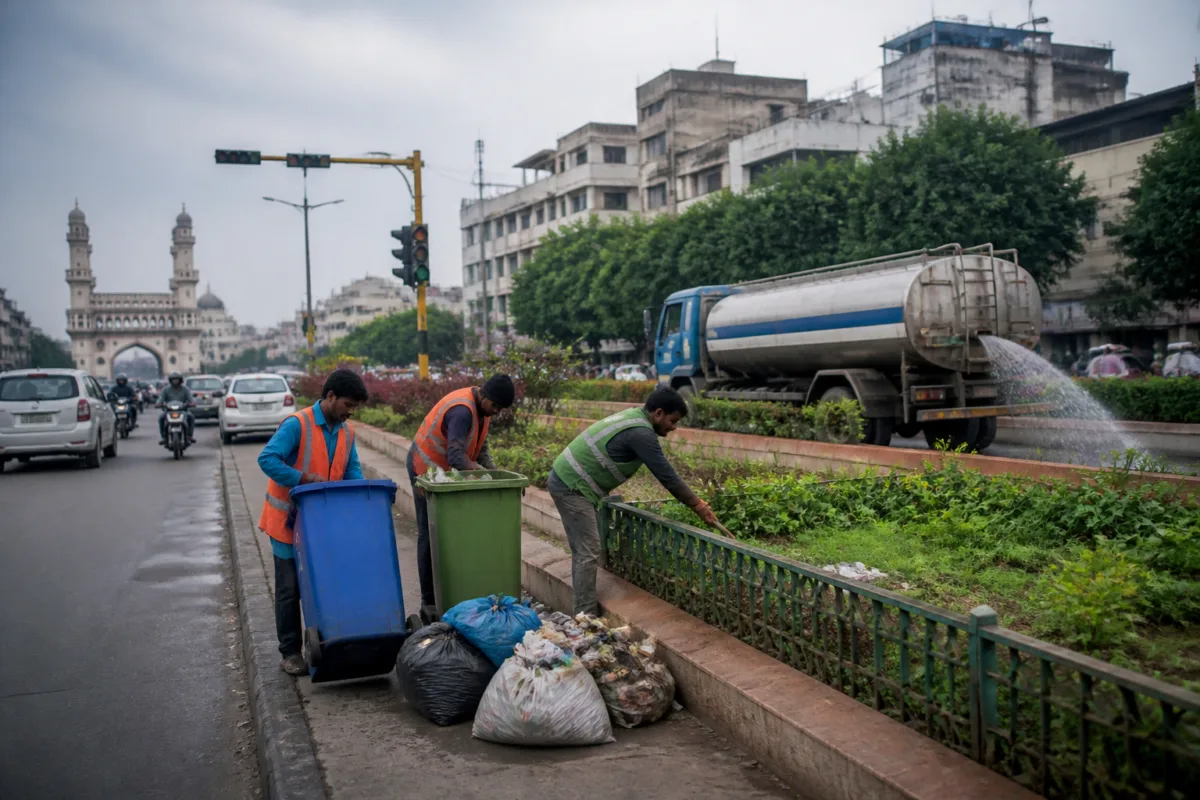
Hyderabad’s clean-up plan will focus on preventing visible garbage, replacing drinking water used for non-potable purposes, improving construction-debris removal and easing traffic congestion, following directions issued by Telangana Chief Minister A Revanth Reddy to municipal officials on Monday.
The chief minister reviewed civic issues with municipal officials at his Jubilee Hills residence and directed them to take measures to make Greater Hyderabad clean and traffic-free. He instructed authorities to ensure that garbage was not seen on city roads and called for continuous monitoring of waste collection.
Officials briefed Reddy on the enforcement of daily door-to-door waste collection and the action being taken against personnel found negligent. The directions place regular collection and field-level monitoring at the centre of the city’s waste-management response, though the source report does not specify new targets, staffing levels or enforcement timelines.
The chief minister also called for special arrangements to remove construction debris and suggested coordination with the industries department to ensure waste collection within industrial zones. Construction and demolition waste can require separate handling from household waste, but the meeting’s reported directions did not include details on collection points, transport arrangements or disposal facilities.
A second focus of the review was the use of treated wastewater. Reddy said drinking water was being used for construction, maintenance of greenery and park development and directed officials to stop supplying potable water for these purposes. He asked authorities to promote the use of treated water from sewage treatment plants, or STPs, for construction activities, landscaping, gardening and park maintenance.
The Hyderabad water board has already started a treated-water tanker service. In its first phase, the service operates 28 green-water tankers sourced from 19 STPs. Reddy advised officials to expand the supply to areas under the Greater Hyderabad Municipal Corporation, Cyberabad Municipal Corporation and Malkajgiri Municipal Corporation.
The direction brings together two urban-service challenges: conserving drinking water and finding productive uses for treated wastewater. The reported review did not establish the volume of treated water currently available, the pricing of tanker supplies, the quality standards for different uses or the mechanism for monitoring whether potable water supplies are discontinued.
Traffic management was the third major component of the meeting. Reddy directed officials to prepare plans for underpasses and elevated corridors to establish a signal-free system at congestion points. He also called for effective traffic regulation and said vehicle movement should remain uninterrupted, with motorists not being held at signals for long periods.
The directions do not identify specific junctions, corridors, project costs or construction schedules. They also do not state whether the proposed underpasses and elevated corridors would be delivered by the municipal corporations, the roads and buildings department or another agency. Those details will determine how the traffic plan moves from a review-meeting instruction to a funded urban-infrastructure programme.
The next reported steps are the preparation of plans for underpasses and elevated corridors, expansion of green-water tanker services across the three municipal jurisdictions, continued monitoring of door-to-door waste collection and arrangements for construction-debris removal. The source report does not provide deadlines for these actions.

