


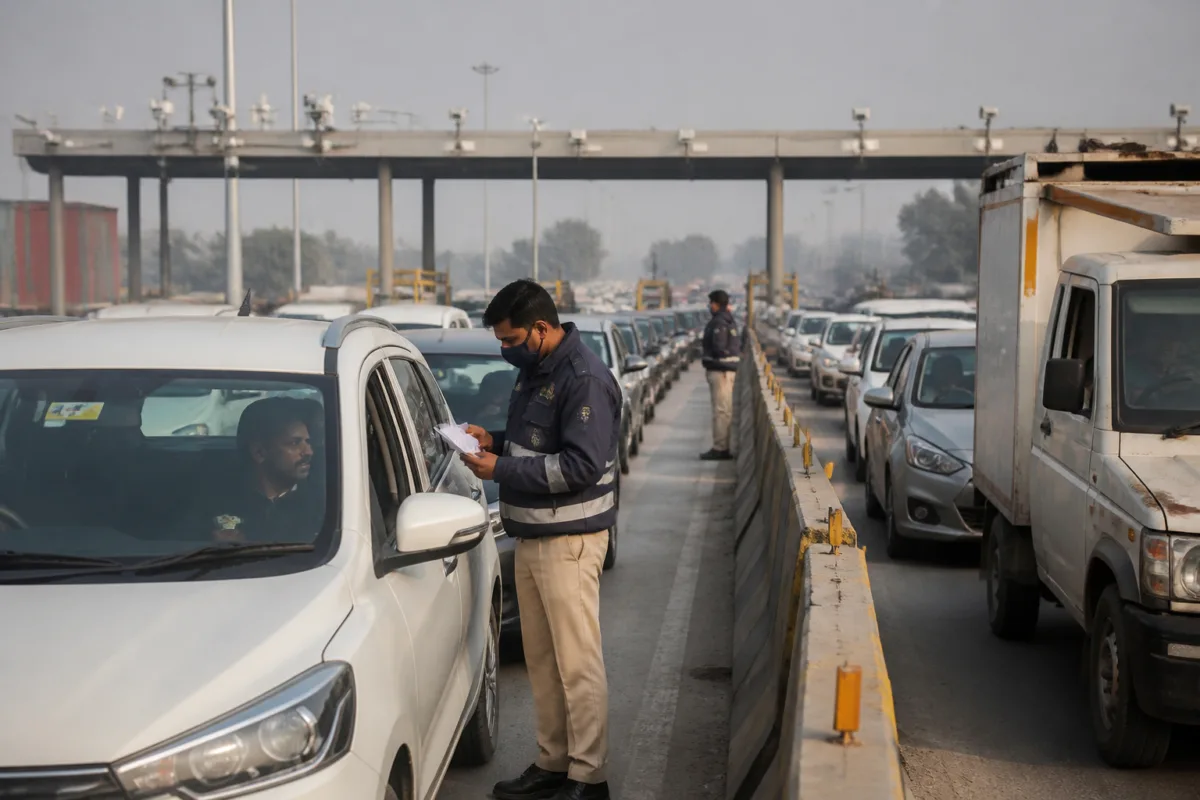
Delhi’s AQI reached 261 on Sunday, the worst reading of the season, just as a new package of winter pollution curbs began producing long queues at the capital’s borders. The simultaneous deterioration in air quality and disruption to traffic has exposed a central problem in Delhi’s seasonal response: controls may be activated quickly, but their effectiveness depends on whether enforcement is coordinated across transport, construction, parking, workplaces and the wider NCR region.
The immediate trigger was the first day of enforcement of restrictions on vehicles entering Delhi. Traffic police and enforcement teams checked vehicles at the Delhi-Gurugram and Delhi-Noida borders, as well as other entry points and toll plazas. Vehicles that did not meet the prescribed emission standards faced action, including electronic challans and possible impounding under the applicable rules. The checks created long queues near MCD toll booths and other border locations, leaving commuters in bumper-to-bumper traffic.
The disruption matters because the policy is attempting to manage two linked but distinct problems. The first is the contribution of vehicles to air pollution. The second is the movement of people and goods through a metropolitan region whose daily economy does not stop at Delhi’s administrative boundary. A border enforcement system can identify and restrict non-compliant vehicles, but it can also concentrate traffic at the very points where checks are being carried out. The report does not establish whether the resulting congestion increased overall emissions, but it does show the operational tension between enforcement and traffic flow.
The air-quality numbers underline the urgency of the intervention. Delhi’s AQI stood at 261, in the poor category, matching the reading recorded on July 12 and marking the highest level recorded in 198 days. The city’s last reading above 250 was 263 on April 17. Of 57 monitoring stations, 22 reported very poor air, 21 reported poor air and 14 reported moderate air. Jahangirpuri recorded the highest AQI at 378, close to the severe threshold of 401. PM2.5 was the predominant pollutant.
These figures also show why a single intervention is unlikely to explain any short-term improvement. According to the Decision Support System for air quality management, transport accounted for 16.4% of Delhi’s pollution contribution on Sunday. Stubble burning contributed as much as 18.5%, while other sectors accounted for 24.3%. Within the city, residential sources contributed 4%, industries 3%, construction 2.2%, energy 1.2%, road dust 1.2% and other sectors 1.1%. The DSS also attributed contributions to neighbouring NCR districts, including Jhajjar at 9.2%, Gurugram at 4.8%, Bhiwani at 2.7%, Rohtak at 2.2% and Bulandshahr at 0.3%.
The data does not make transport controls irrelevant. A 16.4% contribution is substantial, particularly in a city where traffic volumes, road congestion and vehicle movement are visible daily sources of exposure. But it does indicate that Delhi’s pollution problem is distributed across several sources and jurisdictions. Border checks target one part of the emissions system, while the reported contributions from stubble burning, neighbouring districts and other sectors point to the limits of a Delhi-only enforcement approach.
The design of the restrictions reflects this multi-source challenge. Vehicles registered outside Delhi that meet BS-IV or older emission standards face restrictions. Dust-generating demolition and outdoor civil construction activities are banned from November 1 to January 31, with specified essential public infrastructure projects exempt if they meet prescribed conditions. A wider ban on construction and demolition, subject to specified exemptions, is scheduled from December 10 to January 20. Parking charges at authorised parking lots have been doubled from November 1 to February 28, while government and private offices have been asked to cap physical attendance at 50%, with essential and emergency services exempted.
Each measure operates through a different administrative channel. Vehicle checks require coordination between the transport department, traffic police, toll-plaza operators and enforcement teams. Construction restrictions require agencies and project owners to identify dust-generating activity and distinguish it from exempt essential infrastructure work. Parking charges depend on implementation at authorised lots. Attendance limits require employers and government departments to alter work arrangements. The package is therefore not one policy but a set of controls whose results will depend on how consistently they are applied and whether their timelines overlap effectively.
The enforcement architecture is sizeable. The Delhi transport department has deployed around 250 personnel at major entry points, toll plazas and identified pollution hotspots. Thirty-nine teams have been stationed across 13 major toll plazas, including DND, Rajokri on NH-48, Ghazipur, Singhu, Tikri and Badarpur. Automatic number plate recognition cameras at entry points and other key locations are being used to identify violating vehicles. The stated enforcement process includes electronic challans and vehicle impounding.
However, enforcement capacity is not the same as policy effectiveness. The first day showed that the state can place personnel and technology at key gateways, but it also revealed the cost of concentrating checks at high-volume entry points. Commuters reported long delays, including one account of being stuck at a Delhi border for three hours. These accounts were reported as social media reactions and do not independently measure the scale of disruption, but they are consistent with the traffic snarls observed during the rollout.
The administrative response has attempted to address congestion through staggered working hours. MCD offices are to operate from 8.30 am to 5 pm, while state government offices will function from 10 am to 6.30 pm. The attendance cap is intended to reduce commuting demand by shifting part of the workforce to remote work. Yet the effectiveness of such measures will depend on how many workers and institutions are covered, how consistently employers comply and whether traffic demand is redistributed rather than simply moved to different hours. The supplied report does not provide data on compliance or on the volume of trips avoided.
The construction controls raise a similar implementation question. Dust-generating outdoor civil construction is a defined target, but essential public infrastructure projects are exempt under prescribed conditions. This creates a need for clear site-level monitoring: the policy must distinguish between necessary infrastructure work and activities that generate avoidable dust. The report confirms the restrictions and exemptions but does not provide figures on the number of sites covered, halted or inspected. That information will be necessary to assess whether the construction component is operating beyond the level of announcement.
The parking charge increase is designed to discourage private vehicle use, while the vehicle restrictions target older or higher-emitting vehicles entering Delhi. Together, they attempt to change both the cost of parking and the eligibility of vehicles. But the border queues indicate that the implementation point is highly visible to commuters, whereas the pollution benefits are harder to observe immediately. The Air Quality Early Warning System has forecast that air quality will remain poor from November 2 to November 3 and could remain between poor and very poor over the following six days. That forecast means the restrictions will be judged during a period when weather and pollution from multiple sources continue to influence the readings.
This is the deeper governance issue behind Delhi’s winter curbs. Air pollution is measured within city boundaries, but its sources and daily movements extend across the NCR. Transport emissions generated by vehicles travelling into, out of and within Delhi cannot be managed entirely through a single border. Similarly, reported contributions from neighbouring districts and stubble burning show that the pollution load is shaped by activity beyond the capital’s municipal and administrative limits. The enforcement package therefore depends on regional coordination even when the most visible action occurs at Delhi’s borders.
The next test is not simply whether the AQI falls after the restrictions begin. It is whether authorities can connect enforcement activity with measurable changes in vehicle compliance, traffic conditions, construction dust and pollution contributions. The current report provides a baseline: AQI at 261, 57 monitoring stations recording sharply different conditions, transport contributing 16.4% according to the DSS, and substantial enforcement deployed at 13 toll plazas. It does not yet establish the impact of the measures.
Delhi’s winter response has moved from announcement to implementation, but the first day has shown both its reach and its limits. The city has activated border checks, construction controls, higher parking charges and reduced office attendance at the same time that air quality has worsened. What deserves monitoring now is whether these separate measures produce coordinated results, whether traffic management improves at enforcement points and whether the next air-quality readings show a change that can be associated with the controls rather than with other pollution sources or atmospheric conditions.

