


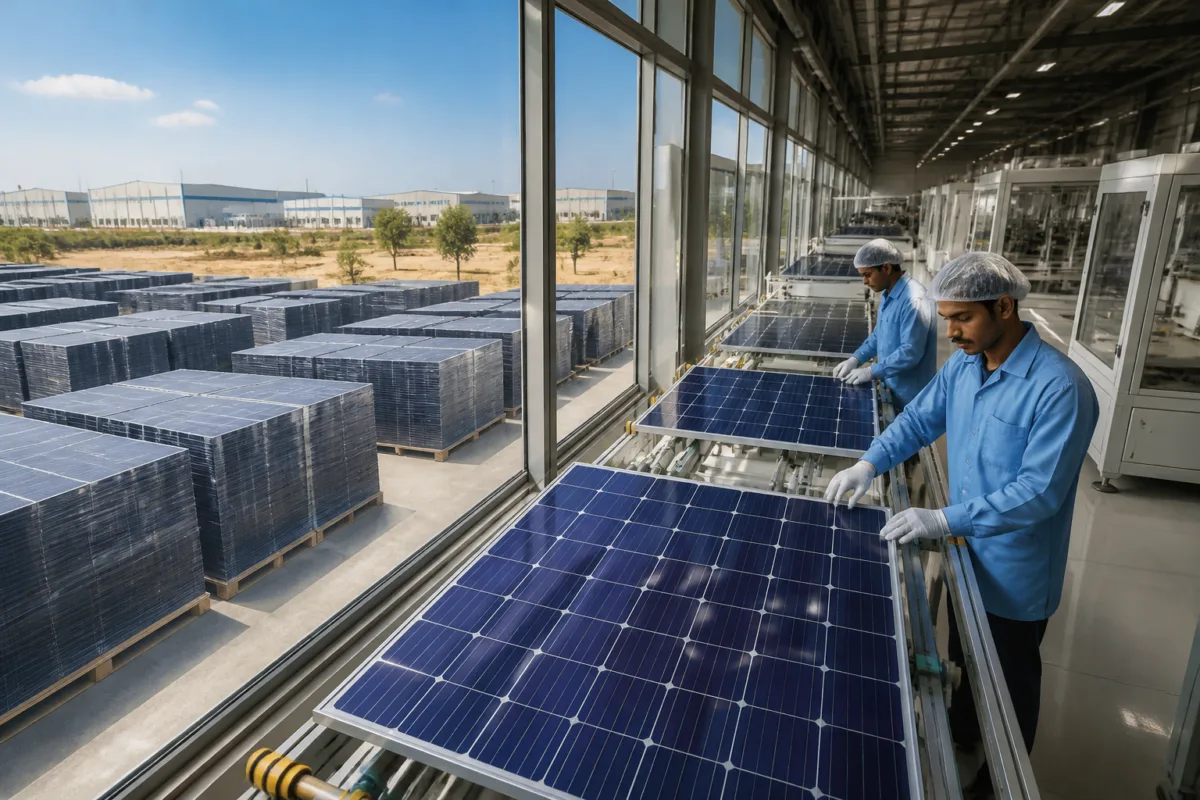
Solex Energy’s proposed US expansion is not only a story about an Indian solar manufacturer seeking overseas growth. It also reveals the uneven development of India’s domestic solar supply chain, where module manufacturing capacity has expanded far faster than cell production and where newer manufacturing technologies are competing with older, partly idle capacity.
The company plans to establish solar module and cell manufacturing capacities in the United States as part of a $1.5 billion investment roadmap through 2030, Chairman and Managing Director Chetan Shah told Press Trust of India. Solex has formed a team to study possible locations, investment requirements and other parameters, but has not disclosed specific US projects, citing regulatory compliance.
That distinction matters. The US proposal is currently an expansion plan under evaluation, not a commissioned project with a published site, capacity, investment schedule or construction deadline. Its significance lies in what is driving the move: access to a large clean-energy market, trade barriers affecting Chinese imports and the search for reliable suppliers of solar components.
## From Gujarat capacity to a global manufacturing strategy
Solex currently operates a 4 gigawatt module manufacturing facility in Gujarat and aims to increase its module capacity to 10 GW. It is also establishing 10 GW of cell manufacturing capacity and 2 GW of ingot and wafer production, according to Shah’s comments reported by PTI.
These planned capacities cover several stages of the solar manufacturing chain. Modules are the finished panels deployed in solar projects. Cells are the units inside those modules that convert sunlight into electricity, while ingots and wafers are upstream inputs used to make cells. Building capacity across these stages can give a manufacturer greater control over supply, although the report does not establish how much of Solex’s proposed capacity is operational, under construction or financed.
The company’s proposed US manufacturing presence therefore sits alongside, rather than replaces, its Indian expansion. The roadmap combines a domestic manufacturing build-out with an international market strategy. Shah described the US as a high-potential market and said the company was targeting it because of global demand for clean-energy components and the opportunity to position Indian production as a cost-effective alternative to Chinese suppliers.
He also said that anti-dumping duties on Chinese imports have made India the sole viable supplier of low-cost alternatives. That is the company chairman’s assessment, rather than an independently established conclusion in the supplied report. It nevertheless identifies the commercial environment in which Indian manufacturers are evaluating overseas investment: solar equipment is increasingly shaped not only by production costs, but also by trade policy and the location of supply chains.
## The capacity imbalance inside India
The most consequential figure in the report is the gap between India’s module and cell manufacturing capacity. As of October 2026, India had about 262 GW of module manufacturing capacity but only about 37 GW of cell capacity, Shah said.
The difference is more than a statistical mismatch. A module industry cannot operate at full potential if the cells required for production are insufficient, unavailable in the right technology or not economically competitive. The figures cited by Shah indicate that India has built a very large potential downstream manufacturing base while cell production remains much smaller.
The report does not say that all 262 GW of module capacity is operational or producing at its stated maximum. Shah specifically said that several capacities are non-operational and that much of the installed capacity uses older monocrystalline PERC technology. He added that the module capacities have been established for the latest tunnel oxide passivated contact, or TOPCon, technology.
This creates a second layer to the capacity problem. The issue is not simply how many gigawatts have been announced or installed. It is also whether facilities are operational, whether their technology matches current market demand and whether upstream cell production can support the modules that manufacturers intend to produce.
The supplied figures therefore describe capacity in different states of readiness and technological relevance. They should not be read as equivalent to actual output. But even with that qualification, the gap cited by the company points to a supply-chain structure in which the availability of cells can constrain the utilisation of module plants.
## Why ALMM-II has become a manufacturing question
The dispute over the Approved List of Models and Manufacturers framework, or ALMM-II, connects the company’s expansion plans to the government’s domestic manufacturing objectives. Shah said the industry is aligned with the framework’s objectives and has invested thousands of crore in Indian module capacity to support the country’s net-zero goals.
He also called for an extension of ALMM-II by at least 12 months because of current cell availability conditions. The framework mandates the sourcing of made-in-India cells from an approved list of module manufacturers, according to the report.
The policy issue is therefore linked directly to the capacity imbalance. If domestic module manufacturers are required to source approved Indian cells but cell availability is limited, companies may face a gap between policy eligibility and physical supply. The report does not provide the government’s response to the request for an extension, nor does it specify the current implementation date or the criteria under which the framework may be extended.
For manufacturers, the timing of compliance can affect procurement, plant utilisation and the commercial viability of new capacity. For policymakers, the challenge is to align a domestic-content framework with the actual pace at which upstream manufacturing is being built. The numbers cited in the report suggest that module capacity has expanded much faster than cell capacity, making implementation dependent on the narrower part of the chain.
## The technology transition behind the numbers
Shah’s reference to older monocrystalline PERC capacity and newer TOPCon technology adds a technology dimension to the supply question. Installed capacity is not automatically interchangeable. A plant configured for one technology may not be able to produce another without additional investment, equipment changes or operational adjustments.
The report does not provide comparative efficiency figures, production costs or utilisation rates for PERC and TOPCon facilities. It also does not establish how much of India’s 262 GW module capacity is based on each technology. What it does show is that capacity expansion is taking place during a transition in manufacturing technology, when the value of a facility depends partly on whether it can serve current demand.
That makes the manufacturing pipeline more complex than a race to add headline gigawatts. Cell production, wafer and ingot capacity, module technology and operating status all influence whether nominal capacity translates into deployable solar equipment. Solex’s plan to add 10 GW of cells and 2 GW of ingots and wafers indicates an attempt to expand into upstream segments, but the report does not provide completion dates or expected output from those facilities.
The same limitation applies to the proposed US operations. Solex has identified the market and created a study team, but has not announced locations, project capacities or a construction timetable. Until those details are disclosed, the US plan is best understood as an announced strategic direction rather than a fully defined infrastructure project.
## What the announcement says about solar manufacturing policy
India’s solar manufacturing policy is being shaped by two simultaneous objectives: creating domestic industrial capacity and supporting the rapid deployment of renewable energy. The ALMM-II discussion shows the tension between those goals when supply-chain capacity is uneven.
A domestic-content requirement can create demand for Indian manufacturing and reduce dependence on imports. But it also increases the importance of whether domestic suppliers can provide sufficient volumes, approved products and the technologies required by project developers. The report’s cited capacity figures indicate that the upstream portion of the chain remains considerably smaller than the module segment.
Solex’s proposed US expansion adds an international dimension. The company is seeking access to a market it describes as large and high-potential while continuing to expand in Gujarat. Its rationale, as stated by Shah, is based on global clean-energy demand and a competitive position relative to Chinese suppliers. The report does not provide a financing structure, projected employment numbers, expected export volumes or details of any US incentives, so the broader economic impact cannot yet be established.
For India’s built environment and energy transition, the key issue is whether manufacturing announcements become functioning, technologically current production lines. Solar capacity is ultimately relevant to cities, industries and households through the electricity projects that use the equipment. That link depends on production reliability, not only on announced gigawatts.
## The larger urban and infrastructure question
Solar manufacturing is often treated as an industrial-sector story, but its consequences extend into infrastructure planning. Renewable-energy deployment requires a dependable supply of modules, cells and upstream inputs. If one part of the chain expands much faster than another, project execution and procurement can be affected, even when the overall manufacturing headline appears positive.
The Solex announcement illustrates why capacity data needs to be read alongside operational status, technology and policy rules. India’s reported 262 GW of module capacity and 37 GW of cell capacity show a substantial imbalance. The company’s call for more time under ALMM-II indicates that manufacturers see cell availability as an immediate implementation concern, while its own investment roadmap shows how firms are responding by pursuing upstream integration and overseas markets.
What is established is that Solex is studying US manufacturing opportunities, expanding its planned Indian capacity and seeking a possible 12-month extension to ALMM-II because of cell availability. What remains unresolved is the location, scale, timing and financing of its US projects, as well as how quickly India’s cell and wafer capacity will become operational. Those details will determine whether the announcement represents an early-stage corporate plan or the beginning of a measurable shift in solar supply-chain geography.

