


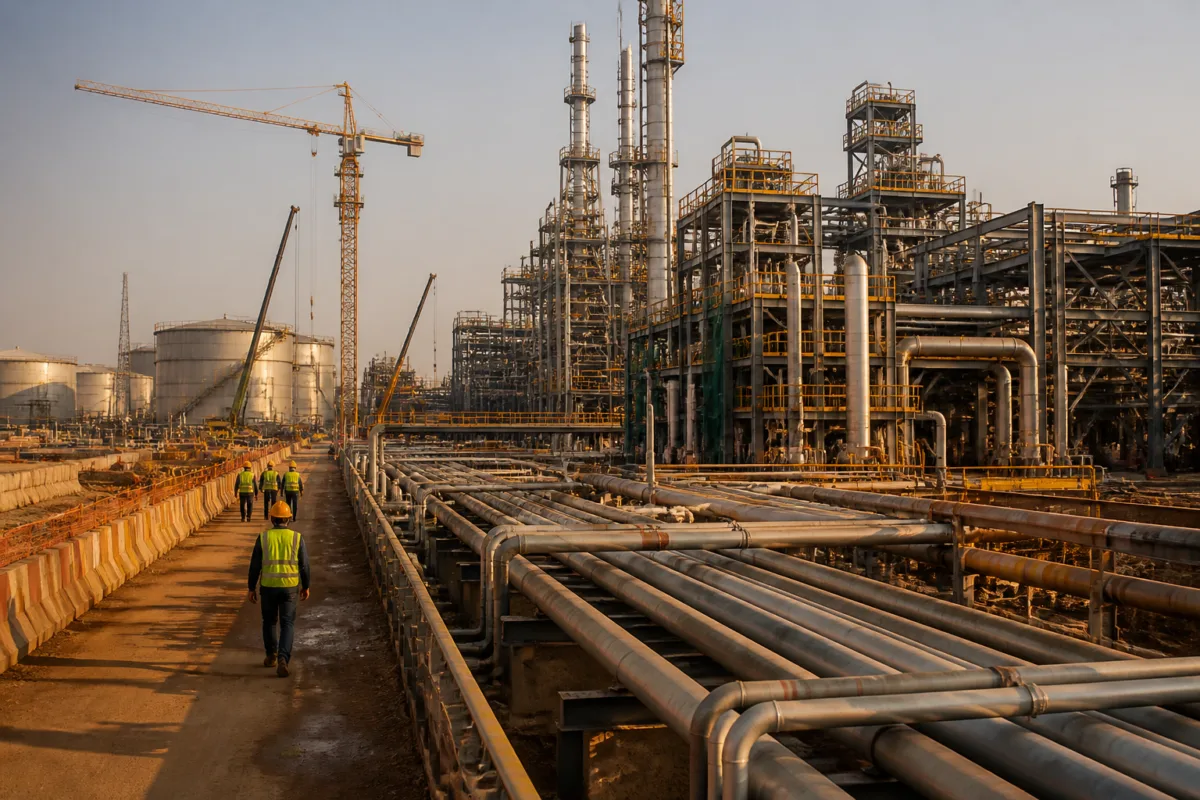
Indian Oil Corporation’s first-half capital spending reveals a company moving cautiously through a large infrastructure build-out even as several refinery, pipeline and petrochemical projects approach commissioning. The state-owned energy major spent ₹12,162 crore, or 37 per cent of its ₹32,700-crore FY27 capex target, between April and September 2026. The more important question is not simply whether the company will meet its annual spending target, but what the pattern says about the changing structure of India’s energy infrastructure.
The spending is concentrated in refining and marketing, which received around ₹9,300 crore during the six-month period, according to Business Standard’s report. Petrochemical projects accounted for ₹1,306 crore, pipelines for ₹582 crore, natural gas projects for ₹133 crore, research and development for ₹109 crore and exploration and production for ₹121 crore. The report also refers to ₹1,300 crore spent on petrochemical projects earlier in the same breakdown; the difference requires clarification, but the broad allocation is clear: Indian Oil is prioritising downstream capacity, distribution assets and projects that can be integrated into its existing operating network.
That allocation marks a shift from the urgency suggested by the company’s annual target. Indian Oil spent more than 47 per cent of its annual capex target by the end of September in the previous financial year. The lower first-half proportion in FY27 does not necessarily establish a funding shortfall. It may reflect the sequencing of large projects, the timing of commissioning activity and the difference between construction expenditure and final integration of completed assets. But it does mean that the second half of the financial year will be important for determining whether the company accelerates spending or carries a larger portion of its programme into later periods.
The projects nearing completion illustrate why the timing of capital expenditure matters. Indian Oil has projects worth ₹1.04 trillion under implementation. Two of the largest are the ₹13,805-crore Paraxylene-Purified Terephthalic Acid complex at the Paradip Refinery and the ₹3,220-crore New Mundra-Panipat Crude Oil Pipeline. Both were mechanically completed in July 2026 and are under commissioning. Mechanical completion indicates that the physical construction phase has reached a significant milestone, but commissioning is the stage in which systems, utilities and operating processes are brought together before commercial capacity can be fully realised.
The company’s executive director for corporate finance and treasury, Nitin Kumar, told investors that the investments were aligned with its long-term strategic roadmap and national energy priorities. He said Indian Oil was undertaking phase-wise commissioning of process-unit utilities and offsite capacities to enable progressive capacity build-up and integration. That statement points to the institutional complexity behind the capex number. Large refinery and pipeline projects do not become productive merely when construction ends. Their value depends on interlinked units, storage, transport systems, utilities, product movement and operating approvals becoming functional in sequence.
Three refinery expansion projects are expected to be completed by the end of December 2026. The Panipat Refinery Expansion, approved at ₹38,231 crore, is intended to raise capacity from 15 million tonnes per annum to 25 MTPA. The Gujarat Refinery Expansion, costing ₹18,936 crore, targets an increase from 13.7 MTPA to 18 MTPA. The ₹18,113-crore Barauni Refinery Expansion aims to increase capacity from 6 MTPA to 9 MTPA. Together, the planned additions would increase the processing capacity of these three facilities by 17.3 MTPA if the stated targets are achieved.
These projects also show how India’s energy infrastructure is being expanded through existing industrial sites rather than only through entirely new locations. Expanding established refineries can allow a company to use existing land, supply chains, workforce arrangements and distribution connections. At the same time, it creates a more demanding integration task because new capacity has to work alongside operating plants. The completion schedule therefore matters not only for construction management but also for the reliability and efficiency of the wider fuel-distribution system.
The pipeline investment provides a different layer of infrastructure. The New Mundra-Panipat Crude Oil Pipeline links an import-facing coastal location with a major inland refining and consumption corridor. Its commissioning could strengthen the physical connection between crude supply and refinery demand, although the supplied material does not provide operating-capacity details, throughput estimates or a commissioning date. Those details will be necessary to assess the project’s eventual contribution to supply resilience and logistics costs.
Indian Oil’s project portfolio is not limited to conventional fuels. The company is also spending ₹3,220 crore on a new research and development campus at Faridabad in Haryana and ₹2,949 crore on a polybutadiene rubber plant at Panipat. The R&D campus suggests an attempt to build technical capacity within the company, while the rubber plant extends the portfolio further into petrochemical and industrial materials. These investments are relevant to the built and industrial environment because they connect energy infrastructure with manufacturing capacity, research facilities and specialised production.
However, the distribution of spending shows that the transition away from conventional hydrocarbons is not yet the dominant financial story in Indian Oil’s current capex. Exploration and production received only ₹121 crore in the first half, while natural gas projects received ₹133 crore. Renewable energy is presented as a longer-term expansion plan rather than the main component of current expenditure. The company’s management said it plans to expand renewable generation capacity over the next five years and would contribute between ₹5,000 crore and ₹10,000 crore as equity in joint ventures created for clean-energy projects.
The renewable-energy figures reported in the source require clarification. The report states that Indian Oil plans to expand capacity from an existing 259 GW to 31 GW, a sequence that is mathematically inconsistent because the stated target is below the stated base. The unit may also require correction. Until the company clarifies the existing capacity, the target and the units involved, the scale of this part of the strategy cannot be reliably assessed. The equity commitment, however, is clearly reported as ₹5,000 crore to ₹10,000 crore over the next five years through joint ventures.
This uncertainty is important because Indian Oil’s investment choices are being made across two time horizons. Refinery expansions, pipelines and petrochemical facilities are large, long-life assets that reinforce the existing energy system. Renewable generation, research and new materials are intended to position the company within a changing energy and industrial economy. The first-half capex numbers show that the immediate capital burden remains concentrated in the former category, while the latter is being developed through a combination of dedicated projects and partnerships.
For public infrastructure, the key issue is execution rather than the headline target alone. Indian Oil’s first-half spending is below the pace recorded at the same point last year, but several major assets are moving from construction into commissioning. The company’s ability to complete the Panipat, Gujarat and Barauni expansions, integrate the Paradip PX-PTA complex and bring the Mundra-Panipat pipeline into operation will determine how much of the announced investment becomes usable capacity.
The next milestones are therefore concrete: phase-wise commissioning of the mechanically completed projects, completion of the three refinery expansions by December 2026, and greater clarity on the renewable-energy capacity plan. Together, they will show whether Indian Oil’s FY27 capex is merely progressing more slowly in the first half or represents a broader rebalancing between conventional energy infrastructure, petrochemicals, research and clean-energy ventures.

