


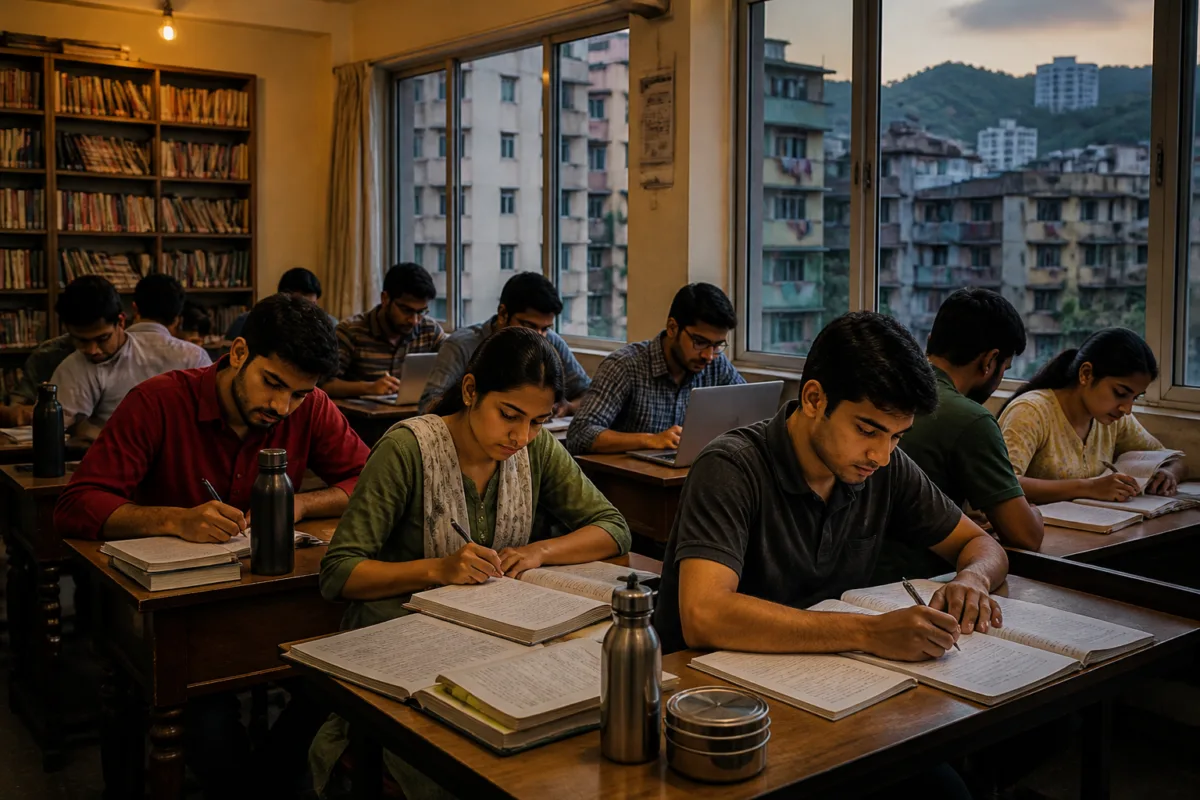
The demands emerging from Pune’s MPSC student community point to a problem that extends well beyond delayed examinations. For many aspirants, uncertainty over exam dates, results and appointments is increasing the cost of remaining in the city, where rent, food, study rooms and daily expenses must be paid even when the recruitment cycle does not move on schedule.
A report by Sakal – Pune says students and competitive-examination guides are seeking a comprehensive support policy from the Maharashtra government. Their demands include a reliable annual examination calendar, time limits for results and appointments, financial assistance for economically vulnerable students, subsidised meals, affordable accommodation, more training places and local study facilities outside major cities.
The underlying urban issue is access. Pune has developed into a major destination for competitive-examination preparation, but access to that ecosystem depends heavily on a student’s ability to pay for accommodation and daily living. The report describes students from rural and farming families who are unable to sustain the cost of staying in Pune, particularly after crop losses or other economic setbacks. Some are reportedly being forced to return to their villages and discontinue their preparation.
This makes examination administration a housing and livelihood question as well as an education question. When an examination is postponed or its results are delayed, the financial consequences are not limited to lost time. Students may have to extend room rentals, continue paying mess charges and study-room fees, and repeatedly plan around dates that are not certain. The report says that this uncertainty has made it difficult for students to determine how long they need to remain in Pune.
Kiran Nimbhore, identified in the report as a competitive-examination guide, said students from drought-affected and economically weaker families should receive a special subsistence allowance. He also called for concessions in application fees and financial relief for students who must apply repeatedly because examinations are postponed. These proposals frame the cost of competitive examinations as a recurring burden rather than a one-time registration expense.
The demand for support is also connected to the geography of opportunity. Student Junaid Shaikh said not every aspirant can travel to Pune for preparation and called for free study rooms at district and taluka levels, dedicated competitive-examination sections in libraries, internet access and digital study material. Such facilities would reduce the need for students to relocate to a large city merely to access basic preparation infrastructure.
This is an important distinction in the debate over examination reform. A punctual examination calendar can reduce uncertainty, but it cannot by itself remove the geographic concentration of coaching, libraries, study rooms and peer networks. The demands reported from Pune suggest that a more distributed preparation system is also needed if students from smaller towns and villages are to compete without taking on the full cost of urban migration.
Food and accommodation are central to that question. Pradeep Handal, identified as an MPSC student, said students living in Pune bear a substantial expense for meals and housing, with the burden particularly severe for those from farming families. He proposed a subsidised meal system on the lines of the Shiv Bhojan Thali scheme and called for more places in government hostels and affordable accommodation.
The proposal is significant because food and housing are the recurring costs that determine whether a student can remain in the city. A student may be able to manage an examination fee or a single journey, but prolonged uncertainty can turn monthly living expenses into the decisive barrier. The report does not provide figures for the number of affected students, the existing capacity of government hostels or the cost of the proposed measures. Those gaps mean the demands cannot yet be assessed as a quantified state-wide programme, but they clearly identify the areas where the present support system is perceived to be inadequate.
The institutional structure is another part of the problem. The report refers to schemes operated through Sarathi, BARTI, Mahajyoti, T-and-D? No. It refers to SARTHI, BARTI, Mahajyoti, TRTI, ARTI and AMRUT, which provide various forms of training, scholarships and fellowships for students from different social groups. Mahesh Gharbude, president of the Competitive Examination Students Association, alleged that reductions in the number of places under these schemes have prevented many eligible students from benefiting. He called for training and scholarship places for UPSC and MPSC preparation to be restored and increased according to student numbers, with timely implementation and special provisions for drought-affected areas.
These demands point to a coordination challenge. Examination scheduling is associated with the Maharashtra Public Service Commission, while accommodation, food support, scholarships, training and counselling involve different departments and institutions. Students seeking help must therefore navigate several systems, each with its own eligibility rules, application process and timeline. The report calls for a dedicated grievance cell coordinated between the commission and relevant departments, with time-bound resolution and official examination information available in one place.
The need for a single information channel is not merely administrative. When examination dates, results, scholarships and hostel availability are communicated separately, students must make housing and financial decisions without a consolidated view of the process. A centralised information and grievance mechanism could make responsibilities more visible, although the report does not specify what authority such a mechanism would have or how quickly complaints would be required to be resolved.
The report also places mental health within the same policy framework. Dipti Nair, identified as a competitive-examination guide, said uncertainty, financial pressure and family expectations were contributing to student stress. She called for counselling centres that could provide support on mental health, study planning and alternative careers. The report says organisations including Vastav Katta and Rinanu-bandh Foundation are already conducting free counselling and guidance initiatives, but it does not establish their scale or coverage.
This matters because the student experience is shaped by a chain of linked uncertainties. A delayed examination can extend accommodation costs; higher costs can force a student to leave Pune; leaving can reduce access to libraries, coaching and peer support; and prolonged uncertainty can add psychological pressure. Treating each issue as a separate grievance risks missing the way these pressures reinforce one another.
The demands also raise questions about the role of civil society and private support. Pravin Chavan, identified as a competitive-examination guide, said community organisations and donors should help create low-cost hostels, meal services and dedicated funds for students. Such support may provide immediate relief, but the report’s broader demands place primary responsibility for predictable examinations, public study infrastructure, scholarships and institutional grievance handling on the state and the examination system.
What the available evidence confirms is that Pune’s competitive-examination economy is not accessible on equal terms. The cost of staying in the city, combined with uncertainty in the examination cycle, places rural and economically weaker students at a disadvantage. What remains unestablished in the report is the scale of the affected population, the extent of any reduction in scheme seats, the available hostel capacity and the financial requirements of the proposed support measures.
The next meaningful test will be whether the state and the Maharashtra Public Service Commission respond with specific measures rather than broad assurances. A published annual calendar, defined timelines for results and appointments, transparent scholarship and training capacity, affordable student services and a functioning grievance mechanism would allow the demands to be assessed against implementation. Until then, the MPSC student crisis in Pune remains a reminder that access to public-sector careers is shaped not only by examination performance, but also by the cost of surviving the preparation period.

