


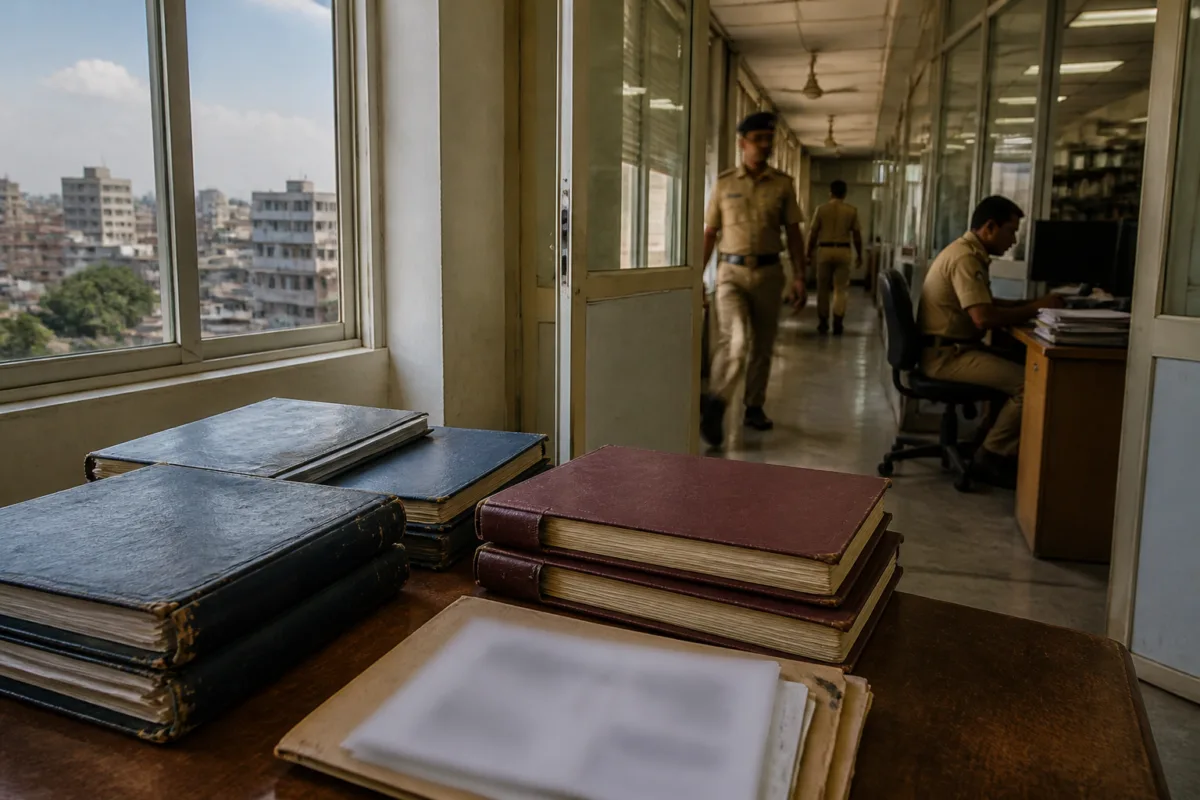
The alleged siphoning of ₹1.33 crore from welfare and service-related accounts at Hyderabad’s City Armed Reserve headquarters is more than a criminal investigation involving two employees. It has also exposed how weaknesses in basic financial administration—unused cheque books, forged signatures, poorly maintained cash books and unauthorised electronic transfers—can place institutional welfare funds at risk.
The case came to light after E Kalyani, an administrative officer at the CAR headquarters, lodged a complaint with the Central Crime Station on October 28. According to the report by Times of India, CCS police arrested junior assistants B Vinay Kumar and Mohsin Jalal and said both were remanded to judicial custody on October 29. The police have registered a case under provisions of the Bharatiya Nyaya Sanhita relating to criminal breach of trust, cheating, forgery, use of forged documents, falsification of accounts, criminal conspiracy and common intention.
The police allegations remain subject to investigation and judicial process. But the reported mechanics of the suspected fraud provide an unusually clear view of the administrative vulnerabilities inside a large public institution. The alleged transactions did not involve a single account or one narrow expenditure head. Investigators identified irregularities in education, sports, widow, dhobi and recreation funds, as well as unit welfare, water charges and canteen accounts managed by the CAR headquarters.
That spread matters because welfare accounts are generally designed around specific institutional purposes. Education and widow funds, for example, imply distinct beneficiary groups and expenditure priorities, while sports, recreation, canteen and water-charge accounts relate to the everyday functioning and welfare environment of the force. When several such accounts are allegedly accessed through the same mechanism, the issue is not only whether money was withdrawn unlawfully. It is also whether account-level separation existed in practice, whether reconciliations were timely, and whether the officers responsible for authorising and recording transactions had effective visibility over the funds.
## What the Hyderabad police welfare fund case reveals
According to the complaint cited in the report, the accused allegedly used unused cheque leaves from old cheque books and forged the signatures of authorised officers. The cheques were presented at the State Bank of India’s Hussaini Alam branch, after which funds were transferred to individual accounts through cheque transactions and NEFT transfers.
The reported use of old cheque books points to a control problem that is operational rather than sophisticated. A cheque book that is no longer in active use can still become a financial risk if its unused leaves are not cancelled, securely stored or formally accounted for. The alleged forging of authorised signatures indicates a second weakness: the signature itself may have been treated as sufficient evidence of approval without a stronger verification process.
The case also underlines the importance of linking banking records to internal financial records. CCS investigators said they had identified 35 suspicious cheques and NEFT transactions carried out between August 2022 and April 2026. The transactions, according to a CCS official quoted by Times of India, were not supported by cash books or other office records.
A cash book is not merely a historical ledger. It is a basic instrument for tracking receipts, withdrawals and balances, and for enabling an institution to compare its internal records with bank statements. If cash books are incomplete or poorly maintained, irregular transactions can remain undetected for longer and it becomes harder to establish who authorised a payment, what it was meant to fund and whether the amount reached an eligible beneficiary.
The police also said some beneficiary accounts belonged to the two employees, while other accounts were suspected of having been opened solely to route the money. That allegation will have to be tested through the investigation and court proceedings. It nevertheless shows why beneficiary verification and transaction-level scrutiny are essential wherever institutional funds move electronically.
## The institutional chain behind welfare accounts
The reported fraud involved accounts managed at the CAR headquarters, but accountability in such cases is distributed across several points in an administrative chain. The unit that maintains the account must preserve records and authorise payments. Designated officers must verify signatures and approve expenditure. Banking channels must process instruments in accordance with their controls. Internal scrutiny must compare the institution’s records with actual transactions. Investigators become involved when anomalies are reported or detected.
The available report does not establish which specific control failed at each stage, nor does it state whether earlier audits had identified discrepancies. It does, however, record that the irregularities were detected during an internal scrutiny of records and that the cash books were poorly maintained, according to police. Those facts point to a gap between the existence of financial procedures and their day-to-day execution.
This distinction is important in public administration. A department can have separate welfare heads, authorised signatories and banking procedures on paper, yet still remain vulnerable if there is no regular reconciliation, if old instruments are not closed, or if one person can prepare, approve and track a transaction without adequate independent review. The report does not say that all these failures occurred, and they should not be assumed. The investigation will need to establish the precise chain of responsibility.
The alleged period of the suspicious transactions—August 2022 to April 2026—also makes the question of detection significant. The longer an irregular payment remains unmatched against cash books, vouchers or beneficiary records, the more difficult it can become to reconstruct the transaction trail. In this case, police have so far identified 35 suspicious cheques and NEFT transactions, but the report does not state whether this is the final number or whether the full amount has been traced.
## Why record-keeping is a governance issue
The case illustrates how a seemingly routine administrative weakness can become a public-interest issue. Welfare funds are not abstract budget lines. They are intended to support personnel and families through designated programmes and services. Any alleged diversion therefore affects both the institution’s finances and the reliability of the support system attached to those accounts.
The report does not identify individual beneficiaries who were denied assistance, nor does it quantify the impact on specific welfare programmes. It would be premature to claim that every affected activity suffered a service failure. However, the presence of irregularities across multiple funds creates a need to determine whether payments were delayed, balances were misstated or planned activities were disrupted.
The case also raises a broader question about administrative visibility. An institution managing several funds needs a consolidated view of balances, payments, signatories and pending reconciliations, while retaining clear separation between each fund’s purpose. Without that visibility, a transaction may appear legitimate within one narrow file even when it does not fit the account’s purpose or the institution’s overall records.
Digital transfers do not automatically solve this problem. NEFT creates a banking trail, but the trail is useful only when the receiving account, payment purpose, authorisation and supporting record are checked against one another. The reported combination of forged cheques and unauthorised NEFT transfers suggests that both paper-based and electronic processes may need to be examined in the investigation.
## What remains to be established
The arrests mark an early stage of the case, not its conclusion. The CCS has said it will seek police remand, and investigators are expected to examine the transaction trail, the role of the beneficiary accounts, the use of old cheque books and the condition of the relevant office records. The judicial process will determine the allegations against the two employees.
Several questions remain unanswered in the supplied report. It is not yet clear when each suspicious transaction was detected, how the alleged ₹1.33 crore was distributed across the different accounts, whether any money has been recovered, who had custody of unused cheque leaves, or whether other employees or external account holders are suspected of involvement. The report also does not establish whether the alleged irregularities affected payments due to police personnel or their families.
Those questions are central to understanding the full institutional impact. A criminal investigation can identify culpability, but the administrative review must also determine how the system allowed the transactions to pass through, why the records did not expose them earlier and whether the same weaknesses exist in other unit-managed accounts.
The Hyderabad police welfare fund case therefore sits at the intersection of financial crime and urban governance. It concerns a city institution, public money and the administrative systems through which services and welfare support are delivered. The immediate legal proceedings will focus on the accused and the transactions. The larger governance test will be whether the investigation produces a clear account of the control failures and whether the affected financial systems are subsequently made more transparent and auditable.

