


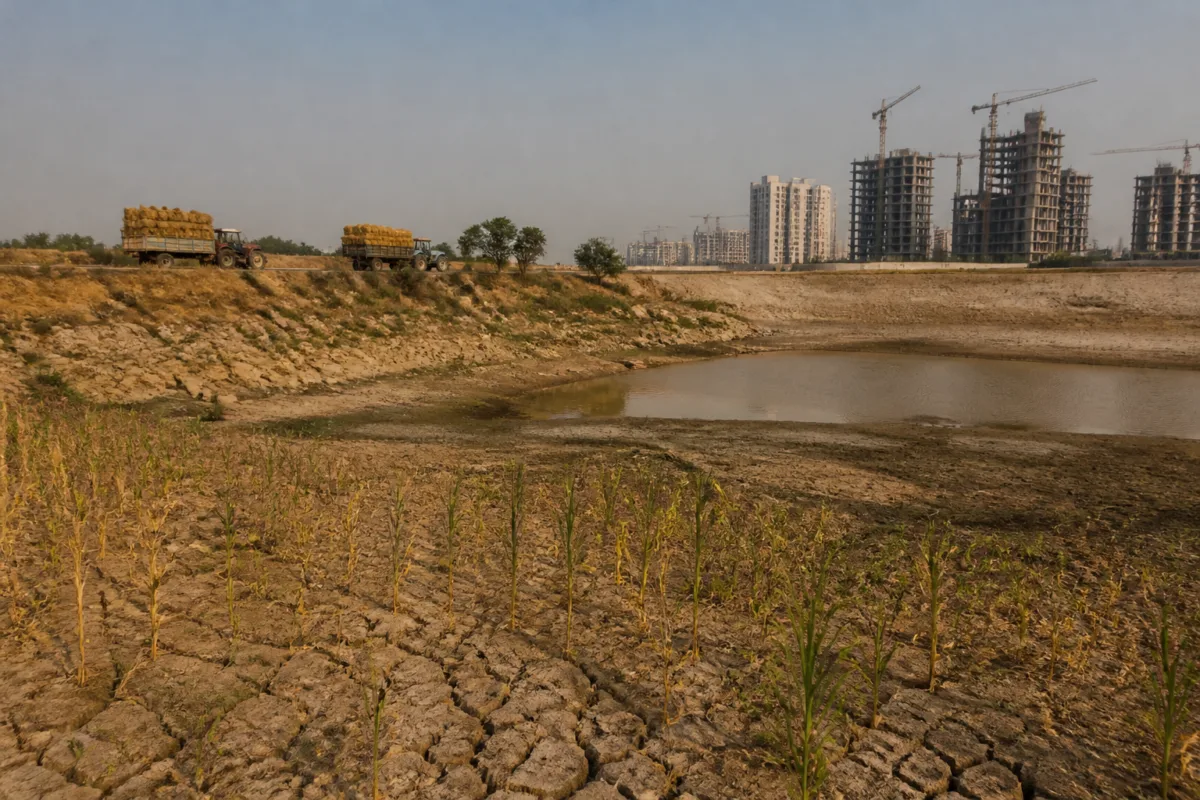
Telangana’s El Niño impact is no longer confined to farms and reservoirs. An expert committee appointed by the state government has warned that a rainfall deficit could reduce gross state domestic product growth by 1.5 to 2 percentage points, weaken government revenue collections and transmit stress through rural consumption, construction, real estate and banking. The warning shows how closely Telangana’s urban economy remains tied to the condition of its agricultural hinterland.
The committee’s report, submitted to the government on October 28, assessed the likely consequences of El Niño and proposed measures to protect agriculture and allied sectors. Its central concern is that poor southwest monsoon rainfall could trigger a chain reaction: lower farm output would reduce rural incomes; weaker incomes would reduce household spending; falling demand would affect businesses and tax collections; and stressed borrowers could increase risks for banks.
The report places this risk against an estimated GSDP growth rate of 10 to 10.7 per cent for the current financial year. A setback of 1.5 to 2 percentage points would not represent a collapse in the state economy, but it would materially reduce the pace at which economic activity and public revenues expand. The committee also cautioned that the impact may become more visible in the coming months, after the first six months of the financial year had already met revenue collection targets.
The important point is the transmission mechanism. Agriculture directly supports more than 60 per cent of Telangana’s workforce, according to the report. A decline in farm incomes therefore affects not only cultivators but also rural artisans, transport workers, loaders, drivers, traders and workers linked to market yards and food processing. When this income weakens, rural households reduce spending, and that reduction reaches sectors that appear, at first glance, to be disconnected from rainfall.
The committee expects demand for automobiles, electronic goods, fast-moving consumer goods and other discretionary products to weaken if rural consumption contracts. It estimates that the state’s share of Goods and Services Tax collections could decline by 15 to 20 per cent if the slowdown in consumption persists. The finding links the condition of rural households directly to the state’s fiscal capacity: lower spending reduces the tax base at precisely the time when public intervention may be required.
The water and agricultural consequences form the first stage of this chain. The report says declining groundwater levels and reduced storage in reservoirs and irrigation projects could restrict Rabi cultivation to between 30 and 40 per cent of the 70 lakh acres normally brought under crops during the season. The agriculture department’s advisory against water-intensive crops could further reduce paddy and other irrigated cultivation.
This is not only a question of the acreage under cultivation. Reduced production would affect rice mills and food processing units through shortages of raw materials. It would also reduce activity at agricultural markets, affecting workers whose incomes depend on the movement, loading, transport and processing of farm produce. The report therefore treats agriculture as an economic network rather than an isolated sector.
The same network extends into Telangana’s construction and property markets. The committee says agricultural land transactions have already declined by around 10 per cent compared with previous levels. This creates a risk for the government’s annual target of ₹18,000 crore from stamps and registrations. A fall in land transactions is therefore both a real estate signal and a potential fiscal problem for the state.
Construction could face a second-order impact if weaker rural incomes and slower property transactions reduce demand. The report warns that reduced construction activity could affect business transactions involving cement, steel, bricks, hardware and other building materials. It estimates that nearly 20 lakh workers, including construction labourers, masons and plumbers, could face employment uncertainty if the sector weakens.
This connection matters for Telangana’s urban centres because construction is one of the principal channels through which land and financial activity become visible in cities. A slowdown in transactions can affect developers, contractors, material suppliers, informal workers and local businesses at the same time. The committee’s assessment suggests that the rural economic shock could reach urban construction markets without requiring a separate collapse in city-level demand.
The fiscal implications are similarly distributed across institutions. Lower consumption would affect SGST collections, while weaker land transactions could reduce stamp and registration revenue. If construction slows, associated economic activity and material purchases could also decline. The state’s revenue position would consequently face pressure from several channels rather than from one isolated shortfall.
The committee has also identified a financial stability risk. A contraction in agricultural and allied activity could weaken the repayment capacity of borrowers who depend on those sectors. The report warns that banks could see a rise in non-performing assets if industrial production and business activity also slow. It does not establish that such an increase has already occurred; rather, it identifies the risk as a possible consequence of declining incomes and weaker transactions.
The proposed response is designed to maintain cash flow through the rural economy. The committee has called for a comprehensive contingency plan, a special financial assistance package and an expansion of employment guarantee works. It has specifically recommended direct benefit transfers to farmers, tenant farmers and rural artisans so that financial support reaches groups whose incomes are exposed to the rainfall deficit.
The report also argues that the existing employment guarantee programme should not be treated as the only tool for reviving rural demand. Wages paid under the scheme would largely be used for essential household requirements and, in the committee’s assessment, may not create sufficient additional demand to sustain rural markets. This distinction is significant: income support can protect consumption at a basic level, but the report suggests that a wider intervention may be needed to prevent a sharper contraction in business activity.
The proposed expansion of employment guarantee works has a dual purpose. It would provide additional income to rural households while maintaining cash circulation in villages. Direct transfers would address immediate income stress among specific groups, while employment works would create a broader channel for support. The report presents both measures as part of a strategy to prevent a fall in rural purchasing power from spreading through the wider economy.
However, the effectiveness of this response will depend on how the state converts the committee’s recommendations into funded and operational measures. The supplied report records the recommendations but does not establish whether a special package has been approved, the amount involved, the districts to be covered or the timetable for implementation. Those details will determine whether the proposed response can address the expected reduction in cultivation, income and demand.
The scale of the Rabi cultivation risk also makes water management central to the issue. If only 30 to 40 per cent of the usual 70 lakh acres is brought under crops, the resulting reduction would affect farm incomes, agricultural markets, food processing and transport activity simultaneously. The report attributes this risk to falling groundwater levels, lower reservoir and irrigation storage, and restrictions on water-intensive crops. It does not provide, in the supplied material, a district-wise assessment of the likely impact.
For cities, the larger lesson is that economic resilience cannot be measured only through urban indicators. Telangana’s construction activity, property transactions, retail demand, tax collections and banking health are connected to income generated outside major urban centres. The state’s urban economy depends on flows of labour, money, materials and consumption that run through rural areas and agricultural markets.
The committee’s assessment therefore frames the rainfall deficit as a governance challenge across departments. Agriculture, irrigation, rural development, finance, taxation, labour, banking and urban-linked construction markets are all affected by the same underlying shock. A response limited to crop protection would not address the revenue, employment and demand risks identified in the report.
What the evidence establishes is a chain of exposure: rainfall deficit threatens cultivation; reduced cultivation threatens farm incomes; weaker incomes threaten rural consumption; lower consumption threatens tax collections and business activity; and slower property and construction markets could add pressure to employment and state revenues. What remains to be established is the scale and timing of the actual economic impact, as well as the government’s implementation plan for the recommended measures. The next important milestones are the state’s response to the committee’s report, the design of any financial assistance package and the extent of Rabi cultivation achieved during the season.

