


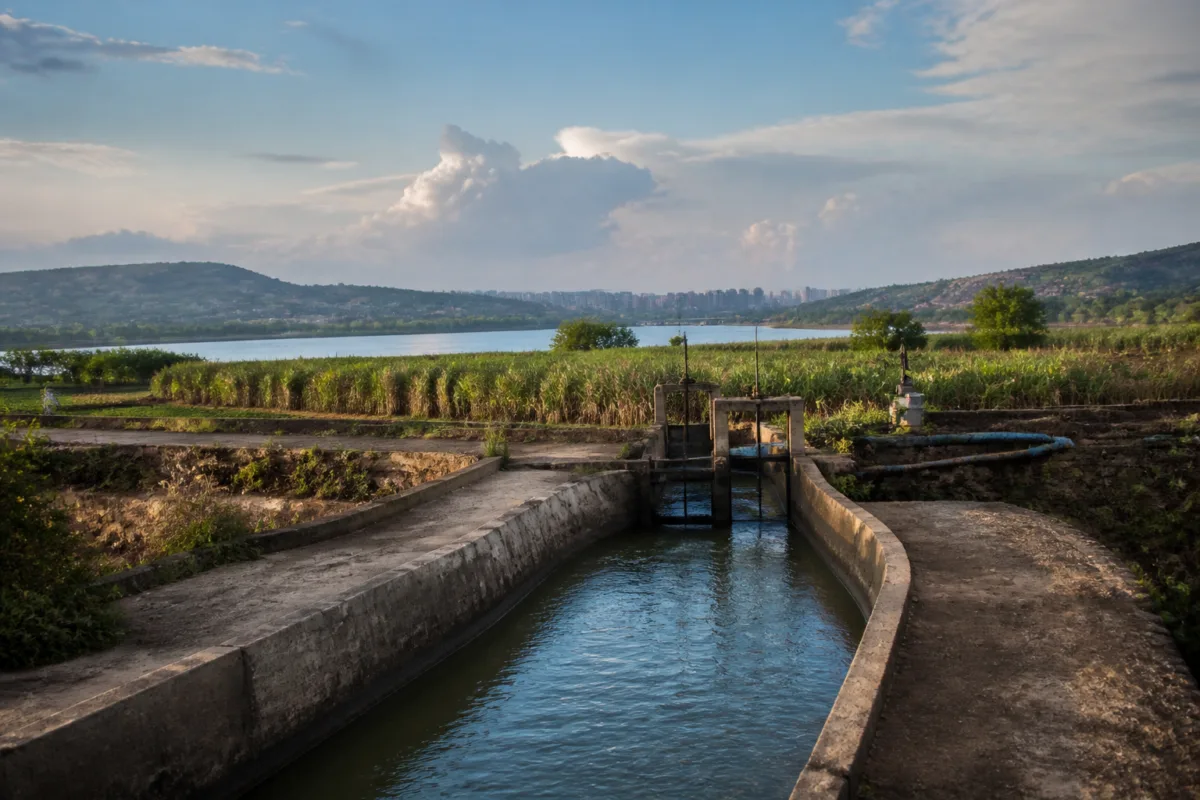
The latest allocation debate over Khadakwasla water is not simply a dispute between Pune and farmers. It is a test of how a rapidly expanding city, a drought-prone agricultural belt and an ageing water-delivery system share one finite reservoir network. A canal advisory committee has prioritised drinking water for Pune, while leaving the release of water for the rabi and summer irrigation cycles undecided, placing around 60,000 hectares of agricultural land in Haveli, Daund, Baramati and Indapur at risk, according to a report by Lokmat – Pune.
The decision reflects a basic institutional hierarchy in water management: drinking water receives priority during scarcity. The Khadakwasla project supplies Pune as well as drinking-water and irrigation requirements in parts of Pune district. But the hierarchy becomes difficult to implement when the same four reservoirs—Panshet, Varasgaon, Temghar and Khadakwasla—serve a city whose population and municipal boundaries have expanded alongside rural areas that depend on canal releases for cultivation, livestock and local water schemes.
The four reservoirs have a combined storage capacity of 29 TMC. The report says all four filled during this year’s monsoon, and excess water had to be released into the Mutha river. Yet rural areas have faced shortages because water was not released into the tanks that were demanding it. This apparent contradiction—full reservoirs during the monsoon followed by uncertainty over irrigation releases—points to a problem beyond rainfall. Storage is only one part of the system. Allocation rules, conveyance infrastructure, municipal demand, leakage and the timing of releases determine whether stored water reaches farms and towns when it is needed.
For the current planning cycle, Pune Municipal Corporation has been allocated 13 TMC for drinking-water planning from the Khadakwasla system. At the same time, the city’s demand for the 2026-27 water year has reportedly been placed at 21.34 TMC, taking into account a population of about 8.3 million and 34 villages incorporated into the municipal limits. The previous year’s allocation was 16 TMC. The gap between current allocation and projected demand is therefore central to the dispute: any effort to meet the city’s rising requirement from the same system increases pressure on irrigation allocations downstream.
The report also identifies an important source of tension within the municipal supply itself. Pune’s environmental report is cited as estimating that 32 to 35 per cent of the water supplied to the city—around 4.65 TMC—is lost through pipeline leakage and theft. In a system where agricultural releases are being reduced or left unresolved, such losses become more than a technical inefficiency. They affect the legitimacy of the allocation process because rural stakeholders see usable water being lost inside the urban network while farms face uncertainty over canal supplies.
This does not mean that reducing leakage alone would resolve the conflict. The city’s requirement is increasing because of population growth and the addition of new settlements to its administrative boundary. But the leakage estimate shows that the debate cannot be framed only as a choice between urban drinking water and rural irrigation. The efficiency of the urban distribution system is also part of the water balance. Every unit lost after treatment or during transmission reduces the amount available for households and increases pressure on the source.
The rural impact is concentrated in areas where irrigation alternatives are limited. The belt covered by the Khadakwasla canal is recognised as drought-prone and receives comparatively low rainfall, making canal water a major support for cultivation. The report says about 6.38 TMC was released through the canal for the kharif season. The rabi cycle began on September 25, but orders to reduce the water quota by 10 per cent have raised fears that canals could be closed earlier than planned.
The consequences extend beyond sugarcane. Sugarcane growers in the operating areas of Bhima Patas, Karmayogi Indapur, Anuraj Yavat, Daund Sugar, Baramati Agro and Chhatrapati Bhavaninagar are identified as exposed to the shortage. Fodder crops and livestock could also be affected. The issue therefore links irrigation policy to rural livelihoods, dairy and animal husbandry, sugar production and the drinking-water needs of towns and villages. Janai and Shirsai lift irrigation schemes, the water supplies of Daund and Indapur towns, and water-supply schemes operated by hundreds of gram panchayats are also reported to be vulnerable.
The institutional challenge is that these uses are managed through different administrative and political channels but depend on the same hydrological system. Pune’s municipal water planning is driven by household demand and the need to serve an expanding urban jurisdiction. Irrigation releases are tied to crop cycles and canal operations. Lift irrigation schemes require pumping infrastructure and dependable source levels. Rural local bodies depend on schemes whose capacity and operating schedules may not align with the city’s supply calendar. A reservoir allocation decision can therefore create effects across multiple agencies even when it is formally taken for one sector.
The Khadakwasla-Fursungi underground tunnel project is presented in the report as a potential way to reduce some of these pressures. The proposed tunnel is 28 kilometres long. By carrying water underground, it is expected to reduce evaporation and leakage and save around 3 TMC. That saving would be significant in a system where the city’s reported distribution losses are estimated at around 4.65 TMC. But the tunnel is not an immediate substitute for better allocation or network management. Its benefits depend on the project being completed at the required pace and on the saved water being managed transparently within the broader allocation framework.
The Mundhwa jackwell illustrates a similar gap between installed capacity and actual delivery. It was expected to draw 650 million litres a day for agricultural supply, but the report says that volume has not been consistently available. After objections were raised, the quantity released for agriculture through the Baby canal was increased to 450 million litres a day, with five pumps operating around the clock. However, difficulties remain because treated water is not being lifted at adequate pressure. The example shows that infrastructure capacity on paper does not automatically translate into reliable supply on the ground. Pumps, pressure, treatment, transmission and distribution must work together.
This is also why the conflict cannot be reduced to a simple question of whether Pune is using too much water or whether rural users are demanding more than the system can provide. The evidence in the report shows a chain of interdependence: the reservoirs hold 29 TMC; Pune has a current planning allocation of 13 TMC and a reported 2026-27 demand of 21.34 TMC; urban leakage is estimated at 32 to 35 per cent; irrigation allocations face a 10 per cent reduction; and a proposed tunnel could save around 3 TMC. Each figure belongs to a different part of the system, but together they demonstrate that the dispute is shaped by both demand growth and delivery inefficiency.
The deeper governance question is whether allocation decisions are being made for a single annual cycle or as part of a durable urban-region water strategy. Pune’s municipal limits now include 34 villages, increasing the city’s responsibility for household supply while also expanding the political and physical footprint of urban demand. At the same time, the reservoirs continue to serve areas outside the corporation’s boundaries. Urban expansion has therefore not separated the city from its rural hinterland; it has made their water systems more closely connected.
The immediate uncertainty concerns the rabi and summer releases. The canal advisory committee has prioritised drinking water, but the report does not establish a final schedule for irrigation releases. That missing decision is important because crop planning, fodder availability and lift irrigation operations depend on timing, not only on the annual volume eventually allocated. The 10 per cent quota reduction and the possibility of early canal closure add to that uncertainty.
The evidence confirms that Khadakwasla’s water dispute is a capacity and governance problem as much as a scarcity problem. Pune’s rising demand, rural dependence on canals, losses in the municipal network, incomplete use of the Mundhwa jackwell and the proposed underground tunnel all point to the same requirement: water must be tracked from reservoir allocation to final use. The next developments to monitor are the formal decision on rabi and summer canal releases, progress on the Khadakwasla-Fursungi tunnel, actual performance of the Mundhwa system and measures to address the city’s reported distribution losses.

