


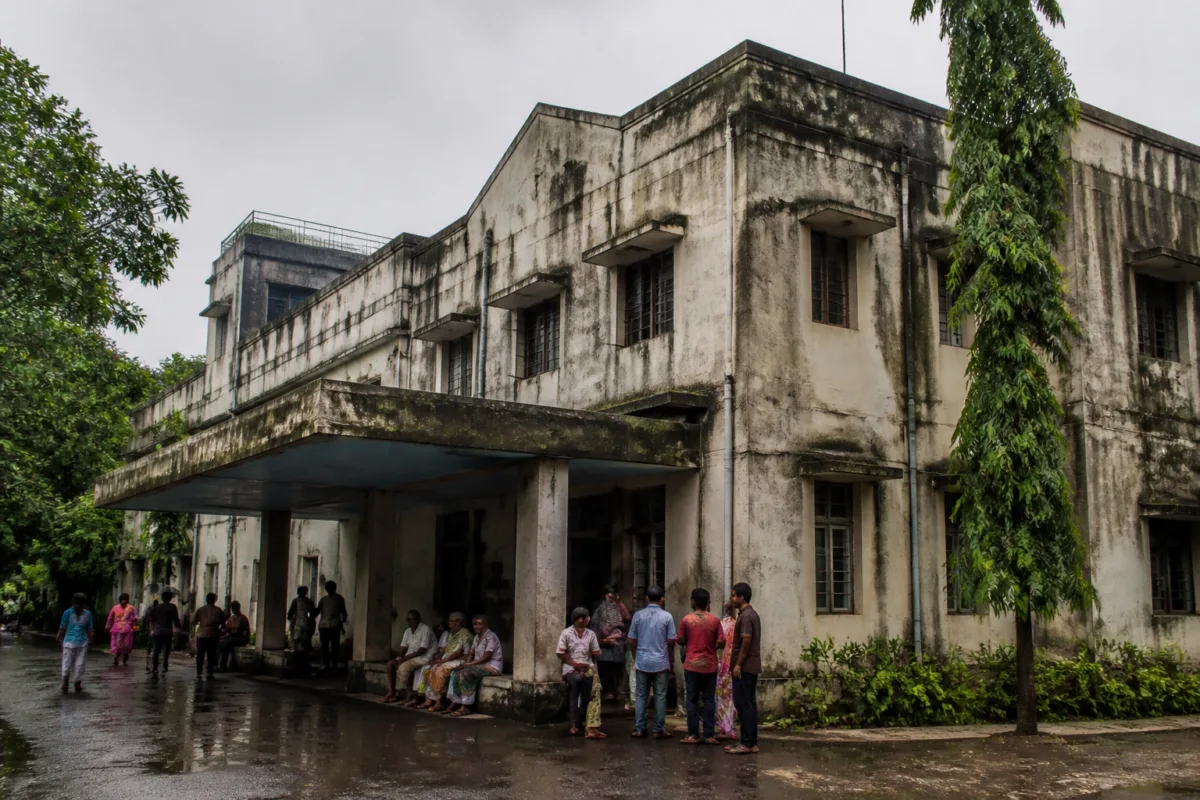
Aundh Kuti Hospital’s deteriorating building and long-standing shortage of specialist doctors reveal a problem that extends beyond one municipal facility: keeping a public hospital open is not the same as ensuring that it can safely and effectively deliver healthcare. The Pune Municipal Corporation-run hospital receives between 100 and 150 outpatients each day, including women registering for childbirth services and children arriving for vaccination, yet its building has developed cracks, its walls become heavily damp during the monsoon and key medical services remain unavailable.
The condition of the hospital, reported by Lokmat – Pune, illustrates how public health infrastructure can weaken gradually. A facility may continue operating, staff may continue treating patients and routine tests may remain available, while the physical environment and clinical capacity fall behind the needs of the surrounding population. In Aundh, that gap has become visible through the building’s condition, staffing structure and the transfer of patients who cannot be treated there.
The hospital began operating in 1972 and has now been functioning for 54 years. According to the report, the building has cracks at several locations. During the rainy season, substantial dampness develops on the walls. The report raises concern that an institution intended to help people recover from illness may itself offer an unhygienic and wet environment that could pose risks to patients’ health. It also records that repairs and improvements to the facility have remained pending despite follow-up with the administration.
This is not a marginal facility serving an isolated population. Aundh includes large housing societies, a village settlement and four informal settlements. Although private hospitals have expanded in the area, economically weaker residents continue to depend on the municipal hospital for treatment. That dependence gives the building and its services a wider public significance: when the municipal facility is weak, the alternative is not necessarily a better hospital but a private service that may be less affordable or a referral to another public institution.
The hospital’s daily outpatient load makes the infrastructure problem more consequential. Between 100 and 150 patients reportedly visit the outpatient department each day. The patient group includes women registering for deliveries and children coming for immunisation. These are not only general outpatient functions; they involve maternal and child health services, where continuity, trained staff and a reliable clinical environment are central to access.
The staffing pattern described in the report points to a second layer of the problem. The hospital has 40 employees, including two doctors, while around 18 workers are engaged on a contractual basis. The report states that a permanent gynaecologist and anaesthetist have not been made available even after 54 years of operation. As a result, caesarean delivery services may exist in principle but cannot be provided in practice. Women requiring such care have to be sent to Dalvi Hospital or Aundh District Hospital.
This distinction between a listed facility and a functioning service is important. A hospital can be described as offering maternity care, but the actual service depends on whether the necessary specialists, support staff, equipment and clinical arrangements are present at the same time. In Aundh, the absence of a gynaecologist and anaesthetist limits the hospital’s ability to manage cases that require surgical intervention. The result is a referral pathway rather than complete local care.
The report also describes the hospital’s diagnostic capacity. Testing for tuberculosis, blood-related conditions and urine is available. Between January and October 2026, 1,100 people were tested, of whom 27 received positive reports. Among 223 dengue tests, 28 were positive. These figures show that the hospital continues to serve as a point of detection for infectious and other health conditions. They also underline why the condition of the facility matters: diagnostic services are part of a larger chain that includes consultation, treatment, monitoring and referral.
However, the hospital does not treat critically ill patients or those with serious injuries, according to the report. A citizen also told Lokmat that some staff advise women waiting in line to see a doctor to go directly to Aundh District Hospital instead of meeting the doctor when the case appears unsuitable for treatment there. This account is attributed to a resident and is not presented as an official municipal position. It nevertheless raises a practical question about how patients are screened, informed and directed between public health facilities.
A referral can be appropriate when a hospital does not have the required clinical capacity. The larger issue is whether that limitation is clearly communicated and supported by a dependable referral system. For a patient, being sent elsewhere can involve additional travel, waiting time, cost and uncertainty. For pregnant women, injured patients or people arriving from low-income households, the consequences of an incomplete service can be more immediate. The supplied report does not establish how referrals are formally managed, but it shows that transfers are a regular part of the hospital’s operating reality.
The history of the proposed relocation adds an institutional dimension. In 2021, there was a proposal to move the hospital to Balewadi. Local residents, doctors and employees protested, after which efforts were made to pursue the matter with then mayor Murlidhar Mohol, former Member of Parliament Girish Bapat and MLA Siddharth Shirole. The relocation decision was subsequently cancelled. The hospital therefore continued at Aundh, but the report states that the infrastructure problem remained unresolved.
That sequence exposes the difference between a location decision and a service-capacity decision. Cancelling relocation may preserve access for existing communities, but it does not by itself repair a building, improve clinical staffing or modernise diagnostic and treatment facilities. A hospital can remain physically close to its users while becoming less capable of meeting their needs. The decision to keep it open therefore requires an accompanying plan for structural repairs, staffing and service delivery.
The report quotes local resident Sachin Ingole as saying that he and his parents rely on the hospital for medicines and treatment and that staff members provide cooperation. This perspective is significant because it shows that the facility is not defined only by its deficiencies. Residents may value the hospital precisely because it remains accessible and affordable. Public confidence is shaped by everyday interactions with staff as well as by the condition of the building and availability of doctors.
Municipal corporator Bhakti Gaikwad is quoted as saying that efforts have been under way to secure a gynaecologist and anaesthetist, as well as infrastructure and building repairs, and that a positive response from the administration is expected. The statement indicates that the concerns have reached the municipal political and administrative system. The supplied material, however, does not provide a confirmed repair schedule, sanctioned budget, tender status or appointment timeline.
That absence of implementation details is central to understanding the problem. Public hospital infrastructure requires more than an announcement that repairs are needed. The municipal system must assess the building, determine the scope of work, approve funding, appoint an executing agency and carry out repairs without compromising patient access. Specialist appointments similarly require sanctioned posts, recruitment or deployment arrangements and supporting clinical infrastructure. The report does not establish whether these steps have been completed at Aundh Kuti Hospital.
The available numbers also show why the issue should not be treated as a simple maintenance complaint. A daily outpatient flow of 100 to 150 people translates into a sustained demand for municipal healthcare. The hospital recorded 1,100 tests for the specified conditions between January and October 2026, while dengue testing produced 28 positive results among 223 tests. These figures are not a complete measure of the hospital’s work, but they demonstrate continuing use of its diagnostic functions. The service gap therefore affects an active public facility rather than an underused building.
The Aundh case raises a broader question about how municipal hospital networks are planned and maintained. A public hospital’s value depends on the relationship between its catchment area, building capacity, staffing, clinical services and links to higher-level facilities. If one element weakens, the burden moves elsewhere. Missing specialists can increase pressure on district hospitals; delayed repairs can reduce usable space; inadequate screening can create confusion for patients; and a poor physical environment can erode trust even when staff continue to work.
The report does not establish whether the cracks pose an immediate structural danger, nor does it include a technical assessment of the building. It also does not provide the municipal administration’s detailed response on the pending repairs, staffing positions or referral practices. Those are important gaps for any final assessment of safety and service performance. What is established is that the hospital has visible building deterioration, persistent dampness, limited specialist staffing, a substantial outpatient load and a history of unresolved infrastructure concerns.
The immediate administrative test is therefore not merely whether Aundh Kuti Hospital will remain open. It is whether the Pune Municipal Corporation can convert that decision into a functioning public health service through documented repairs, adequate specialist staffing and clear patient referral arrangements. Until those steps are confirmed, the hospital’s continued operation will preserve access without fully resolving the capacity and infrastructure problems identified in the report.

