


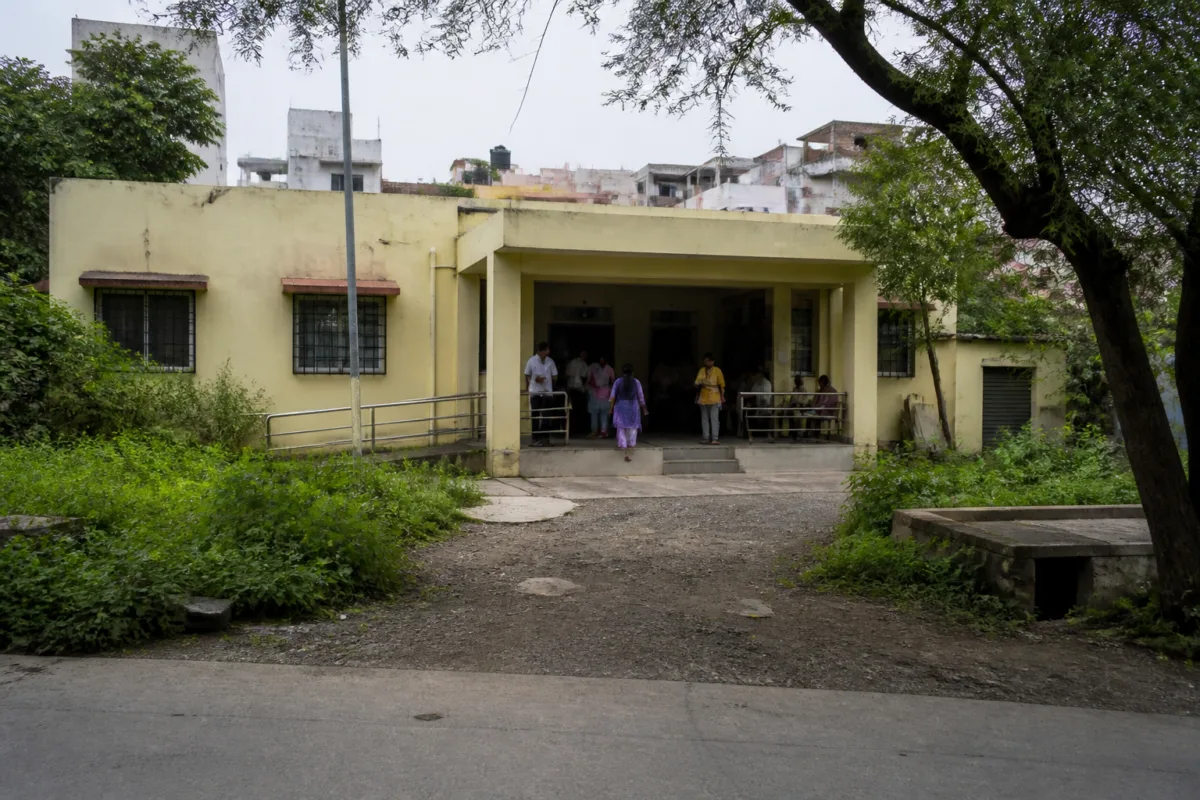
The condition of the Manjari health centre reveals a basic contradiction in Pune’s urban expansion: a settlement with a population of roughly 125,000 has a public facility, but not all the infrastructure required to make that facility reliably functional. The centre provides primary treatment, vaccination and basic screening, yet staff shortages, missing equipment, closed utilities and security failures are limiting the care residents can receive.
The report by Lokmat – Pune describes the facility at Manjari Budruk as operating under pressure even after the village was included in the Pune Municipal Corporation area. The health sub-centre functions under the Primary Health Centre at Loni Kalbhor and sees about 30 to 35 patients a day, or between 700 and 750 patients a month. These numbers make the centre an important part of local access to care, particularly for residents who may otherwise need to travel to Loni Kalbhor or Sassoon Hospital.
But the facility’s physical condition does not match that public role. The report identifies non-functional electricity, water, toilet and drainage arrangements in the new building. Overgrown vegetation surrounds the centre, while unclean conditions have also been reported on the second floor. The result is not simply an unattractive public building. When basic utilities are unavailable, the facility’s ability to provide routine healthcare becomes dependent on workarounds, staff effort and patient tolerance.
This is especially significant because primary healthcare is designed to reduce the need for people to visit larger hospitals for every basic service. At Manjari, the centre provides primary treatment, vaccination, Ayurvedic outpatient services and free medicines where available. It also conducts blood-pressure and diabetes screening and implements national health programmes, according to local doctor Jyoti Nikam. However, a shortage of diagnostic equipment means that some patients must be referred to the Loni Kalbhor health centre and others to Sassoon Hospital.
The referral system is a normal part of healthcare when a case requires higher-level treatment. The problem described here is that referrals are also being driven by limitations in the local facility’s capacity. The report does not establish how many patients are referred or how long they must travel, but it records that essential testing equipment is not available at Manjari. For residents, this can turn a routine consultation into a multi-stage journey involving additional time, transport costs and waiting.
Staffing is another pressure point. The centre’s patient services are being handled by an Ayush department doctor, two multipurpose workers, a community health officer, a nurse and a part-time employee—six staff members in all, according to the report. Patients are reported to wait for long periods, while some have had to fill in their own case papers because there are not enough personnel. A local patient’s relative told Lokmat that he had to assist staff while bringing a schoolchild for treatment after an accident.
The case-paper shortage illustrates how administrative scarcity affects the patient experience at the smallest level. A case paper is a basic record of a consultation, but the report says one paper is sometimes used for two patients. Such practices may reduce stationery use in the short term, but they can weaken the clarity and continuity of patient records. The report does not assess the medical consequences of this practice, but it clearly shows that the centre is operating without sufficient routine supplies and support staff.
Security has emerged as a separate infrastructure failure. According to the report, the windows do not have adequate protection and no security guard has been appointed. Residents and staff have reported that unidentified people enter the premises after evening hours. The reported incidents include drinking, damage to tables, chairs and cupboards, theft of bedsheets and movement of medicines. These accounts were provided by local residents and the health authorities’ response, as reported, attributes earlier damage at the old sub-centre to repeated arson.
Taluka Health Officer Suresh Gore said the old health sub-centre was set on fire three or four times in 2024, causing medicines worth lakhs of rupees to be destroyed. A complaint was filed at the Hadapsar police station, he said. To ensure that services did not stop completely, vaccination and primary treatment were shifted to the newly constructed building next to the old facility. The older building’s services are currently closed.
This history matters because it places the present condition of the centre within a longer sequence of asset damage, relocation and incomplete readiness. A new building can provide space, but it does not automatically create a working health facility. Water, electricity, drainage, toilets, security, equipment, staff and operating budgets must all be connected before the building can perform its intended function.
Gore said funds are available to provide the required facilities and that the Loni Kalbhor department has been asked to spend the grant for the purpose. This is an important administrative detail. The reported problem may not be the complete absence of money, but the gap between an available allocation and its execution on the ground. The report does not provide the amount of the grant, the date of the correspondence or a deadline for completing the works. Those details will determine whether the assurance leads to a functioning facility or remains an administrative response.
There is also uncertainty over institutional responsibility. Former local corporator Ajit Ghule said the sub-centre had not yet been transferred to the Pune Municipal Corporation. He also linked the difficulty in developing a properly equipped facility to the fact that the development plan had not been finalised. The report presents these claims as part of the local governance dispute, but it does not include a response from the municipal corporation confirming the transfer status or explaining the development-plan position.
That unresolved responsibility is central to understanding the Manjari case. The village has entered the municipal corporation’s urban jurisdiction, but the health centre continues to be described in relation to the taluka and district health systems. When an area changes administrative status, service delivery does not necessarily change at the same speed. Assets may remain with one department, staffing may be sanctioned through another, and municipal representatives may be expected to respond even when the facility has not formally moved into municipal control.
This creates a familiar urban governance problem: the boundaries of the city expand faster than the systems that support residents. A settlement can acquire municipal status, roads and new buildings while basic public services remain organised through older rural or taluka-level arrangements. Without a clear transfer of assets, staff, budgets and accountability, residents may not know which authority is responsible for fixing a broken utility, appointing security or supplying diagnostic equipment.
Vaccination arrangements add another layer to the question of service design. Local resident Sachin Ghule said people are gathering at the gram panchayat for vaccination and suggested that the municipal corporation identify a separate open space and provide mobile registration. He also raised concerns about crowding and infection risks for children. These are local suggestions, not independently assessed findings in the report, but they point to the importance of space management when a health centre is too constrained to handle all services comfortably.
The centre is therefore not failing because of one isolated deficiency. The reported problems form a chain: incomplete utilities affect the building; weak security exposes equipment and medicines; staff shortages increase waiting and shift clerical work to patients; missing diagnostic equipment increases referrals; and unclear institutional control makes it harder to identify who must resolve the gaps. Each problem makes the others more difficult to manage.
At the same time, the report records that health workers continue to provide services. Doctor Jyoti Nikam was seen treating patients and said the centre conducts yoga, pranayama, health activities and screening linked to 14 indicators. This distinction is important. The issue is not an absence of public healthcare work, but the mismatch between the efforts of frontline staff and the conditions in which they are expected to operate.
The evidence currently establishes the condition reported at the centre, the approximate patient load, the staffing pattern, the absence of several facilities and the authorities’ stated intention to use available funds. It does not establish when utilities will be restored, when equipment will be installed, whether additional staff have been sanctioned, or when the facility will be formally transferred to the municipal corporation. Those are the next facts required to judge whether the administrative response has moved beyond correspondence.
Manjari’s health centre ultimately raises a wider question about urban inclusion. Adding a locality to a municipal boundary is an administrative act; making it part of a functioning city requires dependable public institutions. Until responsibility, funding and implementation are aligned, a health centre can exist in a new building while remaining unable to deliver the full range of basic services its population needs.

