


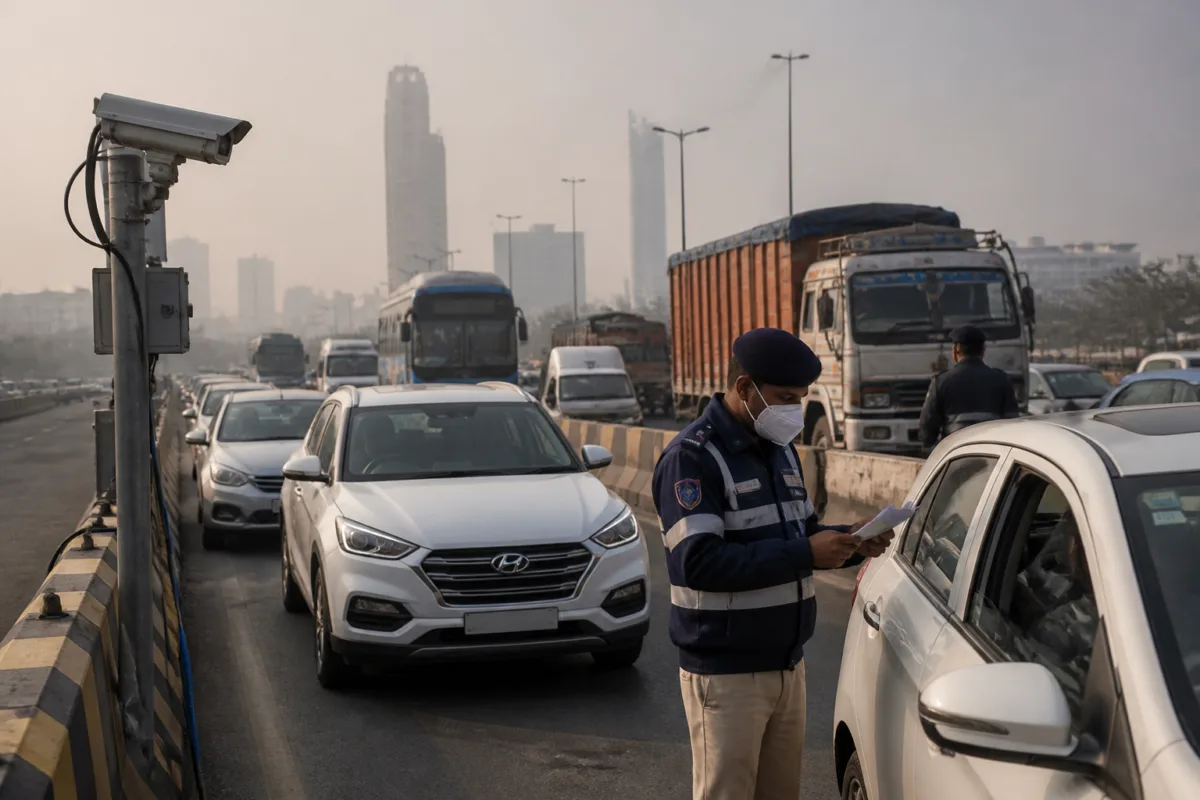
Delhi pollution curbs will tighten from November 1, with non-compliant vehicles registered outside the capital facing entry restrictions as the revised Graded Response Action Plan (GRAP) brings enforcement forward using air-quality forecasts. The restrictions are scheduled to remain in force until at least January 31, 2027, unless exemptions are notified.
The Commission for Air Quality Management (CAQM) had invoked Stage I of GRAP on October 21 after Delhi’s air quality moved into the ‘Poor’ category. The city’s Air Quality Index rose from 179, classified as ‘Moderate’, on October 20 to 244, or ‘Poor’, at 2 pm the following day, according to the report. It was the first Stage I invocation of the winter.
Under the revised rules, petrol and diesel vehicles registered outside Delhi that do not meet BS-VI emission standards will be barred from entering the capital. Electric and CNG vehicles are exempt from this restriction. Commercial goods vehicles registered outside Delhi will also be denied entry if they are not BS-VI compliant. Vehicles entering Delhi must carry valid pollution-control documents and applicable permit papers, either physically or through DigiLocker.
Buses entering Delhi under tourist, contract-carriage and other permit categories must operate on BS-VI diesel, CNG or electricity. Trucks travelling to destinations beyond Delhi will be required to use peripheral expressways rather than pass through the capital. Vehicles without a valid Pollution Under Control certificate may also face restrictions under the traffic police advisory.
Several categories remain allowed to enter, subject to other applicable GRAP measures. These include BS-VI, CNG and electric vehicles, vehicles covered by official exemptions, Delhi-registered commercial goods vehicles, and goods vehicles running on BS-VI diesel, CNG, LNG or electricity. Buses registered in Delhi are also exempt from the new border restriction. Stage-wise limits on goods vehicles will continue to apply whenever a higher GRAP stage is imposed.
The revised framework changes how the administration can activate pollution controls. Rather than waiting for the actual AQI to cross a threshold, CAQM can invoke Stages I to IV in advance when dynamic modelling and weather forecasts indicate that the relevant pollution level is likely to persist. The notification also allows immediate action if extreme weather or an episodic event causes the AQI to breach a threshold unexpectedly.
GRAP Stage I applies when the AQI is between 201 and 300, Stage II covers the ‘Very Poor’ range of 301 to 400, Stage III applies to ‘Severe’ air between 401 and 450, and Stage IV is triggered when the AQI exceeds 450. Measures introduced at a lower stage remain in force when a higher stage is imposed.
The September revision also shifted certain restrictions on older inter-state buses from Stage II to Stage I, allowing them to be enforced earlier. It extended Stage III restrictions on BS-III petrol and BS-IV diesel light motor vehicles to Sonipat in Haryana, removed an exemption for some goods vehicles carrying essential commodities during Stages III and IV, and widened controls covering construction and demolition activity.
Border enforcement will use automatic number plate recognition and radio-frequency identification systems. The GRAP sub-committee will meet regularly to decide whether measures should be invoked and review implementation by different agencies, using air-quality forecasts from the India Meteorological Department. The chief secretaries of the National Capital Region states and the Government of the National Capital Territory of Delhi will also review enforcement of the restrictions.

