


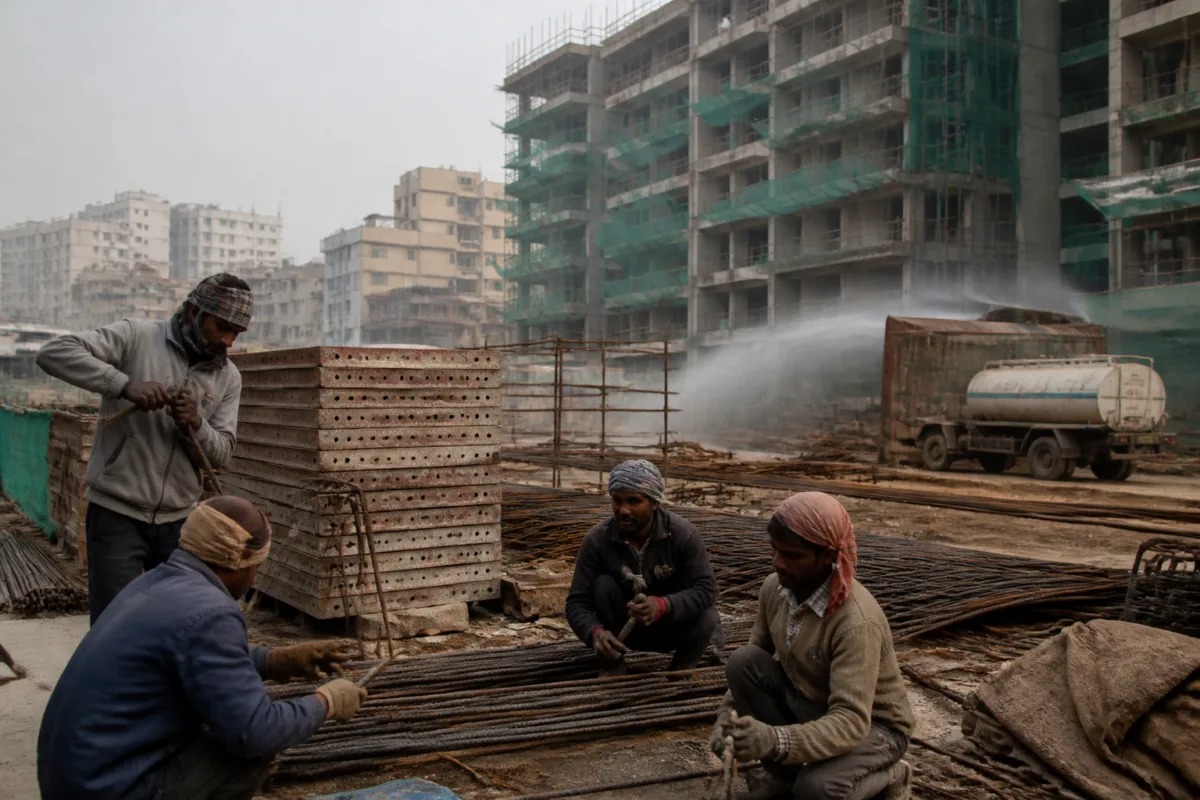
Delhi’s winter construction restrictions are exposing a difficult trade-off in the capital’s urban economy: measures intended to control pollution can also interrupt the income, mobility and employment cycles of the migrant workforce that builds the city. As the November 1 restrictions approach, workers are preparing to leave, developers are rearranging construction schedules and project sites are already showing signs of a slowdown.
At The Amaryllis luxury housing project in Karol Bagh, hundreds of workers were trying to complete exterior work across a 40-acre site before the deadline. The urgency was not only about construction sequencing. For labourers, the approaching restrictions signalled a period without a reliable wage. Rohit, a 29-year-old construction worker from Bikaner, told The Indian Express that work usually stops for two or three months and that contractors ask workers to return to their villages.
Rohit said he earns about Rs 18,000 a month when work is regular, sends Rs 10,000 home and uses the remainder for rent and daily expenses in Delhi. He said he has no savings and would need to look for work in his village during the shutdown. His experience illustrates how a temporary city-level restriction can become a household-level income shock when workers are paid according to active work rather than protected through a year-round employment arrangement.
The disruption is also visible at smaller and older sites. At Amba Deep building on K G Marg, office renovation and repair work had stopped, leaving green nets and steel frames around the structure. The site usually employed 15 to 20 workers, but those workers had left for their villages during the festive season. A site official said many would not return for weeks. Although around 90% of the project was complete after nearly four years, the official estimated that another two years could be required to finish it.
These sites show that Delhi’s construction economy does not operate as a single, continuously staffed system. It depends on workers moving between cities and villages, contractors assembling teams for specific phases and developers coordinating civil, electrical, plumbing and finishing work around regulatory constraints. Once a site stops, restarting it requires more than simply removing a prohibition. The workforce may have dispersed, subcontractors may need to reorganise and the sequence of work may have to be rebuilt.
The regulatory framework has also become more layered. Under the Winter Action Plan, dust-generating demolition and outdoor civil construction will be prohibited from November 1 to January 31. A complete halt to construction and demolition activity is mandated from December 10 to January 20. The plan therefore creates different periods of restriction rather than one uniform shutdown.
This approach differs from the earlier system, under which construction activity was curtailed largely in response to air-quality levels under the Graded Response Action Plan, or GRAP. During GRAP Stages 3 and 4, heavy dust-generating activities such as excavation, demolition and external facade plastering were halted, while some non-dust-generating interior work, including plumbing, electrical wiring, carpentry and elevator or diesel generator set installations, could continue.
The distinction matters because construction is made up of linked activities. A project may be able to continue with interior work while outdoor civil work is suspended, but only if the site has reached the relevant stage and materials, labour and access are available. The new winter framework, as described in the report, reduces that flexibility by moving from restrictions on particular dust-generating activities to a complete halt during the December 10-January 20 period.
For builders, the immediate response has been to bring forward work that can be completed before the restrictions tighten. Kunal Behrani, chief commercial officer of Unity Group, said the company had rearranged its priorities at The Amaryllis to finish civil works first and defer electrical and plumbing work. The change reflects a project-management response to a fixed regulatory calendar: activities that may be impossible later are being prioritised now.
But this strategy has a limit. Behrani said that after the complete ban begins on December 10, the project could be left with no permissible work and that there was insufficient clarity about what could and could not continue. His statement points to an implementation challenge beyond the duration of the ban itself. If the boundaries of permitted work are unclear, developers may either stop more activity than required or risk violating restrictions by continuing work that authorities consider prohibited.
The overlap between the Commission for Air Quality Management’s restrictions under GRAP and the government’s Winter Action Plan is another source of uncertainty for project planning. Behrani described builders as facing two sets of restrictions. For construction companies, the issue is not simply whether work is allowed on a particular day. It is whether they can plan labour, procurement, subcontracting and delivery schedules with enough certainty to keep a project viable.
The labour market consequences may last longer than the formal shutdown. A Confederation of Indian Industry member said that workers could leave quickly when told that work would stop for 40 days, but that bringing them back would be difficult. Workers, the member said, may wait until full-scale operations resume before returning, even after authorities permit some activity. This creates what the developer representative described as a labour retention crisis.
The distinction between a legal restart date and an operational restart is central. A project may technically be allowed to resume on January 31, but the workforce may not return on that date. Workers who have gone back to their villages may find temporary employment there, face travel costs or wait for confirmation that work has actually restarted. Contractors may also be reluctant to mobilise teams until there is enough work to justify the move.
That gap affects project delivery in several ways. A shortage of workers can delay the completion of housing, office renovations and other built-environment projects. It can disrupt the sequence between civil, electrical, plumbing and finishing works. It can also increase the time during which a partially completed building remains enclosed by nets, steel frames or temporary site arrangements. The supplied report does not quantify the number of delayed projects or the financial cost, but the site-level accounts show how the restriction is transmitted through the construction system.
The issue is especially significant in Delhi because the city’s pollution-control measures operate against a backdrop of a large migrant workforce. The workers described in the report are not peripheral to the urban economy; they are necessary to deliver housing, commercial buildings and repairs. Yet their income is closely tied to construction continuity, and their ability to remain in the city depends on whether contractors can provide work during regulatory stoppages.
This creates a policy tension that cannot be resolved by treating pollution restrictions and construction employment as separate subjects. Air-quality controls are designed to reduce dust and emissions during a period of severe pollution. Construction restrictions, however, affect not only developers and contractors but also workers who may have limited savings and no alternative urban income. The report shows that the administrative design of the restrictions determines how these costs are distributed.
The shift from episodic GRAP-based curbs to a defined Winter Action Plan may provide a more predictable calendar, but predictability alone does not eliminate disruption. Developers can plan around dates only when the permitted activities, enforcement rules and restart conditions are clear. Workers can plan their livelihoods only when they know whether employment will continue, pause or resume in stages. The supplied evidence indicates that both sides are still dealing with uncertainty about what work will be allowed during the different phases.
The same framework also raises questions about how urban projects are scheduled. At The Amaryllis, the developer has moved civil work ahead of electrical and plumbing activities. At Amba Deep, a project already close to completion still faces a long remaining timeline. These examples suggest that the effect of a seasonal ban varies according to a project’s stage, workforce requirements and ability to substitute one activity for another. A uniform restriction therefore produces uneven consequences across sites.
For residents, the impact is not immediately visible as a single service disruption. It may appear through delayed housing completion, prolonged building repairs, extended construction traffic at a later stage or workers leaving neighbourhood sites. For workers, the effect is more direct: the stoppage removes wages and requires a decision about whether to remain in Delhi without work or return to the village in search of temporary employment.
The evidence currently establishes three facts. First, construction firms are accelerating selected activities before the restrictions tighten. Second, migrant workers are preparing to leave because they expect a prolonged interruption in employment. Third, the return of labour after the formal restriction ends may not be immediate, creating a second delay after the ban itself. What remains unclear is the scale of the disruption across Delhi, the number of workers affected and how authorities will distinguish permissible interior activity from prohibited construction during each phase.
Delhi’s winter construction ban is therefore more than a temporary pause in building activity. It is a test of whether the city’s pollution-control system can account for the labour, scheduling and project-management structures on which urban construction depends. The next milestones are the November 1 start of restrictions on dust-generating demolition and outdoor civil construction, the December 10 full shutdown, and the planned end of the complete halt on January 20, followed by the January 31 end of the wider winter restrictions.

