


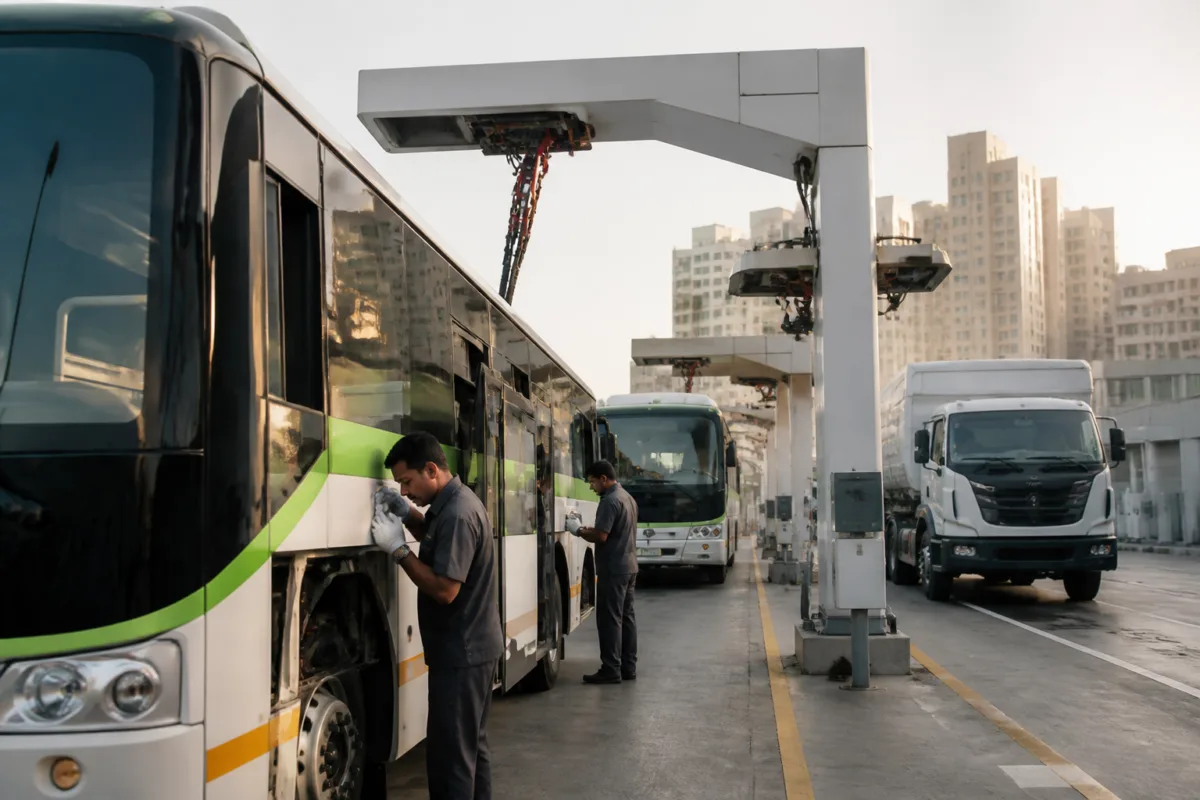
EKA Mobility’s plan to build electric buses, heavy trucks and six-seater vehicles reveals a transport transition that depends on more than selling vehicles. The company’s stated targets link manufacturing capacity to depot readiness, long-term servicing, charging access, dealer networks and the economics of daily operations. That combination is becoming central to how electric mobility can expand across Indian cities, freight routes and smaller towns.
In an interview with The Hindu BusinessLine, EKA Mobility chairman Sudhir Mehta said the company has orders for 11,000 buses valued at almost $2 billion when vehicle supply and long-term servicing are included. The company is targeting $1 billion in annual revenue by 2030 and plans ₹1,000 crore in capital expenditure over three years for electric buses, heavy trucks and six-seater manufacturing. These are company targets and projections, but they indicate the scale at which electric mobility is being treated as an integrated manufacturing and services business rather than a single-product category.
The immediate challenge is converting an order book into vehicles operating reliably on public routes. Mehta said EKA is matching production with depot readiness and that revenue could move by two or three months depending on infrastructure availability. This detail is important because it places deployment capacity alongside factory capacity. A bus can be manufactured on schedule, but its operation depends on a prepared depot, an operating concessionaire, charging arrangements, maintenance support and the ability to keep the vehicle on the road.
EKA currently has 20 operational depots and expects another 80 over 18 months. It also expects to be present in 45 cities. The company’s service contracts run for 12 years, covering maintenance, parts and uptime support. Charging infrastructure, however, is provided by the concessionaires operating the buses. This division of responsibility means that the delivery of an electric bus does not by itself establish the full transport system required for service. Vehicle manufacturers, concessionaires and infrastructure providers must align their timelines and operational obligations.
According to Mehta, EKA is achieving more than 99 per cent uptime, while one of its buses in Mira-Bhayandar carries more than 800 passengers daily. The figures were provided by the company and are not independently established in the supplied material. They nevertheless show the operational metrics that matter beyond procurement announcements: how often a vehicle runs, how many passengers it carries and whether maintenance systems can sustain service over a long contract period.
EKA’s reported vehicle volumes rose 13.4 times to 1,786 in April–September from 133 a year earlier. The company is targeting around ₹2,000 crore in revenue, compared with approximately ₹600 crore last year, while its sister business Pinnacle Industries expects around ₹800 crore. Together, the two businesses are targeting ₹2,800 crore in FY27 revenue. Pinnacle manufactures automotive seating systems, bus interiors and specialty vehicles, including ambulances, and supplies components to other vehicle manufacturers.
This relationship between components and complete vehicles is part of EKA’s stated expansion strategy. Mehta described buses as the business that created manufacturing scale and service infrastructure, while small commercial vehicles helped establish a dealer network. Heavy electric trucks are being positioned as the next major phase. The sequence suggests that EKA is attempting to spread common capabilities across vehicle categories rather than build separate operations for each market.
The company says it is developing vehicles around common elements including motors, batteries, power electronics and software. Its software team has more than 100 people, and it recruits around 150 young engineers annually. EKA is also working with IIT Chennai on pantograph-based fast charging. The company’s stated logic is that internal technology capabilities can be applied across buses, trucks and smaller vehicles. The supplied material does not establish the commercial results of this strategy, but it makes clear that software and charging technologies are being treated as core operating infrastructure.
The rural mobility proposition is different from the city bus model. EKA says around 2,000 of its electric six-seaters are already on the road. The vehicles cost approximately 50 paise per kilometre to operate, travel around 18 kilometres on one unit of electricity and can charge through a normal 16-ampere socket, according to the company. EKA has 75 operational dealer points and is adding six to 10 each month. Its stated ambition is to extend the network through smaller towns into rural markets, connecting villages to schools, markets and public transport.
The significance of this model lies in the role of distribution and access. A vehicle aimed at rural transport requires more than a product specification. It needs dealers, maintenance support, financing and routes where the lower operating cost can translate into affordable mobility. EKA’s own expansion plan identifies smaller-town dealer coverage as a condition for reaching rural users. The supplied interview does not provide passenger fares, financing terms, route data or independent evidence of the vehicles’ impact on rural connectivity, so the broader mobility outcome remains unestablished.
Heavy electric trucks present a separate operating and financial challenge. Mehta acknowledged that their upfront cost and EMI are substantially higher than those of diesel vehicles. He said a fully loaded diesel truck may cost around ₹50 per kilometre in fuel, while an electric truck could cost around ₹30 per kilometre at an electricity price of ₹12 per unit, with the possibility of a further reduction if electricity becomes cheaper. These are illustrative operating comparisons provided by the company, not a complete total-cost-of-ownership calculation. They do not, in the supplied material, include vehicle financing, battery replacement, maintenance, charging equipment or residual value.
EKA is therefore focusing on fixed-load, point-to-point applications where charging can be planned around operating schedules. The company conducts customer trials and demonstrates operating data before selling, and Mehta said it sells only where the business case works. This approach narrows the initial market to operations with predictable routes and dwell times. It also shows why the transition from diesel to electric freight cannot be assessed solely through the price of fuel or electricity. Vehicle utilisation, route design, charging access and financing are equally important to fleet operators.
The company does not consider battery swapping necessary for most applications, although it regards swapping as an option. Its priority is charging availability and financing, particularly where customers can plan charging around their schedules. This position reflects a deployment model based on operational predictability rather than a universal infrastructure solution. Different vehicle categories may require different charging arrangements, and the interview does not specify the power requirements, grid upgrades or land arrangements needed for EKA’s planned truck expansion.
That gap is also visible in the company’s broader revenue ambition. EKA says charging infrastructure and electricity transmission capacity will be critical as electric vehicle adoption rises. The statement places the electricity system directly inside the transport story. Expanding a bus fleet across 45 cities and adding heavy electric trucks will require coordination between vehicle production, depots, concessionaires, dealers and power infrastructure. The source does not provide a city-by-city deployment schedule, investment split or transmission-capacity assessment, so the pace at which these systems can be built remains unclear.
EKA says it has completed its funding rounds for now and is not seeking additional cash at present. Its stated growth plan must therefore be delivered through the capital expenditure already identified, operating revenue and the execution of existing orders. The company’s bus order book includes servicing over long contracts, which can create a continuing revenue stream, but the timing depends on depot readiness and deployment. The interview does not disclose the contractual structure, customer concentration or delivery milestones behind the $2 billion figure.
The larger urban question is whether electric mobility can scale as a dependable service network rather than as a collection of vehicle purchases. EKA’s own account points to the necessary layers: buses must be matched to depots, charging must be provided by concessionaires, service contracts must protect uptime, dealers must reach smaller markets, and truck customers must have routes where charging can be planned. Each layer introduces an institutional or infrastructure dependency.
The evidence supplied confirms that EKA is pursuing an integrated expansion across buses, rural six-seaters and heavy electric trucks, supported by manufacturing investment and technology development. It also shows that the company’s targets depend on conditions beyond the factory, including depot readiness, charging access, electricity capacity, financing and route economics. The developments that merit monitoring are the conversion of the 11,000-bus order book into operating fleets, the planned addition of 80 depots, the expansion to 45 cities, the performance of the six-seater dealer network and the commercial viability of heavy electric trucks in fixed-route operations.

