


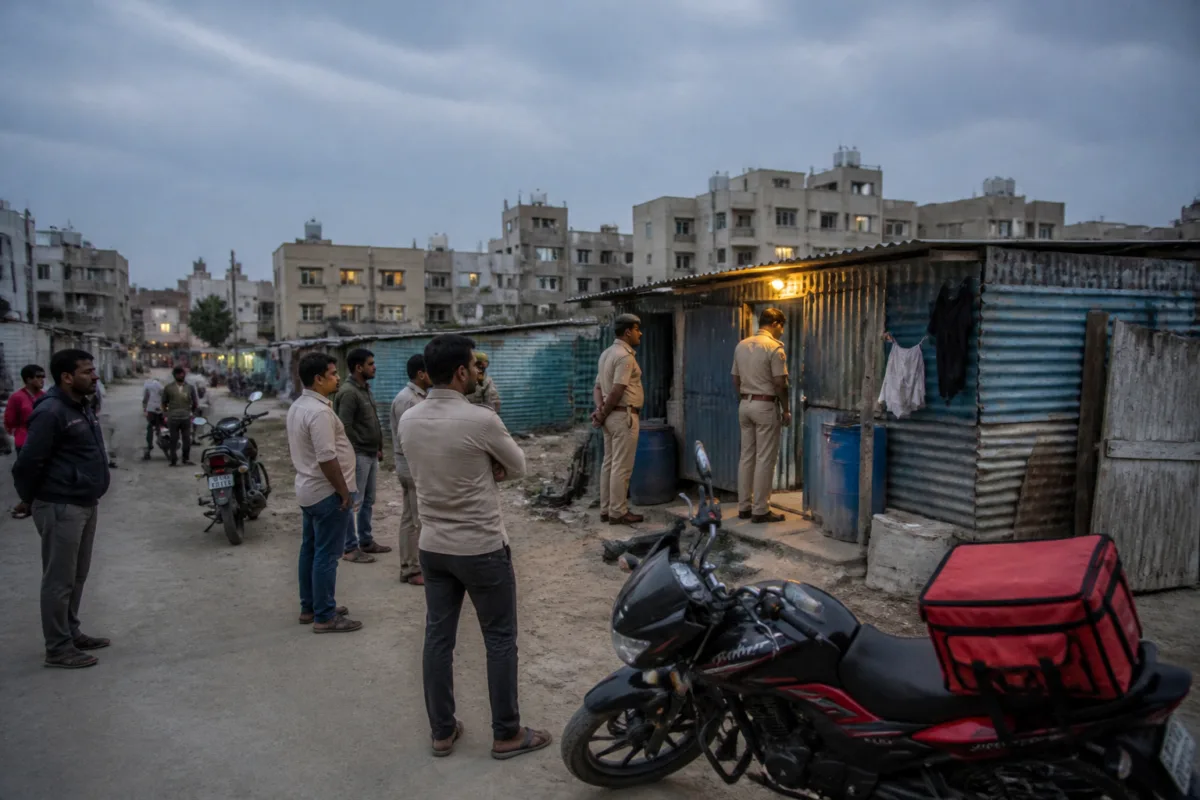
The murder of Bengaluru lawyer and landlord Manjunath after a dispute over unpaid rent has drawn attention to a largely informal rental system that houses migrant workers in makeshift structures, often with limited documentation and weak channels for resolving disputes. Police have formed eight teams to trace two identified suspects, but the case also reveals how the city’s delivery workforce and low-cost rental housing operate at the edges of formal urban regulation.
According to a report by Prajavani, Manjunath, 42, was shot dead in Pattandur Agrahara on October 18. The Whitefield division police said two suspects had been identified and that both were from Bihar. Deputy Commissioner of Police Syedulla Adavat said the two men had worked as delivery workers in Bengaluru for the past two years.
The police account places the alleged dispute within a rented settlement created on land owned by Manjunath. The report says he owned between two and three acres of vacant land in Pattandur Agrahara, where sheds had been built and rented to workers from Assam, Bihar, Odisha and other parts of north India. The sheds were reportedly rented for between ₹5,000 and ₹8,000 per unit.
Four workers, including the two identified suspects, had been renting one shed, according to the report. Police said the group had not paid rent for four months. A disagreement over the unpaid amount had taken place several days before the killing, and another confrontation allegedly occurred on the night of October 18 when Manjunath went to the workers’ accommodation to demand payment.
The reported circumstances of the shooting underline the vulnerability of rental arrangements that are managed informally. The source report says the suspects later came to Manjunath’s residence on a motorcycle used for food-delivery work and called him outside. It alleges that they handed him money and opened fire with a country-made pistol while he was counting it. Three rounds were reportedly fired at his forehead and chest. These details are attributed in the report to investigative sources and remain part of an ongoing police investigation.
Police said one suspect travelled to Chennai by train after the incident, while the other fled to Hyderabad on a two-wheeler. The eight investigation teams have searched in Delhi, Kolkata, Bihar, Chennai, Hyderabad and other locations. The Central Crime Branch has also been providing technical assistance, according to the DCP’s statement reported by Prajavani.
The investigation’s geography is significant because the alleged participants were not operating within a single, contained neighbourhood network. Their work, accommodation and subsequent movements connect Bengaluru to several major transport and employment corridors. Delivery workers can move between platforms, localities and cities with relative ease, while police investigations must coordinate across state boundaries and transport systems.
That mobility is part of the economic structure of Bengaluru’s service economy. The report identifies the suspects as delivery workers, but it does not provide details about their employers, employment contracts, identity records or rental documentation. It also does not establish whether the rented sheds had formal approvals, basic services or written tenancy agreements. Those gaps matter because informal housing arrangements can leave both landlords and tenants dependent on verbal agreements, cash payments and improvised methods of dispute resolution.
The reported rent range of ₹5,000 to ₹8,000 per unit indicates the role that such sheds may play in accommodating workers who need to live near employment opportunities but may not be able to access formal apartments. Pattandur Agrahara is part of Bengaluru’s eastern employment belt, where delivery, technology, logistics and service work generate demand for housing close to workplaces and transport routes. The source material does not quantify the number of workers living in similar arrangements, so the case cannot by itself establish the scale of the wider problem.
It does, however, show the administrative limits of treating rental housing only as a private transaction. When landowners create multiple rental units on vacant land, the arrangement can become a small housing system without necessarily being integrated into the city’s formal rental, building-safety or neighbourhood-management framework. The supplied report does not state whether the sheds in this case were authorised or inspected. That remains an important unanswered question rather than an established fact.
The case also demonstrates how a rent dispute can become a law-and-order matter when there are no visible, trusted mechanisms for settlement. The police account describes repeated disagreements over four months of unpaid rent. It does not say whether either side approached a formal authority, sought mediation or filed an earlier complaint. Nor does it establish why the alleged suspects possessed a country-made pistol. Those issues will have to be addressed through the investigation and any subsequent court proceedings.
For the police, the immediate challenge is to locate the suspects and establish the sequence of events through evidence, including travel movements, communications, forensic material and witness accounts. The DCP said the investigation was progressing under the direction of senior officers and that there had been no negligence. The formation of eight teams and the involvement of the Central Crime Branch indicate that the authorities are treating the case as a coordinated, inter-state search.
For the city, the incident raises a narrower but important question about who is responsible for the safety and documentation of informal rental housing. Municipal authorities regulate land use and construction in different ways, while the police handle crime and public safety. Labour and employment systems may have information about migrant workers, and delivery platforms may hold work-related records. The report does not indicate whether these institutions were involved before the incident or how they might interact during the investigation.
The distinction between formal and informal housing is especially important in a city where workers often choose accommodation based on proximity, affordability and access to employment. A shed rented on private land may meet an immediate housing need, but the source material does not establish whether it offers the same protections, services or accountability associated with registered rental accommodation. The absence of that information is itself a reminder that much of the city’s workforce housing remains difficult to measure.
The available data in this case is limited but concrete: the land parcel was reported to measure two to three acres; rents were reported at ₹5,000 to ₹8,000; four workers occupied the shed linked to the dispute; rent had allegedly remained unpaid for four months; two suspects were identified; and eight police teams were formed to search across several cities. These figures describe the case, not Bengaluru’s entire rental market. They should not be used to infer broader crime or housing trends without additional evidence.
What the case confirms is that the city’s rental geography extends beyond apartment complexes and registered housing projects. It includes sheds on private land, migrant workers employed through fast-moving service networks and landlord-tenant relationships that may be governed informally. When those arrangements fail, the consequences can move quickly from a financial disagreement to a criminal investigation spanning multiple states.
The next decisive developments will come from the police search, the recovery of the suspects, the collection of evidence and the filing of charges, if supported by the investigation. Until then, the alleged motive and sequence should remain attributed to the police and source report. The wider housing question is clear: Bengaluru’s workforce depends on low-cost accommodation, but the systems that document, regulate and protect that accommodation remain only partly visible in the available evidence.

