


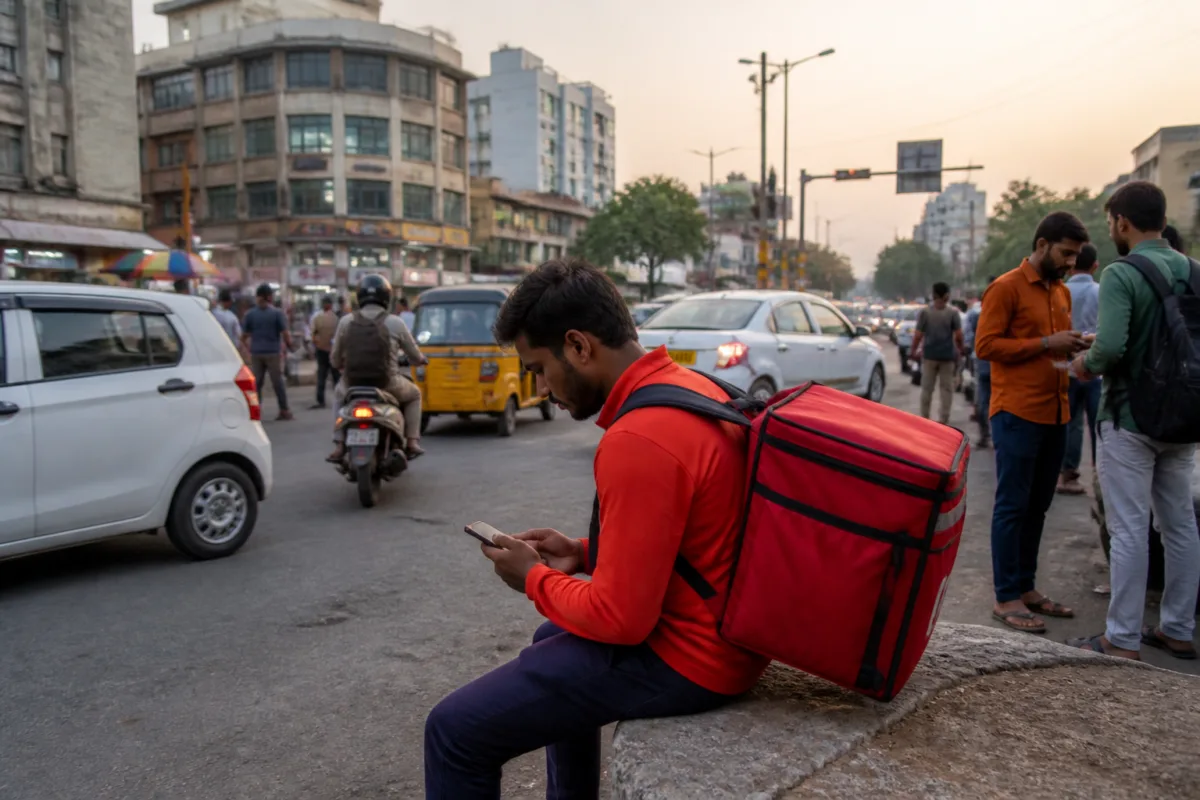
The Telangana Gig and Platform Workers Union’s demand for meaningful social security and pension protection has brought a basic weakness of India’s platform economy into focus: workers who keep urban delivery, transport and commerce systems moving may not have a dependable route to retirement security. The demand came after the Pension Fund Regulatory and Development Authority expanded access to the National Pension System through its e-Shramik (Platform Service Partner) Model, a framework that allows platform workers to access NPS through digital aggregators.
The development is significant because it links a largely informal urban workforce to a formal pension system without changing the basic way in which platform work is organised. Delivery partners, cab and auto drivers, grocery workers, e-commerce workers and others often operate through digital platforms, but the supplied report does not establish whether they are treated as employees, independent contractors or another category for purposes of social protection. That distinction matters because pension access is not the same as guaranteed pension coverage, and an avenue to save is not the same as an assured retirement benefit.
The Telangana union’s intervention therefore raises a question larger than the launch of an access mechanism: who is responsible for protecting the long-term welfare of workers whose labour is essential to urban convenience but whose employment arrangements may be fragmented across platforms? The report identifies the union’s demands as meaningful social security, pension protection and dignified living conditions. It does not provide details of the union’s specific proposals, the financial contribution expected from workers or platforms, or the scale of enrolment under the new model. Those gaps are important when assessing how far a formal framework can address the insecurity of platform work.
The NPS access model appears to work through digital aggregators. According to the report, the PFRDA’s e-Shramik (Platform Service Partner) Model widens opportunities for platform workers to save for retirement. In practical terms, this places digital intermediaries between workers and the pension system. That arrangement may help reach workers who are already registered with platforms and accustomed to completing transactions through mobile applications. At the same time, the supplied material does not establish how workers will be informed, how contributions will be collected, whether contributions will be regular, or what safeguards will apply if a worker changes platforms or stops working in the sector.
These operational questions are central to the urban policy challenge. Platform workers are not a marginal part of city life. They support last-mile deliveries, passenger mobility, grocery access and e-commerce fulfilment. Yet the report provides no estimate of the number of workers covered in Telangana or nationally, and no data on their income patterns, working hours, age profile or existing access to provident fund, insurance or pension schemes. Without those indicators, it is not possible to measure the size of the protection gap or determine whether NPS access will reach the workers most exposed to economic insecurity.
The union’s decision to invite workers to its office for information and guidance is also revealing. It suggests that access to a pension product depends not only on whether a framework exists, but also on whether workers understand it and can navigate it. The report specifically mentions guidance on pensions, NPS and social-security rights. This places worker organisations in an important intermediary role, particularly for workers who may work across multiple apps or whose relationship with a platform changes over time. However, the report does not identify the formal role, resources or responsibilities of the union within the PFRDA model.
The institutional structure described in the report is divided among at least three levels. The PFRDA is the regulator associated with the expansion of NPS access. Digital aggregators are identified as the channel through which platform workers can access the system. The Telangana Gig and Platform Workers Union is acting as an organising and information-support body, while the workers themselves remain the intended participants. The report does not state what responsibilities are assigned to platform companies, state authorities or urban local bodies. That absence matters because the labour being discussed is deeply connected to city operations, even though pension regulation is being addressed through a national financial framework.
This separation between urban dependence and institutional responsibility is one of the central issues raised by the announcement. Cities benefit from fast deliveries, app-based transport and distributed retail services, but the costs of maintaining this system are carried by workers who may bear the risks of fluctuating demand, vehicle ownership, fuel and maintenance, or interruptions in platform access. The supplied report does not provide evidence on any of these costs, so their precise effect on pension contributions cannot be established here. It does, however, show that the union considers pension protection and dignified living conditions unresolved despite the availability of a new access route.
The distinction between access and adequacy is particularly important. A pension system can be open to a worker while remaining difficult to use if contributions are too small, irregular or poorly understood. The report confirms that the new framework enables access to NPS, but it does not state whether contributions will be voluntary or mandatory, whether platforms will make matching payments, whether the government will provide support, or what benefits workers can expect at retirement. These are not minor administrative details. They determine whether the framework functions as a meaningful social-security instrument or simply as an additional savings option.
The same uncertainty applies to portability. Platform workers may operate for more than one company or move between delivery, transport and other forms of app-mediated work. The report does not explain whether the e-Shramik model links a worker’s pension account to the individual rather than to a particular platform, nor does it describe the process for maintaining contributions after a worker changes occupation or location. Since the supplied material contains no technical or operational details, the portability of benefits cannot be assumed.
The immediate significance of the Telangana development is therefore not that it resolves the pension problem for gig workers. It is that a regulatory access mechanism and a worker union’s demands are now appearing together in the same policy conversation. The PFRDA framework creates a possible route into NPS, while the union’s position indicates that workers view retirement savings as part of a broader demand for social security and dignified urban livelihoods. The two positions are related but not identical. Access to a financial product may help with retirement planning, but it does not by itself answer questions about income security, workplace protections or responsibility for contributions.
For policymakers, the evidence supplied in the report points to the need to examine implementation rather than rely on the existence of a framework as proof of protection. The relevant measures would include worker awareness, enrolment, continuity of contributions and the participation of digital platforms. The report provides none of these figures, and no conclusion can be drawn about the model’s performance at this stage. The next layer of reporting will need to establish how the system operates in practice and whether workers can use it consistently.
For cities, the larger question is whether essential urban services can remain dependent on a workforce whose long-term security is treated as an individual savings matter. The supplied report does not answer that question, nor does it set out a city-level policy response. It does show why pension protection has become an urban issue: the workers seeking it are part of the everyday infrastructure of mobility, delivery and consumption.
What is established is limited but consequential. PFRDA has expanded NPS access for platform workers through the e-Shramik (Platform Service Partner) Model, and the Telangana Gig and Platform Workers Union is urging workers to seek information on pensions, NPS and social-security rights. What remains unclear is the scale, affordability, continuity and institutional accountability of the arrangement. Those details will determine whether the new access route becomes a meaningful layer of protection or remains an underused option for a workforce that cities increasingly rely upon.

