


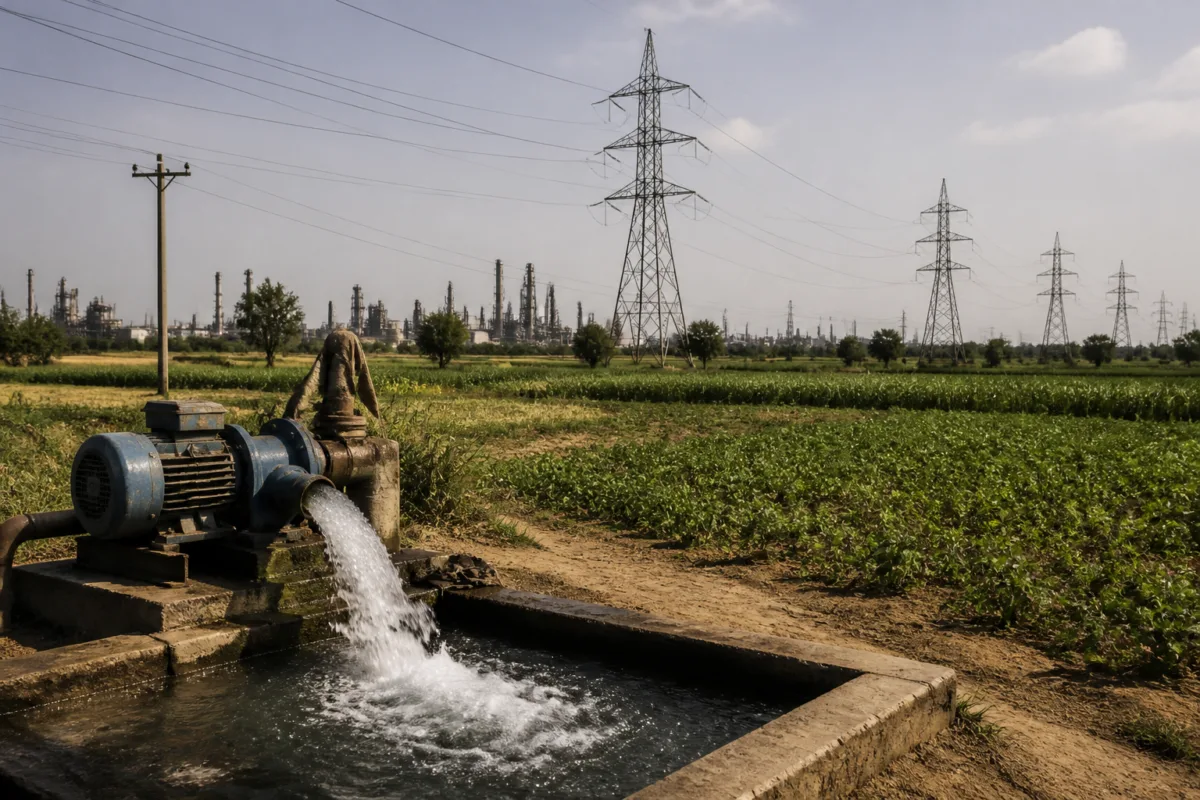
Gujarat’s power demand has climbed sharply as weak monsoon conditions push farmers towards groundwater irrigation while industrial consumption continues to expand. State government data reported by the Times of India shows peak demand reaching 29,822 MW in October 2026, up 37% from 21,822 MW in the corresponding month last year. The immediate story is about electricity. The deeper urban and regional systems story is about how rainfall, groundwater, agriculture, industry and transmission capacity are becoming increasingly dependent on one another.
The state supplied 12,034 million units of electricity up to October 26, compared with 8,994 MU during the same period last year. That represents a 34% increase in energy supplied. Agricultural consumption rose even faster, reaching 2,521 MU from 1,464 MU a year earlier, a 72% increase. Industrial consumption rose 27%, to 6,019 MU from 4,743 MU.
These figures show that the rise in demand was not driven by one isolated category. Agriculture was the sharpest source of additional consumption, but industry also added a substantial load. The result was a power system dealing simultaneously with longer irrigation-pump operating hours, sustained manufacturing demand and the wider electricity needs of households and commercial users.
The agricultural increase is closely linked to rainfall conditions. The report attributes the rise to inadequate rainfall, which forced farmers to rely more heavily on groundwater and run tube wells and irrigation pumps for longer periods. Gopal Sutariya, chairman of the Gujarat Chamber of Commerce and Industry’s agriculture committee, said deficient rainfall had also increased the use of electric dryers, hullers and other farm equipment.
That combination matters because it turns a weather deficit into an electricity-demand problem. When rainfall does not provide enough soil moisture, irrigation becomes the mechanism that protects crops. Where irrigation depends on electrically powered pumps, the burden of compensating for weak rainfall moves directly onto the power system. The connection is particularly important in a state where agricultural production and industrial activity are both significant electricity users.
Sutariya also said that even small and rain-dependent farmers were investing in borewells to take two to three crops a year. The supplied report does not quantify the number of new borewells or the volume of groundwater extracted, but the observation points to a structural shift rather than a purely temporary increase in pump use. As more farms seek assured irrigation, electricity demand can remain elevated even after a particular rainfall shock has passed.
This is the central water-energy relationship visible in the data. A borewell provides a degree of control over agricultural production, but operating it requires power. More intensive cropping can therefore increase both groundwater dependence and electricity consumption. The report does not establish whether groundwater levels have declined in the period under review, nor does it provide data on pump efficiency, feeder losses or the share of subsidised agricultural electricity. Those gaps limit how far the available figures can be interpreted, but they do not weaken the basic evidence of a strong link between rainfall conditions and power demand.
The industrial side of the increase adds a second layer. Industrial consumption reached 6,019 MU, up from 4,743 MU. Rajesh Gandhi, president of the Gujarat Chamber of Commerce and Industry, attributed the higher demand to increased industrial activity ahead of the festive season, alongside high temperatures and greater cooling requirements. The supplied report does not identify individual sectors or industrial clusters responsible for the increase, so it cannot show whether the growth was concentrated in a few manufacturing centres or spread across the state.
Even without that sectoral breakdown, the industrial figure is significant for power planning. Manufacturing facilities generally require dependable electricity not only for production machinery but also for cooling, process control and auxiliary systems. Interruptions can affect production schedules and operating costs. Gandhi said Gujarat needed reliable and affordable power for agriculture, households and industry, while calling for stronger generation and transmission capacity, expanded energy storage, improved renewable-energy integration and better peak-load management.
The pressure was most visible during peak demand. A senior state government official said peak demand had approached 30,000 MW and was driven primarily by agricultural pump loads and higher industrial consumption. The official said the government had planned generation schedules and ensured fuel and transmission readiness to maintain stable supply. This statement indicates that the immediate response was focused on keeping the system operational during a period of unusually high demand.
However, maintaining supply during a peak is not the same as resolving the conditions that create the peak. Generation scheduling and fuel readiness address the short-term balance between available power and consumption. Transmission expansion and storage address system flexibility over a longer period. Agricultural demand, meanwhile, is shaped by rainfall, cropping patterns, groundwater access, pump technology and the economics of irrigation. The supplied material identifies these pressures but does not provide details of any specific demand-management programme or agricultural electricity reform currently being implemented.
The role of lower hydropower generation adds another constraint. Gandhi said reduced hydropower output had added to pressure on peak supply. The report does not state the extent of the reduction or identify the affected facilities, but the point illustrates how electricity systems must manage changes on both sides of the balance sheet. Demand rose because of irrigation, industry, heat and cooling, while one source of generation was reportedly weaker.
For Gujarat, this makes the timing and composition of power demand as important as the total volume. A 34% rise in energy supplied and a 37% rise in peak demand are not identical signals. Energy supplied measures the total electricity delivered over the period, while peak demand indicates the highest level the system had to meet at a particular moment. The difference affects planning: a system may have sufficient annual energy but still face stress during concentrated demand periods.
The numbers also show why a single headline about agricultural consumption can obscure the wider system. Agricultural use rose by 1,057 MU compared with the previous year, while industrial consumption increased by 1,276 MU. Based on the figures supplied, the absolute increase reported for industry was larger, even though agriculture recorded the higher percentage growth. This distinction matters for policy because the two demand categories are shaped by different institutional and economic conditions.
Agricultural demand responds to rainfall and irrigation practices. Industrial demand responds to production, cooling needs, operating schedules and commercial activity. Treating both as one undifferentiated load would make it harder to design targeted interventions. The supplied report does not provide enough information to assess whether the state uses separate peak-management strategies for agricultural feeders, industrial users or other categories.
The policy challenge is therefore distributed across several institutions. Power authorities must schedule generation, maintain fuel availability and strengthen transmission. Agriculture and water agencies influence cropping decisions, groundwater use and irrigation dependence. Industry bodies represent the reliability and affordability requirements of manufacturing units. The report’s comments from the state government and GCCI reflect these different responsibilities, but it does not specify how they are coordinated.
That institutional division is important because the electricity system is absorbing the consequences of decisions made elsewhere. When rainfall is inadequate, farmers increase pumping. When industrial activity and cooling requirements rise, factories draw more power. When hydropower generation falls, other sources must compensate. The state electricity system becomes the point at which these pressures meet, even though it cannot independently control rainfall, groundwater extraction or industrial production.
Gandhi’s call for storage and renewable-energy integration also points to a changing generation landscape, but the available report does not provide Gujarat-specific figures on renewable capacity, storage projects, transmission bottlenecks or the contribution of different generation sources during the reported peak. Those details would be necessary to judge whether the state’s proposed solutions are already being deployed at scale or remain broad planning priorities.
The immediate evidence is clear on three points. Gujarat supplied substantially more electricity by October 26 than it had during the comparable period last year. Agricultural consumption rose 72%, and industrial consumption rose 27%. Peak demand reached 29,822 MW, bringing the system close to the 30,000 MW mark cited by the state official. The supplied material also establishes that weak rainfall, irrigation pumping, industrial activity, heat and lower hydropower generation were all part of the reported pressure.
What remains less clear is whether the increase is a one-season response or part of a longer trend. The report includes a year-on-year comparison but does not provide a multi-year series. It also does not establish how much of the agricultural increase came from additional irrigated area, longer pump operation, new borewells, additional cropping, farm equipment or other factors. Similarly, the industrial figure is not broken down by sector or location.
Those are not minor details. They determine whether the most effective response lies in improving agricultural water efficiency, managing electricity demand, upgrading transmission, expanding generation and storage, or coordinating all of these measures. The available data supports the conclusion that Gujarat’s power system is under growing pressure from interconnected water, climate and economic demands. It does not yet establish which intervention would have the greatest effect.
The next phase of scrutiny should therefore focus on whether demand remains elevated after the current agricultural and festive-season pressures ease, how groundwater and rainfall conditions evolve, and whether the state publishes more detailed data on peak-load management, generation availability and transmission readiness. Gujarat’s near-30,000 MW peak is not only an electricity milestone; it is a measurable indicator of how the state’s development systems are responding to water stress, industrial growth and changing energy requirements.

