


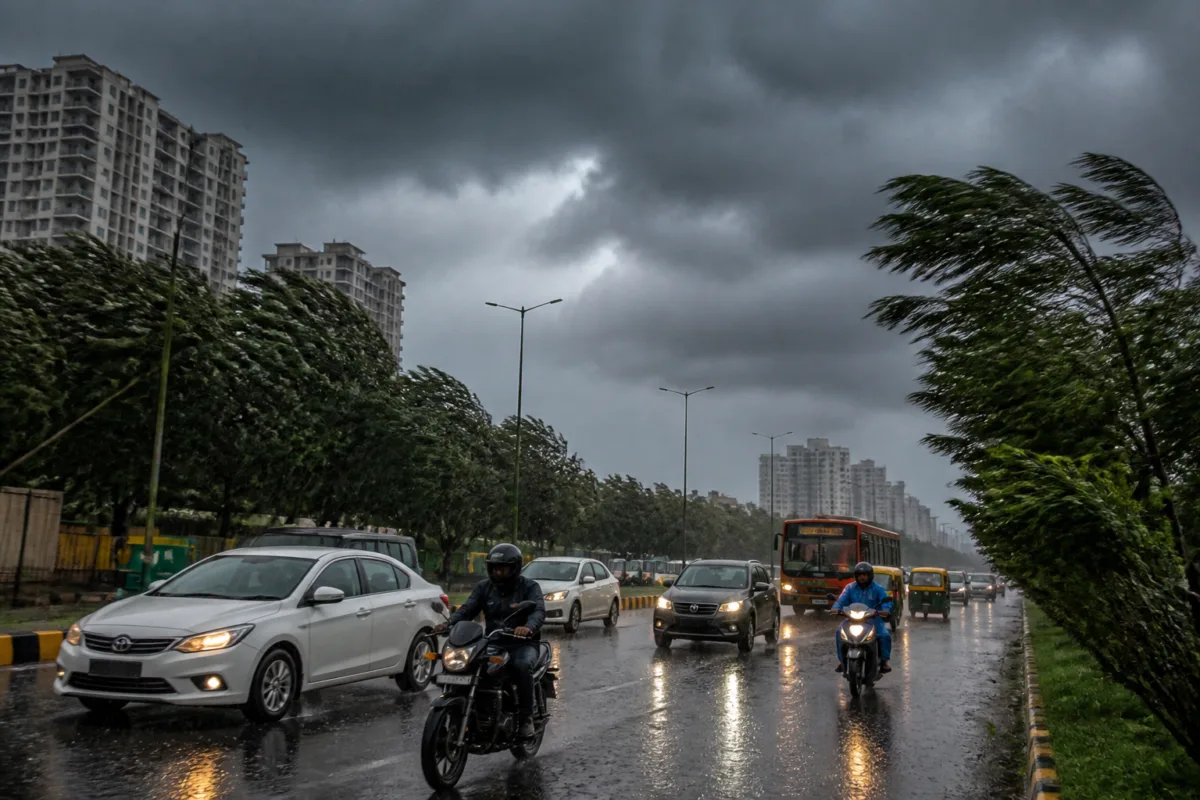
Delhi-NCR is set for two days of thunderstorms, rain and strong winds after the impact of Cyclone Arnab and a western disturbance, with the India Meteorological Department issuing a yellow alert for several areas on 29 October.
According to the weather report published by Live Hindustan – NCR, humid winds associated with the cyclone are expected to move towards Delhi and the National Capital Region. The interaction with the western disturbance is likely to keep skies cloudy and bring light rain accompanied by thunder and lightning in parts of the region on Thursday and Friday.
The IMD has forecast light rain and thunderstorms in several parts of Delhi-NCR during the morning and forenoon of 29 October. Wind speeds are expected to remain between 30 and 40 kilometres per hour, while gusts during storms could reach up to 50 kilometres per hour. Some areas may receive moderate rain. Rain, lightning and strong winds are also possible during the afternoon or evening.
The weather warning is relevant to road users, pedestrians, outdoor workers and urban services across the national capital region. Strong gusts can affect visibility and road conditions, while thunderstorms may disrupt outdoor movement and activities. The supplied report does not specify any traffic restrictions, school closures or civic emergency measures.
Rain is also expected to continue on 30 October. The report says Delhi-NCR will remain cloudy, with light rain, thunderstorms and strong winds possible from the morning until before noon. Winds are again expected to reach 30 to 40 kilometres per hour. The weather system is likely to bring down temperatures in both the daytime and nighttime, increasing the chill in the air.
Delhi’s maximum temperature is forecast to remain between 26 and 28 degrees Celsius on 29 October and between 27 and 29 degrees Celsius on 30 October. The maximum temperature is expected to rise to 28-30 degrees Celsius on 31 October and around 29-31 degrees Celsius from 1 to 3 November. Delhi recorded a maximum temperature of 31.8 degrees Celsius on Wednesday, according to the report.
The expected rain may also temporarily improve air quality by reducing airborne dust and particulate matter, although the report only describes this as an anticipated relief from pollution. No air-quality readings or official pollution-control measures were provided in the supplied material.
The immediate forecast places weather conditions, rather than a longer-term seasonal shift, at the centre of the alert. Residents and urban agencies will now be watching the two-day period for the intensity of rainfall, wind gusts and lightning across different parts of Delhi-NCR.

