


Delhi’s latest political confrontation has exposed a recurring urban governance problem: when large demonstrations enter the city’s most commercially intensive districts, the cost of managing public order is often transferred to traders, commuters and informal workers. The immediate dispute centres on the Congress’s proposed November 1 gathering at Ramlila Maidan, the BJP’s counter-mobilisation in Chandni Chowk and the concern that barricading, traffic diversions and possible restrictions on public transport could disrupt Old Delhi’s festive-season commerce.
The political claims are sharply divided. The BJP has described its Chandni Chowk padyatra as a campaign to “Save Democracy, Remove Anarchy” and has accused Congress leader Rahul Gandhi and his party of repeatedly disrupting normal life. The Congress, meanwhile, is preparing a public campaign around alleged irregularities in the Special Intensive Revision of electoral rolls and has demanded accountability from Chief Election Commissioner Gyanesh Kumar. Traders are caught between these competing positions, arguing that their businesses should not become collateral damage in a political contest.
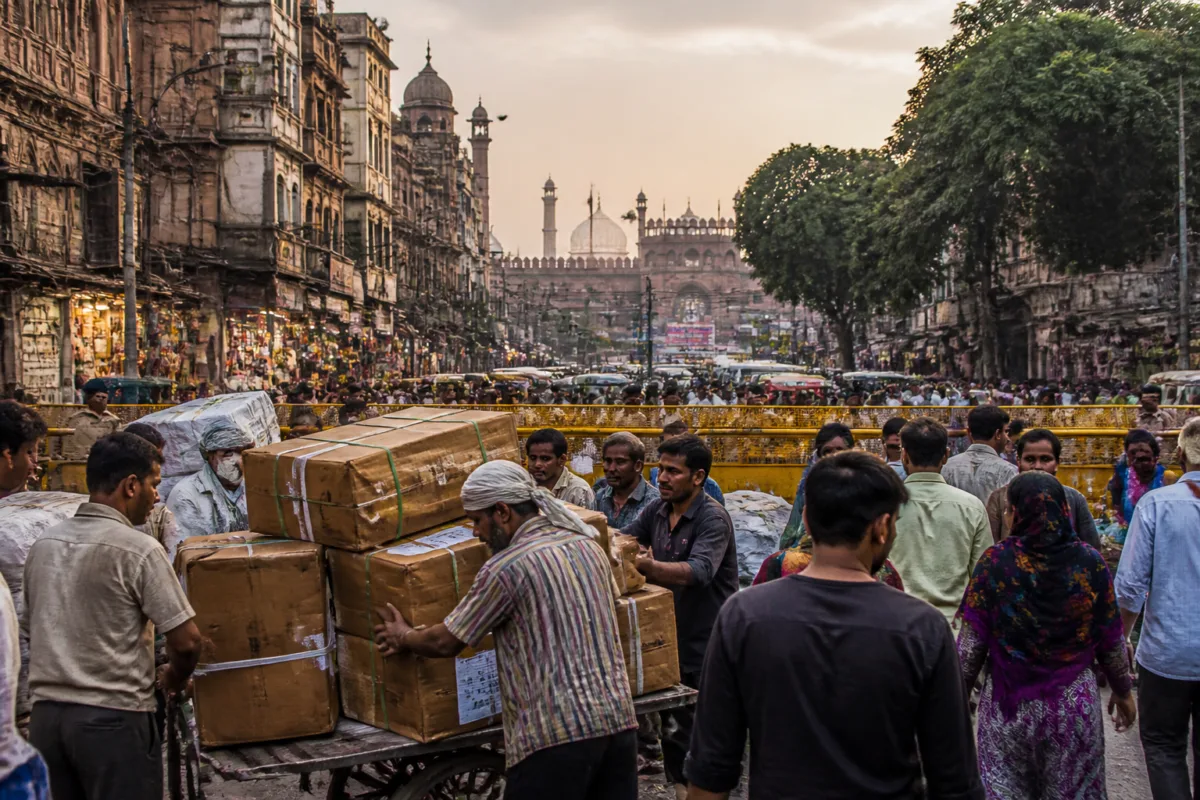
This is not simply a dispute about whether a rally should be held. It is a question about how Delhi allocates access to streets, markets and transport systems when political mobilisation and commercial activity compete for the same urban space. Ramlila Maidan lies close to a cluster of wholesale markets that serve buyers from Delhi and other states. The affected areas named by the Chamber of Trade and Industry include Chandni Chowk, Sadar Bazar, Khari Baoli, Naya Bazar, Chawri Bazar, Daryaganj and Kashmere Gate.
The timing intensifies the conflict. Traders say the period before Dhanteras, Diwali and Bhai Dooj is crucial for wholesale sales, when buyers travel to the capital to purchase goods in bulk. Paramjeet Singh Pamma, president of the Sadar Bazar Bari Market Trade Association, has appealed to Congress leaders to postpone the rally, warning that access problems and traffic restrictions could cause losses worth crores of rupees. The concern is therefore not limited to inconvenience. For wholesale businesses operating around a narrow festive trading window, even a short interruption may affect deliveries, purchasing cycles and customer movement.
The CTI has framed the issue in terms of the scale of the proposed gathering. Its chairman, Brijesh Goyal, said the Congress had indicated that around 10 lakh people could attend, while the capacity of Ramlila Maidan was approximately 50,000, according to his claim reported by PTI. The figures are claims made by the traders’ body, not independently established numbers in the supplied report. But the gap between the expected crowd and the venue’s stated capacity explains why traders are concerned about crowd spillover, security cordons and the wider movement of vehicles and pedestrians.
Goyal said the event could affect more than 20 major wholesale hubs within a five-kilometre radius of the venue. He also claimed that traffic restrictions could prevent three to four lakh buyers from outside Delhi from reaching the markets. These estimates require careful treatment, but they identify the operational chain at stake: a rally at one venue can influence access routes, parking, public transport, loading points and market opening decisions far beyond the event site.
The traders’ argument is supported, they say, by their experience of an earlier gathering. Goyal told PTI that a meeting of around 2,000 to 4,000 people at Jantar Mantar on October 10 resulted in metro station closures, barricading and restrictions that forced more than 20 major markets to shut. The supplied report does not provide an official traffic or police assessment of that incident. It does, however, show why the trading community is seeking advance clarity rather than waiting for security arrangements to be imposed on the day of the rally.
Rahul Gandhi has offered a different explanation for the disruption. In a post on X, he said the government had shut metro services, sealed roads and effectively locked down parts of the capital. He argued that the restrictions were the result of government-imposed security arrangements rather than the opposition’s protest itself. Gandhi called on traders to demand the removal of Gyanesh Kumar and wrote that the protests would stop in 30 seconds if the Chief Election Commissioner were removed. His statement shifts responsibility for the commercial impact from the organisers to the authorities responsible for security and transport restrictions.
That distinction is central to the governance question. A political party may organise a demonstration, but the administration decides how roads are barricaded, which routes remain open, whether metro stations are closed and how emergency and commercial movement is managed. Without a publicly explained mobility plan, affected businesses are left to absorb the uncertainty. The debate then becomes political before it becomes administrative: each side uses disruption as evidence against the other, while traders seek a practical answer about whether customers and goods can move.
Congress leader Sandeep Dikshit has challenged the assumption that the rally would necessarily damage all local commerce. He said the gathering was confined to a specific area and argued that street vendors, food sellers and small shopkeepers could also benefit from the presence of a large crowd. This introduces an important distinction within the informal economy. A rally may generate short-term sales for vendors near the event while simultaneously restricting access to wholesale markets, warehouses and established retail clusters elsewhere. The economic impact is therefore unlikely to be uniform across all businesses, even within the same district.
The disagreement also reveals the limits of treating “the market” as a single stakeholder. Wholesale traders, roadside vendors, transport operators, shop workers, customers from outside Delhi and residents affected by diversions may experience the same event differently. The supplied report records the concerns of organised trader groups and the Congress response, but it does not provide a systematic assessment of gains and losses across these categories. That missing evidence matters because policy decisions based only on the loudest commercial voice may overlook workers and smaller businesses with less institutional representation.
Delhi’s political geography makes such conflicts particularly difficult. Old Delhi combines dense markets, narrow roads, heritage precincts, high pedestrian movement and major transport connections. Its commercial functions are not easily relocated for a day. A security perimeter around one venue can affect access to several neighbouring market areas, especially when buyers arrive in large numbers and goods move through constrained streets. The city’s challenge is not merely crowd control; it is maintaining the ordinary circulation of people, freight and public transport while managing an extraordinary event.
The institutional responsibilities are spread across several actors. Political parties decide the timing, route and expected scale of their mobilisation. Police and security agencies determine access controls and crowd-management arrangements. Transport authorities and metro operators respond to security assessments. Municipal agencies manage streets and public spaces, while market associations communicate operational concerns from traders. The report does not establish whether these agencies have issued a consolidated public plan for November 1. That absence, if it continues, leaves room for competing claims and last-minute decisions.
The political context makes a negotiated solution harder. The BJP’s Chandni Chowk march was led by party president Nitin Nabin and Delhi Chief Minister Rekha Gupta, who attacked Gandhi and defended the Prime Minister’s leadership. The Congress has planned an impeachment-style public proceeding against the Chief Election Commissioner on October 30, followed by a “Dilli Chalo” march and the Ramlila Maidan gathering on November 1, according to the report citing ANI. Each side is therefore using public space not only for mobilisation but also for signalling strength.
For the administration, the immediate test is whether political rights and economic access can be managed together. The traders’ appeal to postpone the rally is not presented as a rejection of the opposition’s right to protest. Their stated demand is to move the event until after Diwali, when the commercial consequences may be lower. Congress leaders have rejected or questioned that framing, arguing that the gathering should not be treated as an automatic threat to trade and that the government bears responsibility for excessive restrictions.
The evidence currently confirms a conflict over anticipated disruption, not the final economic impact of the November 1 event. The expected crowd size, the number of affected markets and the possible losses are claims from trader representatives and have not been independently established in the supplied material. Nor does the report provide a final police, metro or municipal traffic plan. Those are the facts that will determine whether the rally produces widespread commercial disruption, limited local inconvenience or additional business for some informal sellers.
What the dispute already demonstrates is that Delhi’s protest-management framework is also an urban access framework. When a demonstration is planned near a dense commercial district during a critical sales period, crowd control becomes inseparable from livelihoods, freight movement and public transport. The next important developments are the Congress’s October 30 programme, the administration’s security and mobility arrangements, and whether the rally is postponed or proceeds as planned on November 1.

