


India’s compliance gaps are not confined to paperwork. An audit of 52 sites across 17 States and Union Territories found 4,694 instances of non-compliance, with labour, environment, health and safety requirements accounting for 91.7 per cent of the findings. The results point to a structural weakness in how companies govern the physical places where people work: factories, warehouses, depots, offices and mining and metals plants.
The findings were published in TeamLease RegTech’s Compliance Audit Insights 2026 report, titled Hiding in Plain Sight. The audit covered 28 factories, 12 warehouses and depots, six corporate offices and six mining and metals plants, spanning 342 regulations. It found that 70.4 per cent of the findings carried potential penalties, prosecution or other legal consequences. In 46.1 per cent of cases, the applicable provisions at the time of each audit could allow imprisonment. Another 31 per cent carried provisions allowing additional fines for every day a breach continued.
These figures matter because they show that compliance exposure is connected to the operation of sites, not only to the formal existence of a company. A missing record, absent notice or unappointed officer may appear administrative, but the audit indicates that such gaps can carry legal consequences when they relate to workplace protection, statutory duties or continuing breaches.
The report’s central finding is the concentration of risk in labour and environment, health and safety requirements. Labour laws accounted for 65.7 per cent of the total findings, while environment, health and safety requirements contributed another 26 per cent. Among rated findings, 59.8 per cent were classified as critical or high risk. Environment, health and safety findings had the higher risk profile: 81.1 per cent were rated critical or high, compared with 55.8 per cent of labour-law findings.
This distinction is important for the built environment because the same site can combine employment, industrial operations, storage, movement of goods and exposure to physical hazards. The audit does not claim that every breach resulted in an accident or injury. It does, however, show that a large proportion of identified gaps were connected to rules carrying serious legal consequences, particularly in areas intended to protect workers and regulate operating conditions.
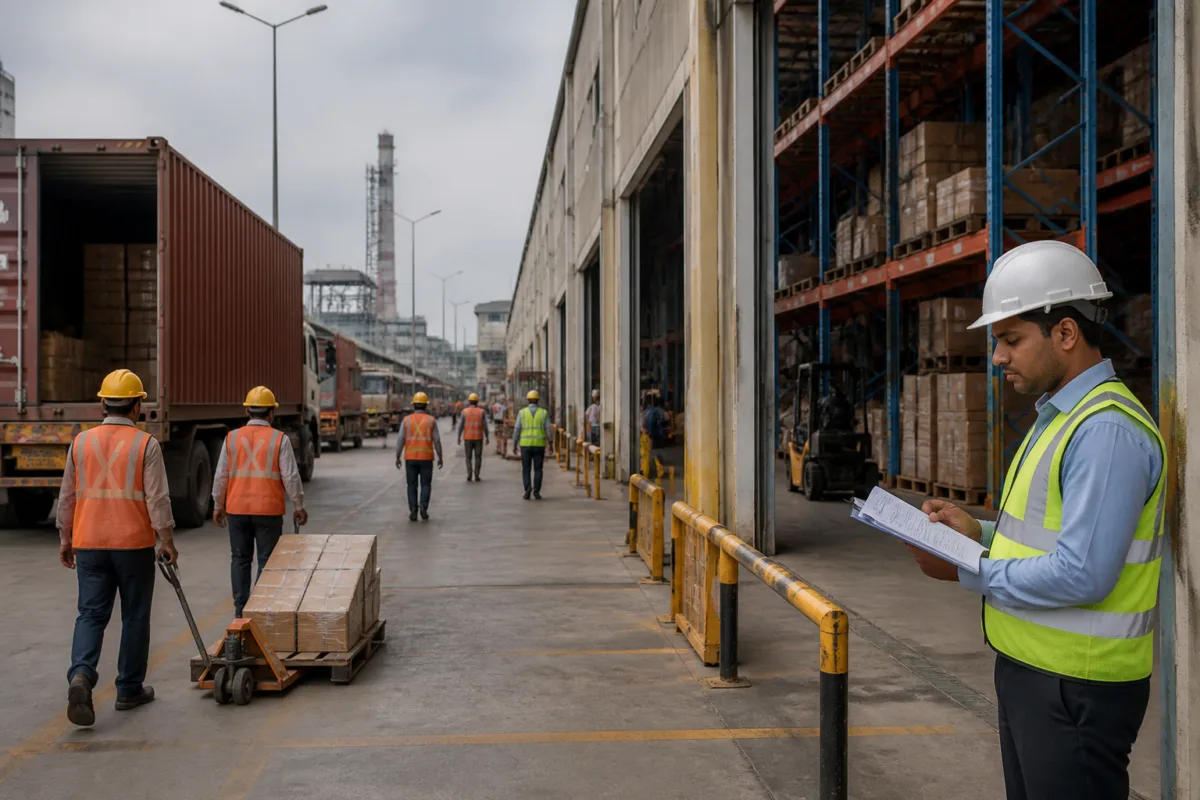
Warehouses and depots emerged as a particularly exposed category. They recorded the highest proportion of findings carrying potential imprisonment clauses, at 52.1 per cent, compared with 46.4 per cent for factories, 46.1 per cent for mining and metals plants and 31.8 per cent for corporate offices. Warehouses also averaged 58.2 findings per site.
TeamLease RegTech attributed this vulnerability partly to fewer supervisors, greater reliance on contract workers and the distance between operating locations and head-office compliance teams. That explanation places the issue within the geography of modern business. A company may have a central compliance function, but the risks are often created or left unresolved at dispersed sites where workers, contractors, supervisors and local authorities interact.
The warehouse finding also exposes the difference between organisational visibility and operational oversight. Warehouses and depots may not receive the same attention as factories or corporate offices, even though they are workplaces with their own staffing structures, records, statutory displays and safety obligations. The audit’s findings suggest that physical distance and limited supervision can allow gaps to persist before they are detected by internal teams or external authorities.
The report found that workplace inclusion laws accounted for 21.2 per cent of all findings, across 16 of the 17 States and Union Territories covered. The identified requirements related to sexual harassment at the workplace, persons with disabilities, HIV and AIDS, transgender persons and maternity benefits. Recurring gaps included failure to appoint complaint officers for transgender persons, provide crèche facilities, establish appropriate workplace mechanisms and communicate required policies to workers.
These findings broaden the meaning of workplace compliance. The built environment is not only a collection of buildings, machinery and logistics systems. It also determines whether workers can access complaint mechanisms, required facilities and information about their rights. A workplace can meet visible operational requirements while remaining deficient in the institutional arrangements that make it accessible and accountable to its workforce.
The audit also found 1,118 findings related to missing displays, including notices, statutory abstracts, policies and committee details. Another 519 concerned registers or records that had not been maintained. Of those record-related findings, 58 per cent could lead to imprisonment under the applicable provisions at the time of the audit.
The numbers indicate that a significant part of the compliance problem involves routine systems of communication and documentation. Displays inform workers and visitors about obligations, policies and responsible committees. Registers create an auditable record of actions and conditions. When these are missing, the organisation loses both a method of informing people and a mechanism for demonstrating that duties were performed.
The report separately identified 1,457 findings carrying potential daily fines. Of these, 901 could also lead to imprisonment. Daily fines change the character of a violation: the exposure may continue for as long as the breach remains unresolved. This makes compliance a matter of operational control rather than a periodic exercise conducted before an inspection or audit.
TeamLease RegTech’s account places this challenge within the complexity of India’s regulatory system. The report says enterprises answer to three levels of government, seven categories of law, 21 types of regulatory instruments and 41 types of compliance. It also says that 3,756 union, state and local government websites can change obligations almost daily, while states and local bodies set their own thresholds, forms, wage structures and penalties.
That fragmentation helps explain why a company can believe it is compliant while individual sites continue to carry unresolved gaps. Responsibility is distributed across national, state and local institutions, while implementation is distributed across business units, contractors and physical locations. The result is a compliance system in which the formal owner of a business may not have a complete, current or site-specific view of what is required.
The audit does not establish that regulatory complexity is the only cause of the findings. It does, however, identify complexity as the root cause in the report’s assessment. The evidence also shows that the burden is not evenly distributed across site types. Warehouses and depots had the highest average number of findings per site, while environment, health and safety violations were more likely than labour-law findings to be rated critical or high risk.
This combination points to a governance problem with a physical footprint. Compliance is often discussed as a corporate or legal function, but many obligations must be implemented at the site level. Supervisors need to know which rules apply to a particular facility. Workers need access to required information and mechanisms. Records need to be maintained where work is performed. Senior officers and designated individuals may remain exposed when those systems fail.
The report found that in 29 per cent of findings, penalty provisions named directors, senior officers, factory occupiers or other designated individuals as potentially responsible. This creates a direct link between site conditions and board-level accountability. The relevant question for leadership is therefore not simply whether a compliance team exists, but whether it can identify changing obligations and verify implementation across every operating location.
Rishi Agrawal, Co-founder and Chief Executive Officer of TeamLease RegTech, said, “Every leadership team we meet believes they are compliant. Yet every site we have audited reveals significant compliance gaps.” He added that the question for boards is whether they find those gaps first or whether an inspector, customer or investor does.
The report’s evidence does not provide a national estimate of all compliance violations, nor does it establish that the 52 audited sites represent every industry or state. Its value lies in showing the pattern within the sites examined: a high volume of findings, substantial exposure to penalties and prosecution, and a concentration of risk in labour, environment, health and safety requirements.
For cities and industrial regions, the wider issue is how regulatory responsibility is translated into everyday conditions at workplaces. Factories, warehouses, depots, offices and mining plants are part of the infrastructure of employment and supply chains. Their safety and accountability systems affect workers directly, while failures can also expose companies and public authorities to continuing legal and administrative consequences.
What the audit confirms is that compliance gaps can remain hidden inside ordinary site operations, particularly where oversight is dispersed and requirements change across jurisdictions. What it does not establish is how many of the identified breaches have since been corrected. The next significant measure will therefore be whether companies convert audit findings into documented, site-level corrective action rather than treating compliance as a periodic review.

