


Raymond Realty’s latest quarterly results present a more complicated picture than a simple growth story. Revenue increased to ₹749 crore in the September quarter from ₹697 crore a year earlier, while EBITDA rose to ₹115 crore from ₹101 crore. Yet net profit fell to ₹53 crore from ₹60 crore. The numbers point to a housing business expanding its sales and development base while still facing the financial pressures that accompany large-scale project execution in the Mumbai Metropolitan Region.
The company’s most significant operating signal was not revenue alone, but the pace of pre-sales and collections. Harmohan Sahni, Managing Director and CEO of Raymond Realty, said the company had nearly doubled quarterly pre-sales without new launches and had recorded a 67 per cent increase in collections. This suggests that the business is drawing value from projects already in its portfolio rather than relying only on a constant cycle of fresh launches to generate customer demand.
That distinction matters in a market where developers often use new project announcements to create sales momentum. Raymond Realty’s reported performance, as presented by the company, instead highlights the conversion of existing inventory, construction progress and customer payments. The supplied results do not provide the absolute value of quarterly pre-sales or the precise collection amount, so the scale of the increase cannot be independently assessed from the figures available. But the direction of movement is clear: operating cash inflows strengthened even as reported net profit declined.
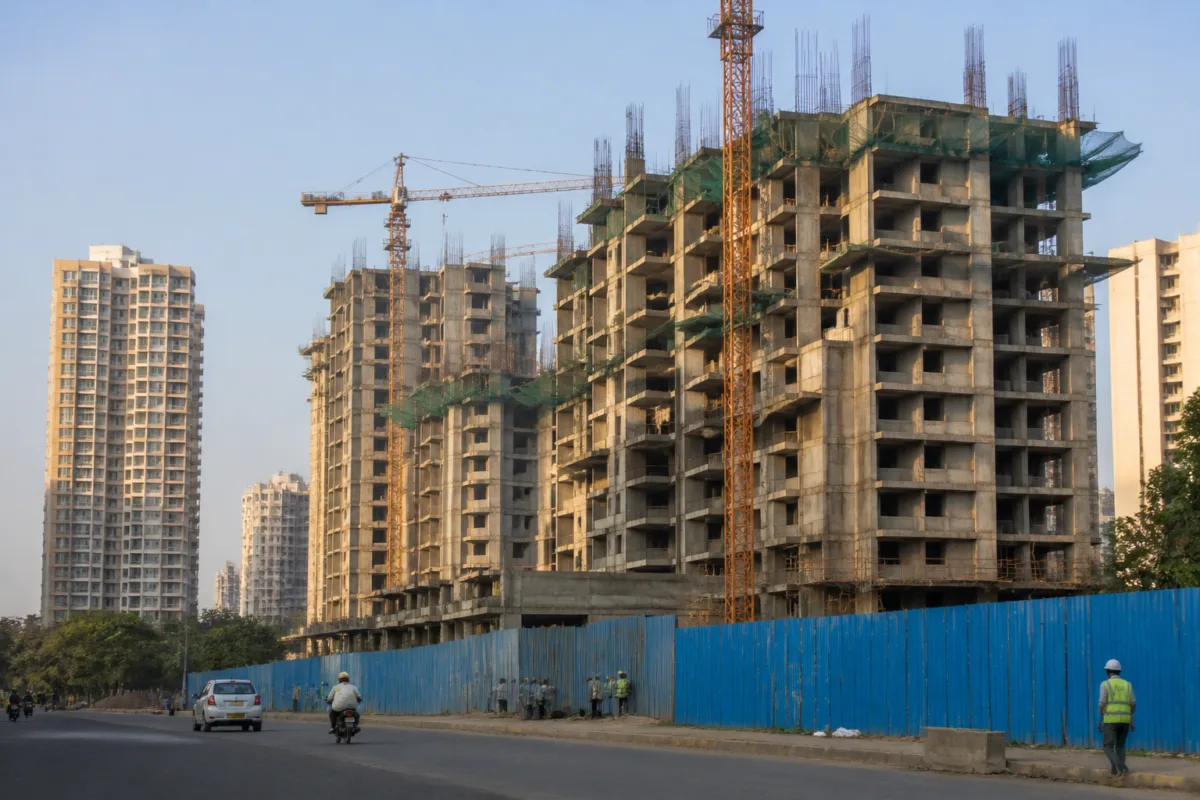
The company’s portfolio also shows the scale at which Raymond Realty is positioning itself. Its gross development value was reported at ₹52,000 crore. It holds land parcels totalling 100 acres with revenue potential of ₹25,000 crore, of which about 65 acres are currently under development. Those projects represent 6.7 million square feet of RERA carpet area and a revenue potential close to ₹16,500 crore.
The figures describe a development pipeline rather than immediate income. Gross development value and potential revenue are measures of the opportunity embedded in land and projects; they are not equivalent to realised revenue, profit or cash in hand. The distinction is important for understanding the company’s financial position. A large pipeline can support future growth, but it also requires approvals, construction, sales, customer collections and delivery over time. The reported quarter therefore needs to be read as one stage in a longer project cycle rather than as a complete measure of the portfolio’s eventual performance.
Raymond Realty’s joint development agreement portfolio adds another layer to this model. The company reported eight projects with a combined revenue potential of ₹27,000 crore. In a joint development arrangement, the developer’s access to projects is structured through an agreement with landowners rather than through outright ownership of all the land. The source material does not set out the revenue-sharing terms, funding obligations or delivery schedules for these agreements. However, the presence of such a portfolio indicates that the company’s growth strategy extends beyond its owned land parcels.
This creates a different set of execution requirements. The developer must coordinate with landowners, obtain and maintain approvals, manage construction and convert project progress into sales and collections. The results supplied by the company provide evidence of operating momentum, but do not establish how quickly the full joint development pipeline will translate into recognised revenue or profit. That remains dependent on project-level execution and accounting recognition over time.
The quarter also included a notable delivery milestone. Raymond Realty said it had delivered a key tower in Thane 18 months ahead of its RERA timeline. The statement is significant because construction delivery is central to the relationship between a developer and homebuyers. A faster handover can support collections, reduce the period during which customers wait for possession and strengthen the company’s execution record. The supplied material does not identify the tower, its number of homes or the original and revised possession dates, so the operational scale of the achievement cannot be assessed in detail.
The company also reported a ₹4,100-crore launch pipeline in the Mumbai Metropolitan Region. This pipeline provides a future source of sales activity, but the announcement does not specify the projects, locations, launch dates or approvals attached to it. Those details are important because the timing of a launch pipeline is shaped by planning permissions, construction readiness, market absorption and the ability of buyers to make payments. Without that information, the pipeline should be treated as stated potential rather than near-term revenue.
The contrast between Raymond Realty’s revenue and profit numbers is the central financial feature of the quarter. Revenue grew by about 7 per cent year-on-year, while EBITDA increased by roughly 14 per cent. Net profit, however, declined by nearly 12 per cent. The figures indicate that operating performance improved, but the increase in operating earnings did not translate into higher profit after all other costs and charges included in the company’s accounts. The supplied report does not identify the specific reasons for the decline in net profit, so it would be inaccurate to assign it to financing costs, taxes, project expenses or any other individual factor.
This gap is relevant to the way real estate businesses should be evaluated. A developer’s performance cannot be understood through revenue growth alone because revenue recognition is linked to construction progress and project accounting. EBITDA indicates operating earnings before certain charges, while net profit reflects the result after those charges. Stronger EBITDA alongside lower net profit can therefore show that the core business generated more operating earnings during the quarter, even though the final earnings available to owners were lower.
Raymond Realty’s parent company, Raymond, reported a different pattern in its broader business. Raymond’s net profit attributable to owners doubled to ₹22 crore in the September quarter from ₹11 crore a year earlier. Revenue rose 24 per cent to ₹655 crore, EBITDA increased 30 per cent to ₹103 crore and expenses rose to ₹641 crore from ₹544 crore. The company attributed the performance to better realisation, with precision technology and auto components contributing ₹471 crore and aerospace and defence contributing ₹139 crore.
Gautam Hari Singhania, Chairman and Managing Director of Raymond, said the results were driven by execution in aerospace and defence and precision technology, while the Andhra Pradesh facility was progressing on schedule. These businesses are separate from Raymond Realty’s housing operations, but their inclusion in the quarterly results shows that the group’s overall performance cannot be read as a direct proxy for the real estate business. The real estate division has its own revenue, EBITDA, profit and development pipeline dynamics.
For the urban economy of the Mumbai Metropolitan Region, the more consequential question is how Raymond Realty converts its stated land and project base into completed homes. The company’s reported 65 acres under development, 6.7 million square feet of RERA carpet area and eight-project joint development portfolio indicate a substantial construction programme. But the supplied information does not state the number of homes, the tenure mix, the price segments or the locations of the projects beyond the reference to Thane and the wider MMR pipeline. Those omissions limit what can be concluded about affordability, buyer access or the distribution of housing supply.
The results also illustrate the institutional framework within which private housing projects operate. RERA timelines provide a formal reference for delivery commitments, while collections reflect the connection between construction progress and buyer payments. Joint development agreements determine how land and development capacity are assembled. Company-reported gross development value and revenue potential describe the commercial scale of the portfolio, but the urban outcome depends on whether projects receive approvals, are built to schedule and are handed over as promised.
The evidence available from the quarter confirms three developments: Raymond Realty increased revenue and EBITDA, reported stronger pre-sales and collections, and continued to expand a large development pipeline. It also confirms that net profit fell despite the improvement in operating measures. What it does not establish is the reason for the profit decline, the absolute value of pre-sales, the project-level economics of the joint development agreements or the timing of the ₹4,100-crore launch pipeline.
That combination makes Raymond Realty’s results less a straightforward account of expansion than a measure of conversion. The company has reported considerable development potential and stronger operating activity, but the durability of the growth story will depend on how efficiently land, construction progress, sales and collections become recognised revenue and completed housing. The next milestones to watch are the execution of projects already under development, further deliveries against RERA timelines, and the conversion of the stated MMR launch pipeline into actual project launches and customer transactions.

