


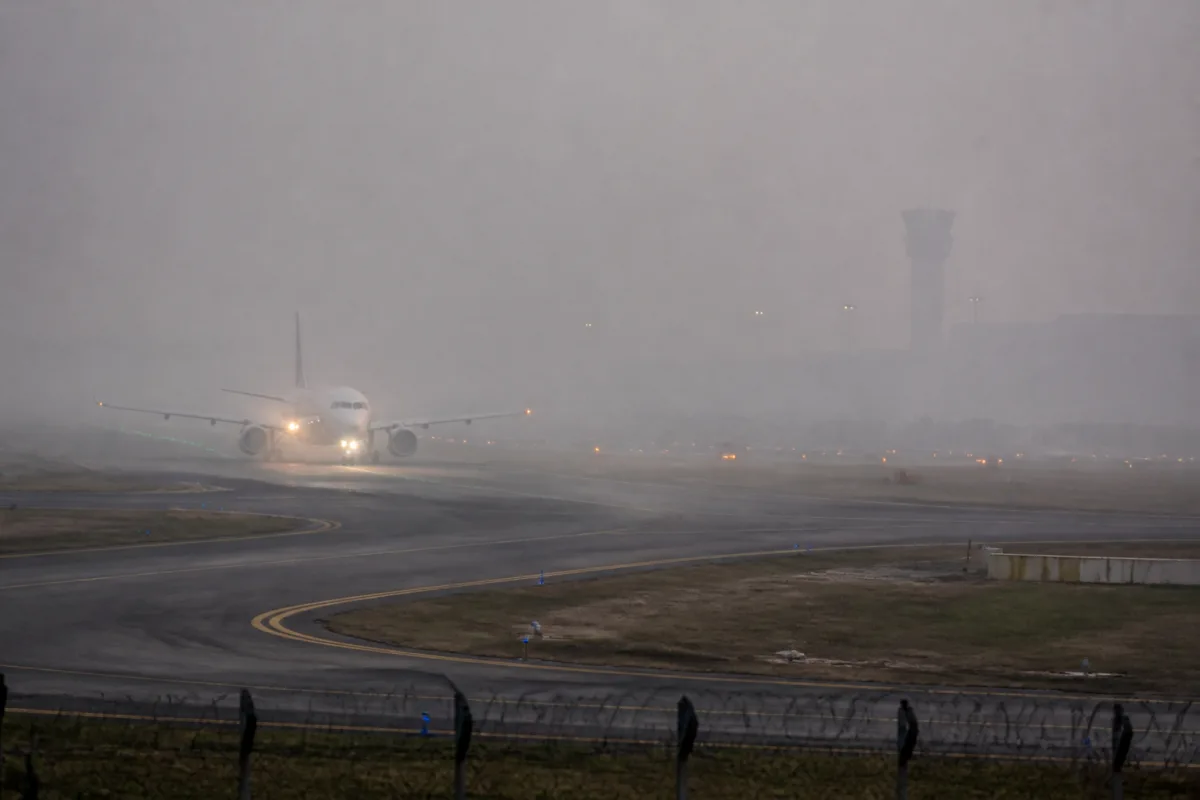
Delhi’s winter fog is not only a weather problem; it is an operational stress test for the airport’s forecasting systems, runway capacity and aircraft-movement procedures. This winter, Indira Gandhi International Airport will rely on the recently introduced SkyCast system, the reopening of its rehabilitated third runway and a new rapid-exit taxiway to limit the disruption caused by low visibility.
The measures address different points in the same chain. SkyCast is intended to improve short-term information about changing weather conditions. The runway rehabilitation project is intended to restore and strengthen the airport’s operating infrastructure. The new Z1 rapid-exit taxiway is designed to allow aircraft to leave the runway more quickly after landing. Instrument Landing System-related work and the reinstallation of airfield ground lighting are relevant to operations when visibility deteriorates.
The combined package is significant because delays at a large airport rarely remain limited to one aircraft. When a landing is delayed, the aircraft may occupy an arrival sequence, a gate or an onward flight schedule. A disruption at one stage can therefore affect several subsequent movements. The report by Jagran – New Delhi describes this as a recurring winter challenge at the country’s largest airport, where dense fog can unsettle flight schedules and create longer passenger waiting times.
The first question is whether better information can produce better decisions. SkyCast was launched on 29 May this year and is being tested during a winter season in which fog will provide its most demanding operating conditions. According to the Ministry of Earth Sciences, the system integrates instruments that monitor wind speed and direction, atmospheric moisture, turbulence and the structure of fog. These include a radar wind profiler, microwave radiometer, sodar and lidar ceilometer.
The equipment is intended to support short-term forecasting. If airport operators, air traffic control and airlines receive earlier and more accurate warnings about deteriorating conditions, they can plan aircraft movements and schedules in advance. That could help reduce sudden operational changes. However, a forecast is not the same as an improvement in landing conditions. The system can provide information about risk, but aircraft can still face restrictions when visibility or other conditions fall below operational requirements.
This distinction is central to assessing the technology. The report notes that the value of SkyCast will depend on the accuracy of its warnings and on the quality of the operational decisions taken in response. A high-quality forecast may help controllers and airlines prepare, but it cannot by itself guarantee that aircraft will land safely or that normal schedules will continue during dense fog.
The report compares Delhi’s effort with weather-monitoring arrangements at Hong Kong airport, where Doppler radar, lidar and wind profilers are used to identify sudden changes in wind and wind shear. According to Hong Kong’s weather observatory, the detection rate for wind shear has been around 90 per cent. That figure measures the identification of a weather hazard, not a reduction in flight delays. The distinction is important because Delhi’s SkyCast system should ultimately be assessed against operational outcomes rather than the presence of sophisticated equipment alone.
The airport’s physical infrastructure is the second part of the winter test. Runway 11R/29L, described in the report as the third runway, was closed for rehabilitation in February 2026 and reopened on 20 September. The work included renewal of the runway surface and pavement, the removal and reinstallation of around 2,000 airfield ground-lighting units, and the construction of the new Z1 rapid-exit taxiway. Work linked to a new Instrument Landing System was also undertaken, including installation and verification-related activity.
Each intervention addresses a different operational constraint. A renewed pavement supports the continued use of the runway. Ground lighting helps pilots and airport personnel operate in reduced visibility. An ILS provides instrument-based guidance for aircraft approaches and landings. The rapid-exit taxiway is intended to reduce the time an aircraft spends on the runway after landing, allowing the runway to be made available for the next movement more quickly.
The Z1 taxiway therefore matters not simply because it adds concrete or changes the airport’s layout, but because runway occupancy time affects how many aircraft movements can be handled in a given period. Faster aircraft exit can improve the flow of arrivals, provided other parts of the system—approach spacing, visibility, gate availability, taxiway movement and air traffic control procedures—do not become the limiting factors.
This is why the winter test cannot be judged by a single infrastructure component. The runway may be available, but fog can still reduce the number of movements that can safely be handled. SkyCast may identify worsening conditions, but the benefit will depend on whether airlines and controllers can use the information early enough. A rapid-exit taxiway may reduce runway occupancy, but it cannot remove restrictions created by very poor visibility or safety requirements.
The project also illustrates how airport capacity is produced through a combination of assets and decisions. A runway is not an independent machine. Its effective capacity depends on pavement condition, lighting, navigation systems, aircraft separation, taxiway geometry, air traffic control and the weather environment. When one element weakens, the performance of the broader system can decline even if the other components remain available.
For passengers, the test will be experienced less through technical indicators than through waiting time, cancellations, missed connections and the reliability of information. The report does not establish how much delay SkyCast or the rehabilitated runway will eliminate. It also does not provide a baseline against which winter performance can be compared. That means the public assessment of the measures will depend on how the airport records and communicates operational outcomes during fog events.
The institutional structure is similarly important. The airport operator, air traffic control, airlines and weather authorities each have different responsibilities. Weather-monitoring systems produce information; air traffic control manages aircraft movement; airlines adjust schedules and aircraft deployment; and the airport operator maintains runways, lighting and associated infrastructure. Passenger relief depends on these functions working together rather than on any one agency acting alone.
The Ministry of Earth Sciences’ role, as described in the report, is connected to the weather information that SkyCast integrates. The runway rehabilitation and associated facilities are linked to airport infrastructure and operations. This division of responsibilities means that winter performance will depend on coordination between technical forecasting and operational implementation. A warning that is not received, understood or translated into a timely decision may have limited practical value.
The available evidence establishes what has been installed and what the systems are designed to do. It does not yet establish the size of the reduction in delays, the number of additional movements that the rehabilitated runway will support, or the level of passenger disruption that will remain during severe fog. Those are outcome questions, and they can only be answered after the airport operates through the winter period and publishes or otherwise records comparable performance information.
The larger urban issue is the vulnerability of a major metropolitan gateway to a recurring seasonal condition. Delhi’s airport serves a city and a national air network in which disruptions can spread beyond the airport boundary. The winter fog challenge therefore connects aviation infrastructure with business travel, freight movement, tourism, public administration and household plans. Improving resilience requires both physical capacity and reliable information about when that capacity cannot be safely used.
Delhi’s new arrangements offer a more integrated response than a single technology announcement. SkyCast addresses forecasting; the third runway rehabilitation addresses infrastructure readiness; the Z1 taxiway addresses aircraft clearance; and lighting and ILS-related works address low-visibility operations. Yet the report makes clear that the decisive measure will be actual performance during fog: the accuracy of forecasts, the operational decisions that follow, the number of delays and the waiting time faced by passengers.
The coming winter will therefore test not just whether Delhi airport has new equipment and renewed infrastructure, but whether those assets function as one operational system. The evidence currently supports confidence in the scope of the upgrades, but not a quantified claim about passenger relief. That assessment will depend on the airport’s performance when dense fog places all of these systems under pressure.

