


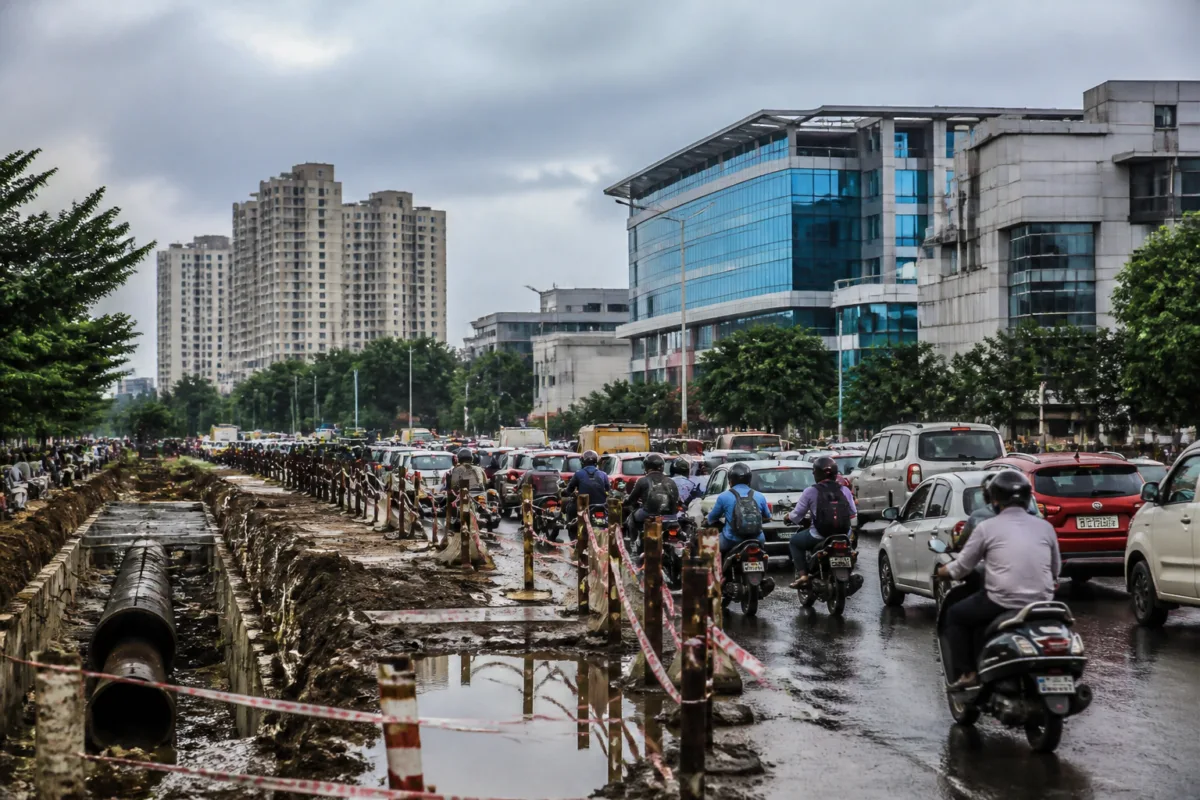
Hinjewadi development works have become a test of whether a fast-growing employment district can convert public announcements into functioning urban infrastructure. According to a report by Sakal – Pune, Shiv Sena (UBT) MLA Aaditya Thackeray said that development works in Hinjewadi remained stalled despite the state government announcing ₹426 crore for basic facilities. Residents and representatives of information technology employees and housing societies also raised concerns about untreated sewage, water shortages, traffic congestion and repeated delays in the proposed metro service.
The significance of the dispute lies not only in the amount announced, but in the gap between financial approval and visible implementation. Thackeray said the funding was announced after a September 6 protest, but argued that there had been no corresponding action on the ground. His criticism was directed at the Maharashtra government and the chief minister, whom he urged to begin implementation rather than limit the response to announcements.
The report does not establish whether the entire ₹426 crore has been released, which agencies control the funds, or which projects have received administrative or technical approval. That distinction is important. In urban infrastructure, an announced allocation does not by itself mean that tenders have been issued, land or permissions are available, contractors have been appointed, or work has begun. The available account records the political demand for implementation, but does not provide a project-wise expenditure or progress statement.
What the Hinjewadi meeting made clear is that the district’s problems are interconnected. Residents are dealing with water and traffic pressures, while companies and large buildings in Hinjewadi Phases 2 and 3 were accused of failing to treat sewage. Participants also alleged that the Pune Metropolitan Region Development Authority, or PMRDA, had repeatedly offered assurances about a sewage treatment project without taking concrete action.
These concerns point to a basic urban management problem: new employment and housing growth can outpace the delivery of common systems. Roads, water supply, sewage treatment and mass transport are not separate services for residents. They determine whether a district can function safely and reliably. When one system is delayed, pressure shifts to another. In this case, the report links traffic congestion to the absence or delay of an expected metro connection, while sewage concerns raise questions about how buildings and companies are being monitored and connected to treatment infrastructure.
The institutional map described in the report is equally important. Thackeray said the lack of coordination among PMRDA, gram panchayats, municipal bodies and other agencies was affecting citizens. The report does not identify a single agency as solely responsible for every issue in Hinjewadi. Instead, it presents a landscape in which multiple authorities are involved, creating the possibility of overlapping responsibilities and delays between announcement, approval, execution and enforcement.
That fragmentation matters because Hinjewadi sits within a rapidly urbanising part of the Pune region where employment centres, private housing developments and village-level jurisdictions meet. The supplied report does not provide population, employment, road-capacity or water-demand figures, so the scale of the infrastructure deficit cannot be quantified from the available evidence. It does, however, document a recurring pattern in the district: civic complaints are being raised alongside demands for a clearer and faster institutional response.
The sewage issue is particularly revealing. The report says that sewage from companies and large buildings in Phases 2 and 3 was not being treated, and that participants criticised PMRDA for giving assurances about a sewage treatment project without concrete action. These are claims recorded by the source and should not be treated as an independently established assessment of every building in the area. Even so, they identify the point at which private development and public infrastructure meet: buildings may be approved and occupied, but the larger treatment network must still be planned, operated and monitored.
The report also does not state the capacity of existing sewage treatment facilities, the number of properties connected to them, or whether enforcement notices or penalties have been issued. Those missing details are central to understanding whether the problem is one of inadequate capacity, incomplete connections, non-compliance by individual properties, delayed public works, or a combination of these factors. A project-wise account from the responsible authorities would be needed to establish that chain clearly.
Transport is another part of the same delivery gap. Thackeray said citizens were struggling with congestion and questioned the repeated changes in the expected start date for the Hinjewadi metro service. According to his statement, dates had been discussed since July and November was now being mentioned. The report does not specify the metro project’s official commissioning schedule, construction status, testing requirements or the authority responsible for the latest date. It therefore establishes the political criticism and public frustration around the timeline, but not whether the November reference is an officially confirmed operational deadline.
That distinction is essential for public communication. A metro date is useful to commuters only when it is linked to a defined milestone, such as the completion of civil works, systems testing, safety approval or passenger operations. Without that information, changing dates can deepen uncertainty even when construction is progressing. The source report does not provide those milestones, leaving the official basis of the latest date unresolved.
The ₹426 crore figure also requires a more transparent implementation trail. A meaningful public account would need to show how much has been sanctioned, released and spent; which department or authority is the executing agency; what works are included; and what deadlines apply to each package. It would also need to clarify whether the allocation covers roads, water, sewage, traffic management, public transport or other facilities. The report provides the headline amount but not this breakdown.
This is where the Hinjewadi episode moves beyond a dispute between a politician and the state government. The available evidence raises a structural question about how urban growth is governed when several authorities share responsibility for the same territory. PMRDA, local village institutions, municipal bodies, companies, large residential developments and transport agencies all appear in the account, but the report does not identify a single public dashboard or coordinating mechanism through which residents can track commitments.
The immediate public-interest requirement is therefore not another announcement, but verifiable progress information. Residents need to know which projects have started, which remain at the approval stage, what sewage arrangements are operational, how water supply constraints are being addressed, and what the current metro milestone actually represents. None of these questions can be answered by the allocation figure alone.
The supplied report confirms that Hinjewadi’s civic problems remain active despite the announcement of funds and that residents and stakeholder groups are seeking urgent action. It also records criticism of inter-agency coordination and uncertainty around sewage and metro delivery. What remains unestablished is the project-wise status of the ₹426 crore allocation, the official explanation for delays, the present sewage-treatment capacity and the confirmed metro schedule. Those are the next facts that will determine whether the funding announcement becomes infrastructure on the ground.

